
Jerez de la Frontera has three things it does better than almost anywhere else in Spain. It produces the finest sherry in the world. It is home to the most celebrated school of classical equestrian art on the peninsula. And it has a claim to flamenco – not just as a performance for tourists, but as a living tradition rooted in the city’s Gypsy quarter – that rivals anything Seville can offer. The things to do in Jerez de la Frontera are built almost entirely around these three pillars, and none of them disappoints.
That much is known. What’s less talked about is the city itself – the old town around the Alcázar and the cathedral, the broad avenue of Avenida Álvaro Domecq lined with palms and bodegas, the tapas bars in Plaza Arenal where locals prop up the bar at noon with a glass of fino and a plate of jamón. Jerez de la Frontera is an unhurried city. It doesn’t push itself at you the way Seville does. You have to be a little curious, a little willing to walk down a street that doesn’t appear in the brochure.
It sits in the province of Cádiz in western Andalucía, around 30km from the coast and 80km south of Seville. Most visitors arrive as a day trip from Seville or as part of a wider circuit of the Sherry Triangle – the triangle of towns formed by Jerez de la Frontera, Sanlúcar de Barrameda and El Puerto de Santa María, each of which has its own bodega culture and its own distinct personality. Jerez de la Frontera works well as a day trip, but it rewards a night or two more generously.
The city is also a useful base for the Costa de la Luz, the Pueblos Blancos of the Sierra de Grazalema and the Doñana National Park across the river from Sanlúcar. If you’re spending time in this corner of Andalucía, Jerez de la Frontera is worth treating as a centre rather than a stop.
Best Things to Do in Jerez de la Frontera
The Real Escuela Andaluza del Arte Ecuestre
The Real Escuela Andaluza del Arte Ecuestre – the Royal Andalusian School of Equestrian Art – is the centrepiece of any visit to Jerez de la Frontera and one of the finest equestrian spectacles in Europe. The school occupies a grand 19th-century palace on Avenida Duque de Abrantes, a short walk from the main hotel district, and its performances are the result of years of training in the tradition of classical dressage developed on the Iberian peninsula over several centuries.
The headline show, Cómo Bailan los Caballos Andaluces (How the Andalusian Horses Dance), takes place on certain days throughout the year and combines horsemanship with period costume, live music and choreography that is genuinely beautiful to watch. The horses – Carthusian Andalusians, a breed developed by the Carthusian monks of Jerez de la Frontera – move with a precision that looks effortless and is anything but. Tickets sell out well in advance, particularly in spring and during the Feria del Caballo period. Book directly through the Real Escuela official website before you travel rather than on arrival.
On non-performance days the school offers training sessions open to visitors, which are a more informal but still impressive way to see the horses at work. The palace gardens and carriage museum are also worth an hour of any visit.
Sherry Bodega Tours and Tastings
Jerez de la Frontera produces the world’s most famous fortified wine and the bodegas – the cathedral-like warehouses where sherry ages in American oak barrels under the solera system – are among the most atmospheric spaces in all of Andalucía. The smell alone, a combination of damp wood, alcohol and something faintly saline, is enough to make you want a glass immediately.
González Byass, the producer of Tío Pepe, is the most visited bodega in the city and the most architecturally impressive. The tour is well produced and the tasting room is excellent.
Bodegas Sandeman on Calle Pizarro sits almost directly opposite the Real Escuela and is well positioned for visitors staying in the hotel district. The tour is shorter and the premises less grand than González Byass but the tasting is most enjoyable.
Bodegas Lustau in the old town is worth seeking out for a more intimate experience. Smaller than the big names, it produces some of the finest amontillado and palo cortado in the region. Lustau official site
Bodegas Williams & Humbert is another serious producer worth visiting, particularly for its manzanilla and the impressive scale of its ageing halls.
Most bodegas offer English-language tours at set times. Check individual websites for current tour schedules and booking requirements. Prices vary but are generally modest for what you get.

Flamenco in Jerez de la Frontera
Jerez de la Frontera has a stronger claim to being the spiritual home of flamenco than it often gets credit for. Seville has the international profile; Jerez de la Frontera has the roots. Several of the most important palos – the distinct forms of flamenco – originated specifically in Jerez de la Frontera and in the Gypsy community of the Barrio de Santiago, the old quarter that runs north from the cathedral towards the Real Escuela.
The Centro Andaluz de Flamenco on Plaza San Juan is the national flamenco documentation and research centre, housed in a 15th-century palace. It isn’t a performance venue but rather an archive and exhibition space – video footage of great performers, historical documentation, information on the different palos and their origins. Entry is free and it’s worth an hour, particularly if you want to understand what you’re watching when you see a show. Centro Andaluz de Flamenco official site
For live flamenco, Jerez de la Frontera offers both tablaos aimed at tourists and more authentic performances in peñas flamencas – the private clubs where aficionados gather informally. The tourist tablaos are perfectly decent and provide a good introduction to the art form. The peñas are harder to access as a visitor but occasionally hold open evenings; asking at the tourist office is the most reliable approach.
Walking through the Barrio de Santiago – the streets around Plaza de Santiago and the Iglesia de Santiago – gives some sense of where this tradition lives. It’s a modest neighbourhood, not a tourist quarter, and the contrast with the sherry district a few streets away says something about the social complexity of Jerez de la Frontera.
The Alcázar and the Cathedral
The Alcázar de Jerez de la Frontera on Plaza del Arroyo stands as the most visible trace of the city’s Moorish past. Built in the 11th and 12th centuries under Almohad rule, it survived the Christian reconquest largely intact and today contains a well-preserved mosque converted to a chapel, an Arab bathhouse and a formal garden laid out around an octagonal pool. The Cámara Oscura at the top of the tower – a rotating periscope that projects a live image of the surrounding city onto a concave dish – is a genuine curiosity worth seeking out, though it operates only at specific times. Check at the entrance. [Alcázar de Jerez de la Frontera information](https://www.turismodeJerez de la Frontera.com)
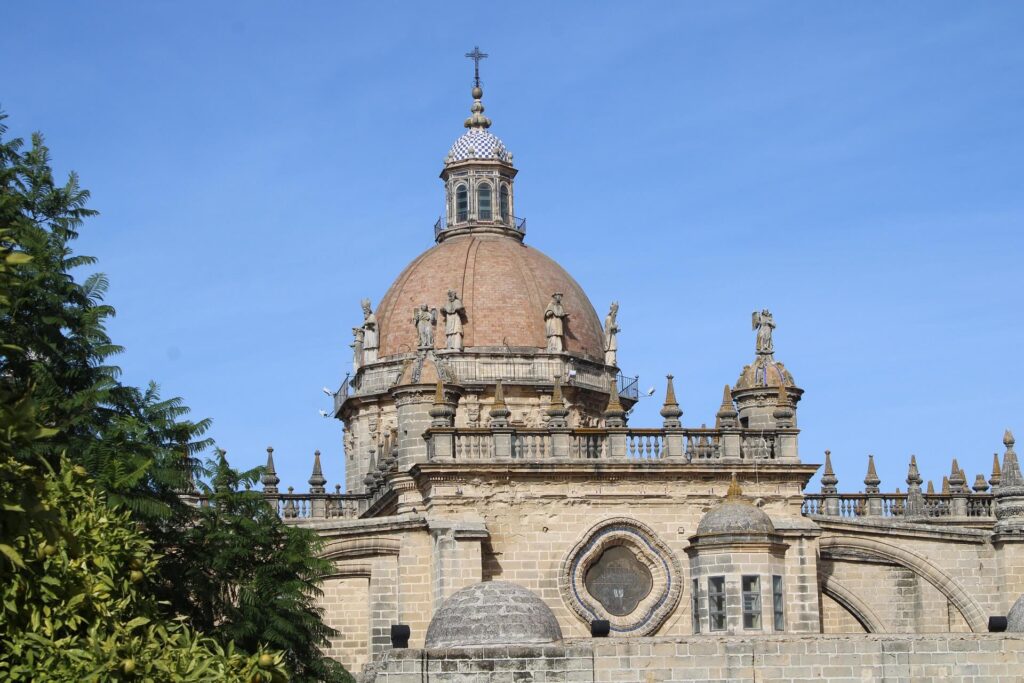
The Catedral de Jerez de la Frontera on Plaza de la Encarnación is a short walk from the Alcázar and reflects the layered architectural history of the city – Gothic, Baroque and Neoclassical elements accumulated over several centuries of building and rebuilding. The bell tower stands separately from the main body of the church, a legacy of a minaret which preceded it. Inside, the most significant work is Zurbarán’s painting of the Virgen de la Merced, hanging in the sacristy.
Plaza Arenal and the City Centre
Plaza Arenal is the social heart of Jerez de la Frontera – a broad rectangular square surrounded by terraced restaurants and dominated by an equestrian statue of Miguel Primo de Rivera. It’s a fine place to sit with a glass of manzanilla and watch the city go about its business, particularly on a weekday morning when it belongs entirely to locals.
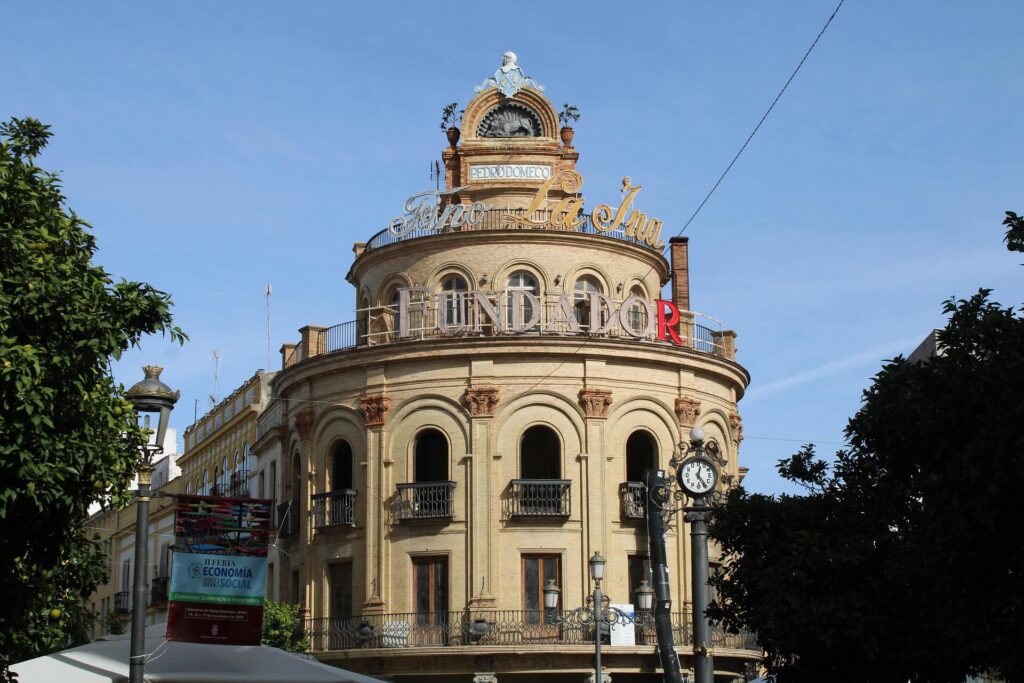
Walking northeast from the square along Calle Lancería brings you to Plaza Gallo Azul and the famous Torre de la Atalaya – the Domecq clock tower that has served as the most recognisable landmark of central Jerez de la Frontera for generations. Continuing east you reach Calle Larga, the main pedestrianised shopping street, which runs down to the Mercado de Abastos – the covered market where the city’s produce traders and some excellent breakfast kiosks operate in the mornings. Highly recommended is the ‘Chocolate con Churros’.
The streets between the Alcázar and the cathedral – the old Jewish quarter known as the Barrio de la Judería – are worth exploring on foot. Narrow, largely untouched and noticeably quiet compared to the main squares.
Festivals in Jerez de la Frontera
Jerez de la Frontera takes its festivals seriously and the annual calendar contains three events which are each worth timing a visit around.
Feria del Caballo
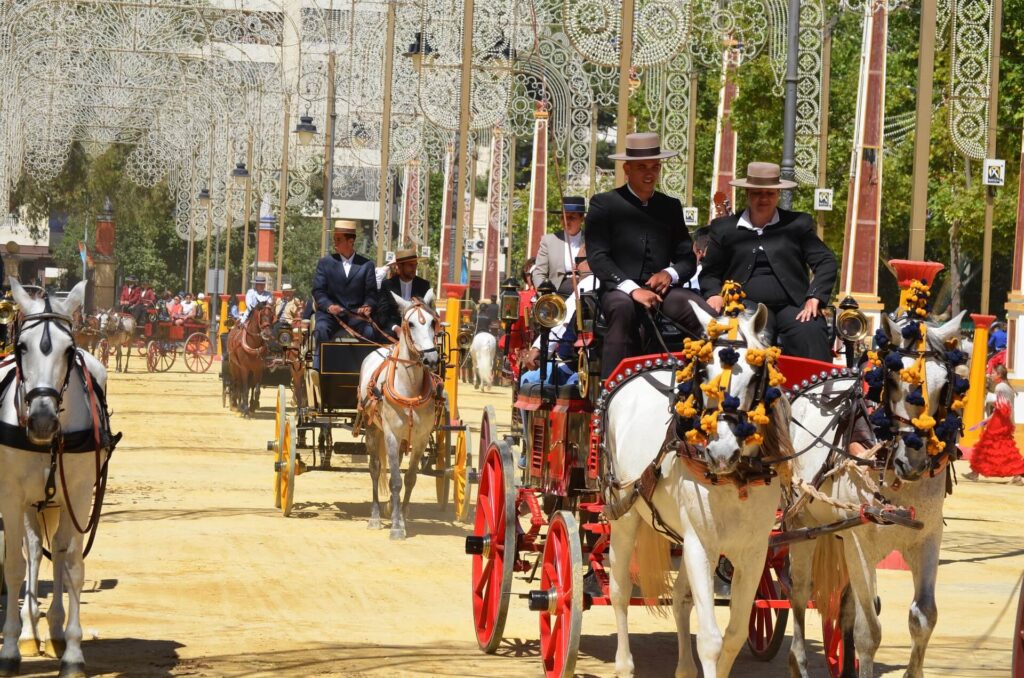
The Feria del Caballo – the Horse Fair – takes place in early May and is one of the great equestrian spectacles of Spain. Whilst Seville’s April Feria is the more internationally famous event, the Jerez de la Frontera Horse Fair has an argument for being the more authentic – the horses are the genuine centrepiece rather than a backdrop to a fashion parade. The Real Escuela and the city’s riding clubs put on displays throughout the week, the fairground fills with casetas serving fino and manzanilla and the streets of the horse district see a procession of riders in traditional Andalusian dress that has barely changed in a century.
Festival de Jerez de la Frontera
The Festival de Jerez de la Frontera runs for two to three weeks in February and March and is one of the most respected flamenco festivals in Spain. It draws performers from across the country and beyond, with performances ranging from international headliners in the Teatro Villamarta to more intimate shows in smaller venues around the city. The festival also includes workshops and educational events. For anyone with a serious interest in flamenco, this is the best time to visit Jerez de la Frontera. Check out the Festival de Jerez website for information on this year’s calendar and performances.

Fiestas de la Vendimia
The Fiestas de la Vendimia – the sherry harvest festival – takes place during the second and third weeks of September and celebrates the grape harvest with ten days of events centred on the blessing of the harvest in front of the cathedral. There is flamenco, processions, bullfighting and considerable amounts of sherry consumed in public. The treading of the first grapes takes place on the cathedral steps in an annual ceremony that has been going since the 15th century.
It’s a good time to visit Jerez de la Frontera for the combination of cultural depth and festive atmosphere, and the September weather in this part of Andalucía tends to be excellent.
MotoGP at the Circuito de Jerez
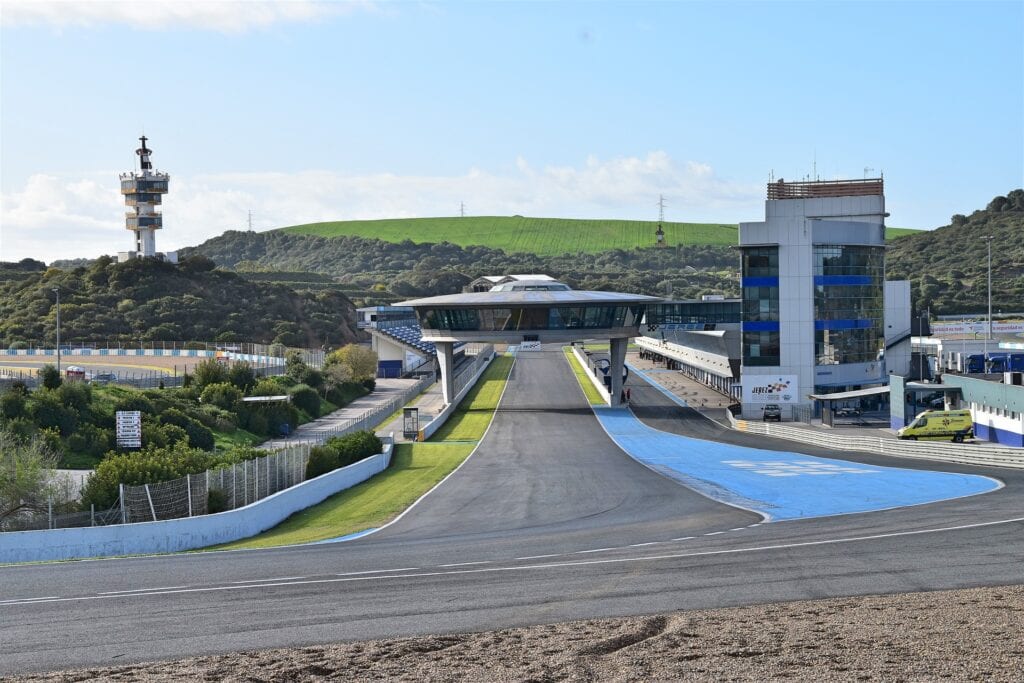
One weekend in late April or early May, the Circuito de Jerez hosts the Spanish MotoGP round, drawing an estimated 150,000 motorcycle fans to the area. If you’re here for the cultural heritage of the city, this is a weekend to avoid – hotels triple in price and the roads around the circuit are chaotic. If you’re a MotoGP fan, it’s one of the great race weekends on the calendar. The circuit sits 10km from the city centre. Note that the MotoGP weekend often coincides with the Feria del Caballo, which compounds both the crowds and the hotel situation. Check current dates at the Circuito de Jerez official site.
Day Trips from Jerez de la Frontera
Sanlúcar de Barrameda
Sanlúcar de Barrameda is 20km northwest of Jerez de la Frontera and is the third point of the Sherry Triangle. It produces manzanilla, the lightest and most delicate expression of sherry, which many argue can only be fully appreciated in Sanlúcar itself where the sea air contributes to the wine’s distinctive character. The restaurants at Bajo de Guía – the old fishing quarter on the riverbank – look directly across the water to the Doñana National Park and serve some of the finest seafood in Andalucía. Langostinos de Sanlúcar, the local prawns, are legendary. More information at Sanlúcar de Barrameda tourism.
El Puerto de Santa María
El Puerto de Santa María, 15km south on the Bay of Cádiz, is the second point of the triangle and home to Bodegas Osborne and several other significant producers. The old town is attractive and the waterfront is lively in summer. The ferry crossing from El Puerto to Cádiz is worth taking for the views across the bay alone. More information at El Puerto de Santa María tourism.
Arcos de la Frontera and the Pueblos Blancos
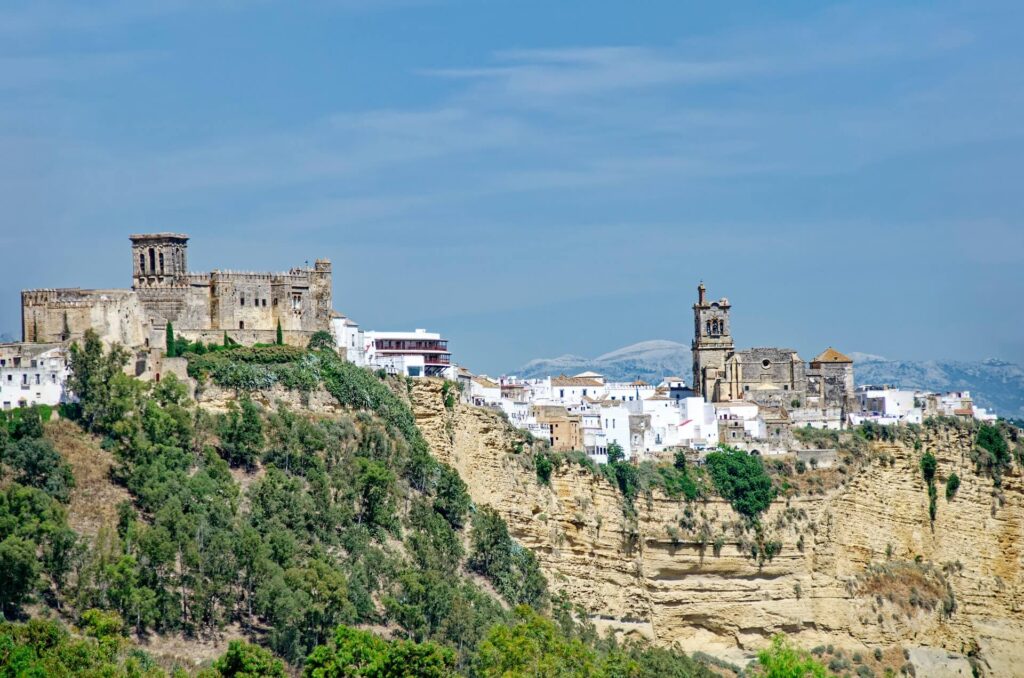
Arcos de la Frontera is 30km east of Jerez de la Frontera and the gateway to the Pueblos Blancos – the white villages of the Sierra de Grazalema. Arcos sits on a dramatic sandstone ridge above the River Guadalete, its old town clinging to the cliff edge with views stretching across the Cádiz lowlands. The drive from Jerez de la Frontera takes under 40 minutes and the road through the sierra beyond Arcos – past Zahara de la Sierra, Grazalema and Ronda – is one of the finest in Andalucía.
Visiting Jerez de la Frontera
Getting There
By Air: Jerez de la Frontera Airport (XRY) lies 8km northeast of the city and is served by a small number of domestic and European arrivals. If a suitable flight isn’t available, the most practical alternatives are Seville (80km north, around an hour by car or train), Málaga (230km east) or Gibraltar (110km south). From Seville Airport a hire car gives the most flexibility for exploring the region. A train service from Jerez de la Frontera Airport connects directly to the city centre in under ten minutes and continues to both Seville and Cádiz in around an hour. Taxis meet arrivals directly outside the terminal.
By Car: From Seville take the AP-4 motorway south towards Cádiz and exit at Jerez de la Frontera Norte – this exit also serves Arcos de la Frontera in the opposite direction. Follow signs for centro ciudad through several roundabouts until you reach the roundabout at Hotel Jerez de la Frontera on Avenida Álvaro Domecq. The hotel district is concentrated in this area, which puts you within walking distance of the Real Escuela and Sandeman bodega and a short taxi ride from the centre.
One important practical note: the main street through Jerez de la Frontera city centre is restricted to buses and taxis during the day. First-time drivers regularly find themselves unable to cross from one side of the centre to the other. Park near the Real Escuela area on arrival and use taxis or walk for everything within the city.
By Train: Regular services connect Jerez de la Frontera with Seville (around 1 hour), Cádiz (30 minutes) and Madrid (via AVE to Seville, then onward). The station is a 15-minute walk south of the city centre. Timetables and booking information appear on the official Renfe Rail Travel Website
Where to Stay
Most visitors are best placed in the hotel district along Avenida Álvaro Domecq, the broad palm-lined avenue running north from the city centre. It’s the most practical base – the Real Escuela is on this street, the main bodegas are within easy reach and the Feria del Caballo fairground sits directly alongside, which matters considerably if you’re visiting in May.
The Hotel Jerez AQ35 at number 35 is the obvious choice for this part of town – a well-run four-star with a pool, a spa and gardens large enough to escape the Jerez heat in the afternoon. It’s 2km from the city centre so you’ll be using taxis rather than walking, but for the Real Escuela and the Feria del Caballo it couldn’t be better placed.
A more compact option on the same avenue is the NH Avenida Jerez at number 10, which sits a few steps from the Real Escuela entrance and is a ten-minute walk to the city centre. It’s a straightforward four-star chain hotel without the gardens or spa facilities of the Hotel Jerez, but the location relative to the horse school is hard to beat and it consistently offers good value.
For something with considerably more character, the Hotel Bodega Tío Pepe on Plaza Encarnación is a different proposition entirely. A boutique hotel of just 27 rooms connected to the González Byass estate, it sits directly beside the cathedral in the old town. Guests have access to winery tours and the rooftop pool looks across the cathedral roofline and the Alcázar. It’s the most expensive of the three options and books up quickly – but it puts you at the heart of the historic centre with the tabancos, the Alcázar and the flamenco quarter all within easy walking distance.
Where to Eat in Jerez de la Frontera
La Carboná (Calle San Francisco de Paula 2) is the most consistently recommended restaurant in Jerez de la Frontera and has earned that status. Housed in a former bodega with high wooden ceilings and a central fireplace, it specialises in sherry-paired menus built around local ingredients – almadraba tuna, Iberian pork, Sanlúcar prawns – and its sherry list is exceptional. It holds a Michelin recommendation and a Sol Repsol award and books up quickly. Reserve well in advance.
For the highest end, Restaurante Mantúa (Plaza Aladro 7) holds one Michelin star and two Repsol Soletes. Chef Israel Ramos trained under Ángel León of Aponiente and his menus are rooted in the flavours of Cádiz province – local, seasonal and sherry-forward. It sits adjacent to the Hotel Palacio María Luisa. For a serious food visit to Jerez de la Frontera, this is the restaurant that justifies planning around.
The tabancos are the soul of eating and drinking in Jerez de la Frontera – old sherry bars serving fino and manzanilla straight from the barrel alongside simple tapas, in rooms that haven’t changed much in decades. Tabanco El Pasaje on Calle Armas, just off Plaza Arenal, is one of the most atmospheric – it combines genuine tabanco culture with live flamenco performances on certain evenings and is worth an early arrival to secure a table. Tabanco Las Banderillas is another well-regarded option and consistently appears on current local recommendations alongside Bar Juanito on Calle Caballeros, a popular local tapas bar with a loyal following and a counter groaning with fresh ingredients.
More on Andalucía from Spanish-Fiestas.com
Our travel guides cover Spain’s most visited cities and regions in depth – where to stay, what to eat, when to go and what the other guides miss. Browse the full list at amazon.com/author/gerrykerkhof.
FAQ About Jerez de la Frontera
When is the best time to visit Jerez de la Frontera?
Spring – March to May – is the strongest choice. The weather is warm rather than punishing, the Festival de Jerez de la Frontera runs in February/March, the Feria del Caballo falls in May and the Real Escuela is on its full performance schedule. October and November are also good: the Vendimia harvest festival in September marks the transition into a quieter and cooler autumn.
July and August are fierce. Temperatures regularly reach 40°C and above in the afternoon and the city slows noticeably in the midday heat. Manageable if you structure your day around it, but not the most comfortable time to walk the streets.
Winter is mild and largely dry. The bodegas tour all year round and the Real Escuela maintains training sessions and occasional performances outside the summer months. If you’re coming specifically for the horses, check performance dates directly with the school before booking.
How far is Jerez de la Frontera from Seville?
Jerez de la Frontera is around 80km south of Seville via the AP-4 motorway, a drive of about an hour depending on traffic. By train the journey takes roughly the same time. It’s a comfortable day trip from Seville, though staying a night gives you time to explore the bodegas and the old town at a more relaxed pace.
Do I need to book the dancing horses show in advance?
Yes – and well in advance, particularly in spring and during the Feria del Caballo in May. The shows sell out regularly and there’s no reliable way to get tickets at the gate. Book directly through the Real Escuela website. If the main show is sold out, the training sessions open to visitors are a worthwhile alternative.
What is the Sherry Triangle?
The Sherry Triangle is the area in the province of Cádiz defined by the three towns of Jerez de la Frontera, Sanlúcar de Barrameda and El Puerto de Santa María. By law, all sherry must be produced within this triangle. Each town specialises in slightly different styles – Jerez de la Frontera in fino, oloroso and the aged varieties; Sanlúcar exclusively in manzanilla; El Puerto in a style between the two. A day touring all three by car, with bodega visits and lunch in Sanlúcar, is one of the better ways to spend a day in this part of Andalucía.
Is Jerez de la Frontera worth visiting beyond the bodegas?
Very much so. The Real Escuela is in a different category from most tourist attractions in Spain. The flamenco heritage of the Barrio de Santiago is genuine and deep. The Alcázar is one of the better-preserved Almohad fortresses in the south. And the city has a lived-in unhurried quality that’s increasingly rare in southern Spain’s most visited places. Most visitors who spend a full day here wish they’d allowed two.
Worth the Journey
Jerez de la Frontera rewards visitors who arrive with some curiosity about what the city actually is rather than just what it’s famous for. The sherry, the horses and the flamenco are all real and all exceptional – but so is the Alcázar on a quiet Tuesday morning, the cathedral in the late afternoon light and the things to do in Jerez de la Frontera that you find by simply walking in a direction that interests you.
The Sherry Triangle sits in one of the least visited corners of Andalucía despite being one of the most rewarding. From Jerez de la Frontera you can be in the white villages, on the Costa de la Luz or looking across the Guadalquivir at the edge of the Doñana in under an hour. It’s a part of Spain that takes a little effort to reach and pays that effort back generously.