
The Peninsular War, also known as the Spanish War of Independence, was a key conflict that took place on the Iberian Peninsula between 1808 and 1814. This protracted struggle pitted the Spanish, Portuguese and British forces against the military might of the French Empire, ultimately resulting in the expulsion of French troops from the region and the restoration of Spanish independence. The war was a critical chapter in the broader Napoleonic Wars and its outcome had far-reaching implications for the geopolitical landscape of Europe.

Origins of the Peninsular War
The origins of the Peninsular War can be traced back to the French Revolution and the subsequent rise of Napoleon Bonaparte. As the French Emperor sought to expand his influence across the continent, he recognized the strategic importance of the Iberian Peninsula. In 1807, Napoleon orchestrated the invasion of Portugal, prompting the Portuguese royal family to flee to their Brazilian colony. This event was followed by the occupation of Spain the following year, as Napoleon installed his brother Joseph Bonaparte as the new Spanish monarch.
The Naval Context: The Shadow of Trafalgar
The Peninsular War unfolded against the backdrop of a dramatically altered naval landscape. Just three years earlier, in 1805, the Battle of Trafalgar had effectively destroyed Spain’s naval power and severely crippled France’s maritime capabilities. This naval defeat – which will be explored in detail in our subsequent article – proved crucial to the dynamics of the Peninsular War in several ways:
- It secured British naval supremacy, allowing for relatively safe transport of British troops and supplies to the Iberian Peninsula.
- It made it difficult for France to reinforce its armies in Spain by sea.
- It isolated the French forces in Spain from potential support, making them dependent on difficult overland supply routes through the Pyrenees.
- It prevented Napoleon from evacuating his armies when the tide of war turned against him.
This naval context helps explain why a land war in the Iberian Peninsula became such a drain on French resources and why British intervention proved so effective.
The Causes of the Spanish Uprising
The Spanish people, however, were deeply opposed to this foreign domination. A range of factors contributed to the growing resentment towards French rule. Firstly, the Spanish were resentful of the perceived arrogance and heavy-handedness of the French occupiers, who often treated the local population with disdain. Additionally, the imposition of Joseph Bonaparte as the new Spanish king was seen as a blatant violation of Spanish sovereignty and national pride.
Furthermore, the French occupation disrupted the existing social and political order in Spain. The traditional power structures, which had been dominated by the monarchy, the Catholic Church and the landed aristocracy, were threatened by the reforms and centralizing policies implemented by the French authorities. This fueled widespread discontent among various segments of Spanish society, ultimately contributing to the outbreak of the war.
The Outbreak of the Peninsular War
The spark that ignited the Spanish War of Independence was the popular uprising in Madrid on May 2nd 1808. This event, known as the Second of May Uprising, marked the beginning of the Peninsular War. The French were met with fierce resistance from a diverse array of Spanish forces, including regular army units, guerrilla fighters and civilian militias.
The Spanish Resistance
The Spanish resistance proved to be more formidable than Napoleon had anticipated. The French invaders were faced with a daunting task of subduing a population that was deeply committed to defending its independence and national identity. The Spanish forces employed a variety of tactics, including hit-and-run attacks, ambushes and the sabotage of French supply lines, which gradually wore down the occupying army.
The Rise of Guerrilla Warfare
Perhaps the most distinctive feature of the Spanish resistance was the emergence of guerrilla warfare (the term “guerrilla” itself comes from the Spanish word for “little war”). This form of irregular warfare proved remarkably effective against the French occupiers:
Organization: Guerrilla bands ranged from small groups of 20-50 men to larger formations of several hundred fighters, often led by charismatic leaders like Juan Martín Díez (“El Empecinado”), Francisco Espoz y Mina and Julián Sánchez (“El Charro”)
Tactics: The guerrillas exploited their superior knowledge of local terrain to ambush French convoys, attack isolated garrisons and disrupt communication lines. They typically avoided direct confrontation with large French forces, instead striking quickly and then melting away into the countryside
Local Support: The guerrillas relied heavily on the support of the rural population, who provided food, shelter, intelligence and new recruits. This symbiotic relationship made it extremely difficult for the French to distinguish between combatants and civilians
Psychological Impact: The constant threat of guerrilla attack had a profound psychological effect on French troops, creating an atmosphere of perpetual insecurity and fear that sapped morale
The guerrilla campaign tied down vast numbers of French troops in garrison and escort duties, preventing them from being used in major field operations against Wellington’s Anglo-Portuguese forces. Napoleon himself would later acknowledge that it was “those Spanish ulcers” that had bled his empire dry.
Furthermore, the Spanish resistance was bolstered by the arrival of British reinforcements in 1808 under the command of Sir Arthur Wellesley (later the Duke of Wellington). The British forces provided crucial military support, training and equipment to the Spanish and Portuguese armies, helping to turn the tide of the conflict.
The Campaigns of the Peninsular War
The Peninsular War can be divided into several distinct phases, each characterized by shifting alliances, tactical manoeuvres and major battles.
The Early Campaigns (1808-1809)
In the initial stages of the war, the French forces enjoyed some success, capturing Madrid and forcing the Spanish armies to retreat. However, the Spanish resistance proved to be more resilient than anticipated and the French were unable to consolidate their control over the peninsula.
One of the key battles of this early period was the Battle of Bailén, which took place in July 1808. In this engagement, a Spanish force under the command of General Francisco Castaños decisively defeated a French army led by General Pierre Dupont, marking the first major defeat of Napoleon’s forces in the Peninsular War. This victory boosted the morale of the Spanish troops and demonstrated the growing prowess of the Iberian resistance.
The Tide Turns (1810-1812)
As the war progressed, the balance of power began to shift in favor of the Allies. The Spanish and Portuguese forces, bolstered by British support, gradually gained the upper hand, inflicting a series of defeats on the French armies.
One of the most significant battles during this period was the Battle of Bussaco, which took place in September 1810. In this engagement, the Allied forces under the command of the Duke of Wellington successfully repelled a French attack, demonstrating their growing military capabilities.
Another pivotal moment was the Battle of Fuentes de Oñoro, fought in May 1811. In this clash, the Allied troops, led by Wellington, were able to hold off a determined French assault, further strengthening their position on the Iberian Peninsula.
The Decisive Years (1813-1814)
The final phase of the Peninsular War witnessed the steady decline of French power in the region. The Allied forces, led by the Duke of Wellington, launched a series of decisive offensives that ultimately drove the French out of Spain.
The turning point came in the Battle of Vitoria, fought in June 1813. In this engagement, the Allied troops, comprising Spanish, Portuguese and British forces, decisively defeated the French army under the command of King Joseph Bonaparte and Marshal Jean-Baptiste Jourdan. The French were forced to retreat across the Pyrenees, marking a critical juncture in the war.
Following the Battle of Vitoria, the French forces continued to lose ground, as the Allies pushed forward, eventually crossing the Pyrenees and invading southern France. The final major battle of the Peninsular War took place at Toulouse in April 1814, where the Allies once again emerged victorious, securing the expulsion of French troops from the Iberian Peninsula.
The Social and Cultural Impact of the War
The Peninsular War profoundly transformed Spanish society and left an indelible mark on the nation’s cultural landscape:
The Human Cost: The war exacted a devastating toll on the Spanish population. Estimates suggest that between 215,000 and 375,000 Spanish civilians perished during the conflict – victims of famine, disease and direct violence. The French policy of “living off the land” often meant requisitioning food from already struggling rural communities, leading to widespread hunger and malnutrition.
Destruction of Infrastructure and Economy: The physical destruction was equally severe. Towns and villages throughout the peninsula were razed, agricultural lands were devastated and infrastructure was destroyed. The economic consequences were profound, with Spain’s already fragile economy suffering a severe setback that would hamper its development for decades to come.
Cultural Expressions of Resistance and Suffering
The traumatic experience of the Peninsular War generated a powerful cultural response that continues to resonate in Spanish collective memory:
Visual Arts
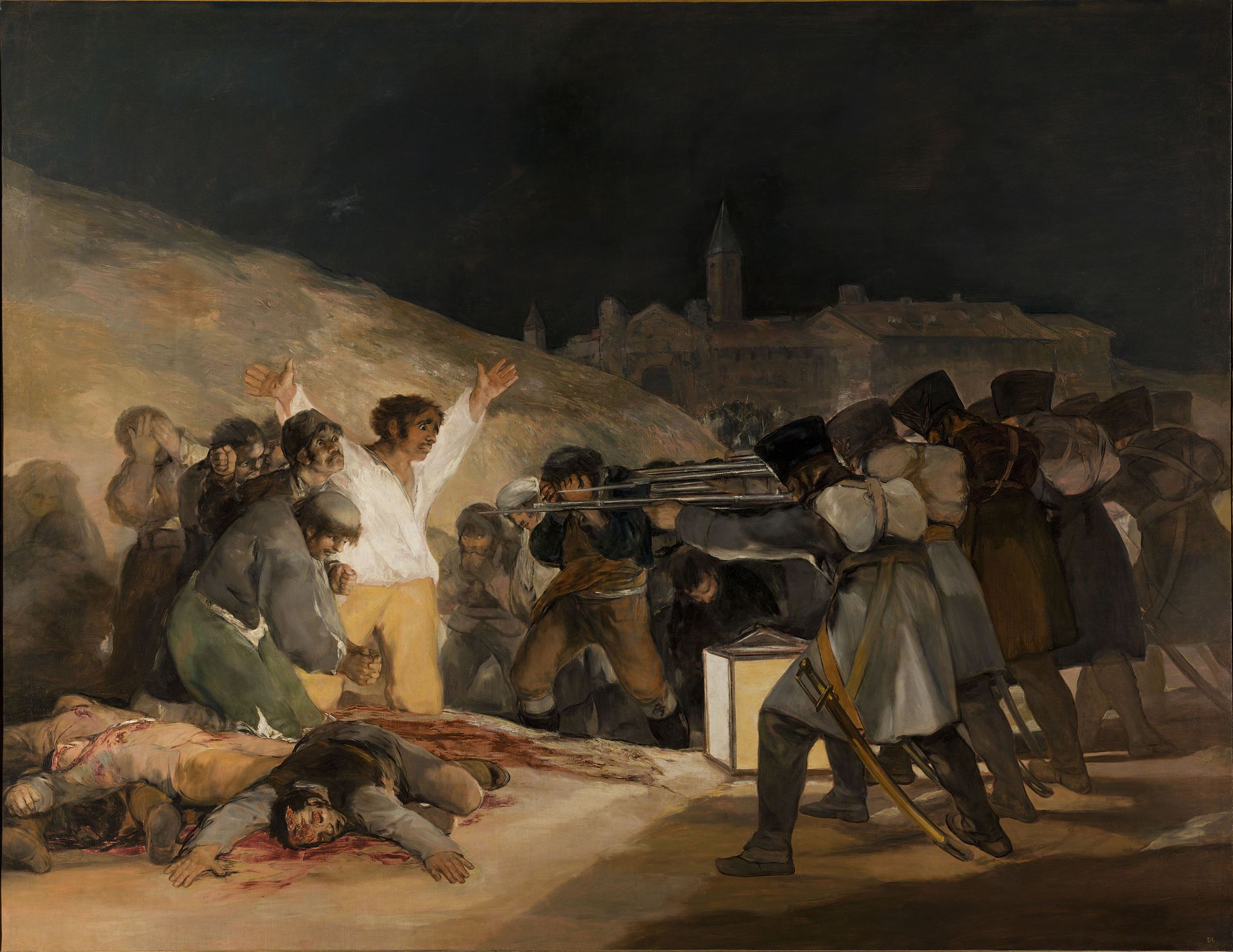
In our previous article about the Napoleonic Wars in Spain, we identified paintings by Francisco Goya depicting this war. You will notice similar references here with regard to the Peninsula War. The reason for this is that the Peninsular War was a significant theatre of the broader Napoleonic Wars and Goya was documenting the Spanish experience during this period. His main works of art which focus primarily on the Peninsular War are:
“The Second of May 1808” (1814) – Depicts the uprising in Madrid against French troops, the specific event that started the Peninsular War.
“The Third of May 1808” (1814) – Shows the execution of Spanish rebels by French soldiers following the uprising.
“The Disasters of War” series (1810-1820) – 82 prints documenting the atrocities of the Peninsular War specifically.
Literature
The war inspired countless patriotic poems, plays and novels. Works like Benito Pérez Galdós’ later historical novels in the “Episodios Nacionales” series immortalized the struggle against French occupation in Spanish literature.
Popular Culture
Folk songs, stories and regional traditions commemorating acts of resistance emerged during this period and became integral parts of Spanish cultural heritage.
These cultural expressions helped transform the experience of occupation and resistance into foundational elements of modern Spanish national identity.
Political Transformation of Spain
Whilst military campaigns raged across the peninsula, a profound political transformation was taking place that would shape Spain’s future for generations to come:
The Cádiz Cortes and the 1812 Constitution
In 1810, Spanish representatives gathered in the southern port city of Cádiz – one of the few areas free from French control – to establish a governing body known as the Cortes of Cádiz. This assembly drafted Spain’s first liberal constitution, promulgated on March 19th 1812, which:
- Established a constitutional monarchy with limited royal power.
- Created a unicameral legislature elected through a broad (though not universal) male suffrage.
- Abolished feudal privileges and the Inquisition.
- Guaranteed civil liberties and property rights.
- Proclaimed the sovereignty of the nation.
Despite its short life – Ferdinand VII abolished it upon his return to the throne in 1814 – the Constitution of 1812 represented a revolutionary development in Spanish political thought and served as a model for liberal movements throughout Southern Europe and Latin America.
The Birth of Political Divisions
The Peninsular War catalyzed the emergence of distinct political factions that would dominate Spanish politics throughout the 19th century:
Liberals: Inspired by Enlightenment principles and the Cádiz Constitution, they advocated for constitutional monarchy, civil liberties and economic modernization.
Traditionalists: Defenders of absolute monarchy, the privileges of the Catholic Church and Spain’s traditional social hierarchy.
This ideological divide, born during the resistance to French occupation, would fuel Spain’s political instability for decades to come, culminating in the Carlist Wars and subsequent civil conflicts..
Regional Variations in War Experience
The Peninsular War was experienced differently across Spain’s diverse regions, reflecting the country’s complex geography and cultural plurality:
Andalucía: Southern Spain saw intensive fighting early in the war but then remained relatively secure under Allied control after 1810. The city of Cádiz, protected by British naval power and its defensible position, became the centre of Spanish resistance and liberal political thought.
Catalonia: The north-eastern region endured particularly harsh occupation under Marshal Louis-Gabriel Suchet. Barcelona remained under French control throughout the war, while the countryside became a hotbed of guerrilla activity. The war reinforced Catalonia’s distinct identity and its historical grievances against centralized authority.
Galicia and the Northern Coast: These regions saw early liberation from French control and became crucial bases for British naval operations supporting the Allied war effort. The rugged terrain favoured guerrilla operations, making these areas particularly difficult for the French to pacify.
Central Spain: The Castilian heartland, including Madrid, changed hands multiple times during the conflict, subjecting its population to repeated cycles of occupation, liberation and reprisal. The central plateau’s harsh climate and sparse resources created logistical challenges for both sides.
The Basque Country and Navarre: These northern regions had a more complex relationship with the French occupiers. While resistance was strong in many areas, some Basque and Navarrese communities found French administrative reforms and respect for local fueros (traditional rights) preferable to the centralizing tendencies of Spanish liberals.
These regional variations would influence each area’s subsequent political development and relationship with the Spanish state.
The Legacy of the Peninsular War
The Peninsular War had far-reaching consequences, both for the combatants and the broader geopolitical landscape of Europe.
The Decline of French Power
The protracted nature of the conflict and the unexpected resilience of the Spanish and Portuguese forces dealt a significant blow to the French Empire. The heavy casualties and logistical challenges faced by the French armies in the Iberian Peninsula contributed to the gradual decline of Napoleon’s power, ultimately paving the way for his eventual downfall.
The Peninsular War also served as a distraction for the French, diverting resources and attention away from other fronts of the Napoleonic Wars. This allowed the Allied forces to make gains elsewhere, further undermining the French position in Europe.
The Rise of British Influence
The successful intervention of the British forces, under the leadership of the Duke of Wellington, enhanced the reputation and influence of the United Kingdom. The Peninsular War cemented Britain’s status as a major military power and solidified its position as a key player in the Napoleonic Wars.
Furthermore, the British victory in the Iberian Peninsula strengthened the country’s strategic position, as it allowed the Royal Navy to maintain control over important maritime trade routes in the region. This, in turn, contributed to the growth of British economic and political influence in the decades that followed.
The Emergence of Spanish Nationalism
The Peninsular War played a pivotal role in the development of Spanish nationalism. The popular resistance against French occupation fostered a sense of national identity and pride amongst the Spanish people, which would have lasting implications for the country’s political and social landscape in the years to come.
The war also highlighted the importance of the Spanish monarchy and the Catholic Church in the eyes of the population. These traditional institutions were able to rally the people against the foreign invaders, further cementing their influence in Spanish society.
The Beginning of Imperial Decline
The Peninsular War accelerated the disintegration of Spain’s American empire. With the metropole consumed by internal conflict, colonial elites in Spanish America seized the opportunity to launch independence movements. By the time Ferdinand VII returned to power in 1814, revolutionary movements were well established throughout Latin America, leading to the eventual loss of most of Spain’s overseas territories.
The Peninsular War: A Final Word
The Peninsular War was a complex and multifaceted conflict that left an indelible mark on the history of Europe. The Spanish people’s courageous stand against French domination, the strategic brilliance of the Allied forces and the broader geopolitical implications of the war all contributed to its enduring significance.
For Spain, the war represented both a heroic moment of national resistance and the beginning of a painful period of political instability and imperial decline. The conflict’s legacy can be seen in Spain’s political divisions, its cultural expressions and its evolving national identity. The war’s impact on Spain was compounded by the devastating loss of naval power at Trafalgar just years before, which had already begun to undermine Spain’s position as a global empire.
As scholars and historians continue to study this critical chapter in the Napoleonic era, the Peninsular War remains a testament to the power of determination, resilience and the pursuit of national independence, whilst also revealing how the interplay of military conflict, political transformation and cultural expression can reshape a nation’s destiny.

