
Flamenco represents one of the world’s most emotionally charged performing arts – a centuries-old fusion of dance, song and guitar that emerged from Andalusia’s complex cultural landscape. Recognised by UNESCO in 2010 as Intangible Cultural Heritage of Humanity, this art form embodies the historical convergence of Moorish, Jewish, Roma and Spanish traditions whilst continuing to evolve through contemporary innovation. This comprehensive guide explores the history of flamenco’s transformation from marginalised folk expression to globally celebrated cultural phenomenon.
The History of Flamenco and Its Origins
The Moorish Foundation (711-1492)
Flamenco’s musical architecture owes considerable debt to Al-Andalus, the Moorish territories that dominated the Iberian Peninsula for nearly eight centuries. The Moors introduced sophisticated musical forms including the muwashshah and zejel, poetic-musical structures characterised by complex rhythmic cycles and melismatic vocal ornamentation. These elements profoundly influenced what would become flamenco’s signature compás structures.
The Moorish legacy extends beyond melody into flamenco’s fundamental rhythmic DNA. The intricate 12-beat cycle of soleá and the asymmetrical patterns of bulería trace lineage to North African and Middle Eastern musical traditions. Archaeological evidence and musicological analysis reveal that instruments like the oud influenced early Spanish guitar development, whilst Moorish percussion traditions informed the percussive footwork (zapateado) central to flamenco dance.
The Sephardic Jewish Contribution
Between the 8th and 15th centuries, Sephardic Jewish communities in Spain developed rich musical traditions that significantly shaped flamenco’s emotional palette. The liturgical cantillation technique – particularly the use of extended melisma and microtonal variations – became embedded in flamenco’s vocal style. Themes of exile (galut) and spiritual longing found in Sephardic liturgy resonate powerfully in flamenco’s most profound styles, particularly siguiriyas and soleares.
The expulsion of Jews from Spain in 1492, coinciding with the fall of Granada, created a cultural atmosphere of loss and displacement that permeates flamenco’s thematic core. Many scholars argue that flamenco’s characteristic quejío (the distinctive vocal cry) reflects these historical traumas embedded in collective memory.
The Roma Arrival and Crystallisation (1425-1783)
The arrival of Roma peoples in Spain around 1425 marked the decisive moment in flamenco’s formation. These communities, facing systematic persecution and marginalisation, developed flamenco as an expression of resistance and cultural identity. The Great Gypsy Round-up of 1749 (La Gran Redada), which imprisoned approximately 12,000 Gitanos, intensified the art form’s themes of suffering and defiance.
Historical records from the late 18th century, particularly from traveller George Borrow’s accounts in “The Zincali” (1841), document distinctive Gitano musical practices in Triana (Seville) and Jerez de la Frontera. These communities developed what ethnomusicologists now recognise as proto-flamenco – unaccompanied vocal expressions performed at family gatherings and private celebrations.
The Emergence of Classical Flamenco (1780-1860)
The Pre-Café Period: Flamenco’s Hidden Development
Between 1780 and 1860, flamenco developed primarily within closed communities, making historical documentation sparse. This period saw the codification of fundamental palos (styles), each with distinct compás, melodic structure and emotional character:
Cante Jondo (Deep Song): The most serious flamenco styles, including siguiriyas, soleares and tonas, emerged during this period. These forms express profound emotions – grief, anguish, existential contemplation – through complex melodic structures and irregular rhythmic patterns. The siguiriya, possibly flamenco’s oldest form, follows a distinctive 12-beat pattern subdivided as 3+2+3+2+2, creating inherent tension and release.
Cante Intermedio: Styles like tangos and tientos occupy emotional middle ground, balancing gravity with accessibility. These forms allowed flamenco to communicate across social boundaries whilst maintaining artistic integrity.
Cante Chico (Light Song): Forms like alegrías, bulerías and fandangos developed for festive occasions. Despite the “light” designation, these styles demand considerable technical sophistication, particularly in their complex rhythmic variations.
The Guitar Revolution
The Spanish guitar’s integration into flamenco during the late 18th century transformed the art form fundamentally. Early guitarists like Francisco Rodríguez “El Murciano” (1795-1848) developed techniques specifically for flamenco accompaniment, including rasgueado (strummed chord sequences), picado (single-note runs) and alzapúa (thumb technique). These innovations established guitar as an equal partner to voice rather than mere accompaniment.
The Golden Age: Cafés Cantantes and Professional Flamenco (1860-1920)
The Café Cantante Phenomenon
The establishment of Café Silverio in Seville in 1842 marked the beginning of flamenco’s public professionalisation, though the café cantante movement reached its apex between 1860 and 1920. These venues – concentrated in Seville, Cádiz, Málaga, Granada and Madrid – provided structured environments where artists could develop technical prowess and earn livelihoods through performance.
Notable venues included El Burrero in Seville, Café de Chinitas in Málaga and Café del Brillante in Madrid. These establishments attracted diverse audiences, from working-class locals to bourgeois patrons and international visitors, democratising access to flamenco whilst simultaneously raising performance standards.
The Birth of Professional Flamenco Dance
Prior to the café cantante era, dance remained secondary to cante. However, the visual demands of public performance elevated baile to co-equal status. This period witnessed the development of sophisticated choreographic vocabulary:
Zapateado Evolution: Percussive footwork became increasingly complex, with dancers developing techniques to produce varied sounds through different parts of the foot – toe (punta), heel (tacón), ball (planta) and sole (toda la planta). The legendary dancer José Otero developed systematic approaches to rhythmic foot patterns that remain foundational to flamenco pedagogy.
Upper Body Technique: Braceo (arm movements) and floreo (hand articulation) evolved into sophisticated expressive languages. Dancers developed the characteristic flamenco posture – elevated chest, extended spine, dynamic tension – that distinguishes flamenco from other dance forms.
Traje de Flamenca: The iconic flamenco dress emerged during this period, evolving from working-class Andalusian garments. The bata de cola (trained dress) required specific techniques to manipulate during performance, adding visual drama whilst demanding physical control.
Regional Styles and Maestros
Different Andalusian cities developed distinctive flamenco characteristics:
Seville: Known for elegance, refinement and sophisticated braceo. Triana, Seville’s Gitano neighbourhood, produced legendary performers including Silverio Franconetti (1831-1889), considered the greatest singer of the 19th century.
Jerez de la Frontera: Developed the most intense, austere style. Jerez’s contribution includes the bulería, flamenco’s most technically demanding and rhythmically complex form. The city produced Manuel Torre (1878-1933), whose innovations in cante influenced generations.
Cádiz: Created lighter, more playful styles, particularly the alegrías. The city’s maritime history and relative cosmopolitanism produced a distinctive flamenco character balancing joy with underlying melancholy.
Granada: The Sacromonte caves housed Gitano communities who preserved older, more “primitive” styles whilst developing unique zambra performances.
The Opera Flamenca Period: Controversy and Evolution (1920-1955)
Theatrical Expansion and Purist Opposition
The 1920s-1950s witnessed flamenco’s theatrical expansion through opera flamenca – large-scale variety shows featuring flamenco alongside other entertainment. These productions, staged in theatres and bullrings, attracted massive audiences but provoked fierce criticism from purists who argued that commercialisation compromised artistic integrity.
The 1922 Concurso de Cante Jondo in Granada, organised by composer Manuel de Falla and poet Federico García Lorca, represented an attempt to preserve “authentic” flamenco by celebrating traditional styles and discouraging theatrical innovations. Paradoxically, this event helped establish flamenco’s cultural legitimacy whilst attempting to limit its evolution.
Female Pioneers and Gender Dynamics
Despite flamenco’s patriarchal structures, female performers fundamentally shaped the art form’s development:
La Niña de los Peines (Pastora Pavón, 1890-1969): Revolutionised female cante by mastering traditionally male-dominated deep song styles. Her vocal power and emotional intensity challenged gender conventions whilst establishing new technical standards.
Carmen Amaya (1913-1963): Transformed flamenco dance by incorporating aggressive, athletic movements previously considered exclusively masculine. Her decision to perform in trousers scandalised conservative audiences but expanded flamenco’s expressive possibilities. Amaya’s international tours introduced flamenco to global audiences, performing at venues including Carnegie Hall and appearing in Hollywood films.
La Argentinita (Encarnación López Júlvez, 1895-1945): Bridged flamenco and classical Spanish dance, elevating both forms through sophisticated choreography and theatrical presentation. Her work influenced subsequent generations of choreographers who sought to maintain traditional authenticity whilst embracing artistic innovation.
Flamenco Under Franco: Suppression and Survival (1939-1975)
The Dictatorship’s Complex Relationship with Flamenco
Franco’s regime (1939-1975) maintained an ambivalent relationship with flamenco. Whilst promoting sanitised versions as symbols of Spanish national identity to international audiences, the dictatorship suppressed flamenco’s subversive elements and Gitano cultural expressions. Regional languages and cultural practices faced systematic repression, yet flamenco’s association with Spanish nationalism granted it conditional protection.
State-sponsored flamenco programmes promoted ideologically acceptable performances whilst marginalising authentic Gitano traditions. Government-funded festivals and competitions established technical standards but often privileged aesthetic conformity over emotional authenticity. Despite these constraints, flamenco communities maintained underground networks preserving traditional styles and passing knowledge through family lineages.
The Mairenista Movement
Antonio Mairena (1909-1983) emerged as flamenco’s most influential theorist during this period, advocating for return to “pure” Gitano traditions. His writings and teachings emphasised cante jondo’s primacy whilst dismissing commercial innovations as corruption. Though controversial, Mairenista orthodoxy preserved traditional knowledge that might otherwise have been lost to commercialisation.
The New Flamenco Revolution (1960-2000)
Musical Innovation and Fusion
The late 20th century witnessed flamenco’s most dramatic evolution since the café cantante era:
Paco de Lucía (1947-2014): Revolutionised flamenco guitar by incorporating jazz harmonies, Latin rhythms and classical techniques whilst maintaining flamenco’s essential character. His 1973 album “Fuente y Caudal” introduced cajón (Peruvian box drum) to flamenco, now considered integral to modern performance. De Lucía’s collaborations with jazz guitarist Al Di Meola and classical guitarist John McLaughlin demonstrated flamenco’s capacity for cross-cultural dialogue.
Camarón de la Isla (1950-1992): Transformed flamenco singing through collaboration with Paco de Lucía and integration of rock, Latin and contemporary musical elements. Albums like “La Leyenda del Tiempo” (1979) provoked controversy amongst traditionalists but attracted new audiences, ensuring flamenco’s relevance for younger generations. Camarón’s influence extended beyond technique to embody flamenco’s essence—his personal struggles with addiction and poverty lent his performances devastating emotional authenticity.
Enrique Morente (1942-2010): Explored flamenco’s boundaries through collaborations with rock musicians, most notably the album “Omega” (1996), which set García Lorca’s poetry to flamenco-rock fusion. His willingness to experiment whilst maintaining deep knowledge of tradition influenced contemporary artists seeking to balance innovation with authenticity.
Contemporary Dance Innovation
Modern choreographers have redefined flamenco dance whilst respecting its foundations:
Antonio Gades (1936-2004): Created narrative flamenco ballets including “Bodas de Sangre” and “Carmen”, collaborating with filmmaker Carlos Saura to produce internationally acclaimed flamenco films. Gades demonstrated how flamenco could sustain full-length theatrical productions with complex storytelling.
Cristina Hoyos (1946-present): Combined technical virtuosity with theatrical innovation, establishing flamenco as a legitimate concert dance form. Her work bridged traditional tablao performance and contemporary theatre.
Israel Galván (1973-present): Deconstructed traditional flamenco vocabulary, incorporating contemporary dance techniques and experimental approaches whilst maintaining profound connection to flamenco’s rhythmic essence. His controversial innovations have expanded understanding of what flamenco can encompass.
Rocío Molina (1984-present): Explores feminist perspectives and contemporary themes through flamenco. Her choreography addresses gender violence, identity and modernity whilst demonstrating extraordinary technical mastery. Molina represents flamenco’s continued relevance to contemporary social discourse.
Sara Baras (1971-present): Achieves mass popularity whilst maintaining artistic integrity. Her powerful, athletic style and large-scale productions have introduced flamenco to audiences worldwide, proving commercial success and artistic excellence need not be mutually exclusive.
Understanding Flamenco’s Technical Language
The Compás: Flamenco’s Rhythmic Foundation
Compás represents flamenco’s most distinctive and complex element—the cyclical rhythmic structure governing all performance. Unlike simple time signatures, compás embodies an entire rhythmic ecosystem including accent patterns, subdivisions and feel. Mastering compás requires years of immersion, as it must be felt physically rather than merely counted intellectually.
Principal Compás Structures:
- 12-beat cycles: Soleá (3+2+3+2+2), Bulería (12-beat with emphasis on beats 12, 3, 6, 8, 10), Alegrías (similar to soleá but lighter character)
- 4-beat cycles: Tangos, Tientos (slower tangos)
- 3-beat cycles: Fandangos, Sevillanas
- Irregular/Free: Seguiriya (12-beat pattern grouped as 3+3+2+2+2, creating distinctive asymmetry), Taranta (free rhythm mining song)
Palos: The Styles of Flamenco
Flamenco comprises over 50 distinct palos, each with unique compás, melodic character, harmonic progression and emotional territory. Understanding palos provides insight into flamenco’s remarkable expressive range:
Soleá: Considered flamenco’s “mother” style, soleá expresses profound loneliness and existential reflection. Its moderate tempo and clear 12-beat structure make it fundamental to flamenco education whilst allowing infinite expressive variation. The name possibly derives from “soledad” (solitude).
Bulería: Flamenco’s most technically demanding form, requiring precise rhythmic control within a fast 12-beat cycle. Bulerías typically conclude performances (cierre), building intensity through rhythmic interplay between dancers, singers and palmeros. The form originated in Jerez, where it remains most authentically performed.
Siguiriya: Flamenco’s most serious and ancient form, expressing ultimate grief and tragedy. Its irregular compás creates inherent tension, whilst its melodic structure permits extensive vocal ornamentation. Many consider siguiriya flamenco’s spiritual core.
Tangos: Not related to Argentine tango, flamenco tangos feature a straightforward 4-beat pattern allowing considerable rhythmic variation. Originating from Cádiz, tangos range from playful to deeply serious, demonstrating flamenco’s versatility.
Alegrías: A major-key form expressing joy and celebration, alegrías originated in Cádiz and feature the same 12-beat structure as soleá but with lighter character. The name means “joys”, though skilled performers reveal underlying melancholy within apparent happiness.
Duende: The Ineffable Quality
Federico García Lorca’s 1933 lecture “Teoría y juego del duende” remains the definitive exploration of flamenco’s mysterious essence. Lorca distinguished duende from inspiration (musa) or technique (ángel), describing it as a force rising from “the very soles of the feet” that requires confrontation with death and authentic emotional risk.
Duende cannot be summoned at will or achieved through technical mastery alone. It emerges from the performer’s absolute commitment to emotional truth, vulnerability to the moment and connection with flamenco’s historical depths. Audiences recognise duende instinctively—performances possessing it create collective emotional intensity transcending normal theatrical experience.
The Role of Jaleo: Audience Participation
Flamenco’s interactive nature distinguishes it from most Western performance traditions. Jaleo – vocalisations and encouragement from musicians and audience – constitutes an essential element rather than mere appreciation. Common expressions include:
- “¡Olé!”: General encouragement and approval
- “¡Eso es!”: “That’s it!”—recognition of particularly effective moment
- “¡Así se canta/baila!”: “That’s how to sing/dance!”
- “¡Agua!”: “Water!”—recognising fresh, flowing quality
- “¡Arsa!”: Encouragement, particularly in Jerez
Effective jaleo requires understanding when to interject without disrupting rhythmic flow. In traditional peñas, knowledgeable audience members time their exclamations to enhance rather than interrupt performance, creating dialogue between performers and witnesses.
Flamenco Fashion: Function and Symbolism
The Traje de Flamenca
The iconic flamenco dress evolved from 19th-century working-class Andalusian fashion, particularly the traje de gitana worn during Seville’s April Fair. The modern bata de cola features a fitted bodice, voluminous skirts and train requiring specific manipulation techniques:
Train Work (Cola): Dancers use kicks, wraps and turns to control the train, creating visual drama whilst maintaining rhythmic precision. Train manipulation demands considerable physical control—the dress can weigh several kilograms and requires strength to lift and manipulate without losing balance.
Sleeve Work (Mangas): Tight sleeves or ruffled variants frame arm movements, emphasising braceo’s artistry. Some dresses feature bell sleeves that create additional movement possibilities.
Lunares: Polka dots became emblematic during the café cantante era, though traditional performances often feature solid colours or simpler patterns.
Footwear and Sound Production
Professional flamenco shoes (zapatos de baile) feature reinforced leather construction with nails embedded in toe and heel, creating characteristic percussive sounds. Shoe construction significantly affects sound quality and technique – professional dancers often have shoes custom-made to their specifications.
The nails’ specific placement and number determine tonal variety. Dancers develop different striking techniques to produce varied sounds: the tacón (heel) produces deep, resonant tones whilst the punta (toe) creates sharper, higher-pitched sounds. Advanced dancers combine these techniques at extraordinary speeds, creating complex polyrhythms.
Male Attire
Male dancers traditionally wear fitted trousers, shirts and sometimes short jackets (chaquetillas). The simpler costume emphasises body lines and footwork without visual distraction. Contemporary male performers sometimes incorporate more elaborate costumes, though most maintain relatively understated aesthetic focusing attention on movement and rhythm.
Flamenco Education and Transmission
Traditional vs Formal Training
Historically, flamenco knowledge transmitted through family lineages and informal apprenticeship. Children in flamenco families absorbed compás and style through constant exposure, developing musical understanding before formal technical training. This osmotic learning remains ideal, producing performers with innate rhythmic feel and stylistic authenticity.
Modern flamenco education combines traditional oral transmission with formal pedagogy. Conservatories throughout Spain and internationally offer structured flamenco programmes, systematising technical training whilst attempting to preserve essential cultural context.
The Role of Peñas Flamencas
Peñas – private flamenco clubs – serve crucial roles preserving tradition and providing performance spaces outside commercial contexts. These member organisations, concentrated in Andalusia but existing throughout Spain and internationally, host performances, classes and gatherings maintaining community connections essential to flamenco’s survival.
In peñas, performances occur in intimate settings where audience members possess sophisticated flamenco knowledge. This informed audience creates pressure for authenticity and excellence, maintaining traditional standards that might erode in purely commercial contexts.
Academic Study and Documentation
Since flamenco’s UNESCO recognition in 2010, academic study has intensified. Universities offer degree programmes in flamenco studies, examining historical, musicological, anthropological and cultural aspects. Institutions like the Centro Andaluz de Flamenco in Jerez maintain extensive archives documenting flamenco’s history through recordings, photographs and written materials.
This academic attention legitimises flamenco whilst raising concerns about over-intellectualisation potentially distancing the art form from its emotional and cultural roots. The tension between preserving tradition through documentation and maintaining flamenco’s living, evolving character remains ongoing.
Flamenco Venues: Where to Experience Authentic Performance
Traditional Tablaos
Flamenco in Madrid: Corral de la Morería, established 1956, remains one of the world’s premier flamenco venues, attracting elite performers and sophisticated audiences. Casa Patas, though sadly closed in 2020, hosted legendary performances for decades. Cardamomo and Las Carboneras continue Madrid’s tablao tradition.
Flamenco in Seville: La Carbonería offers authentic, intimate performances in informal settings. El Palacio Andaluz provides more theatrical presentations suitable for first-time audiences. Casa de la Memoria emphasises traditional styles in a small courtyard setting.
Flamenco in Granada: The Sacromonte caves provide unique cultural contexts where Gitano families maintain centuries-old traditions. Whilst some cave performances cater primarily to tourists, others preserve authentic expressions. Notable venues include Cuevas Los Tarantos and Maria La Canastera.
Flamenco in Jerez de la Frontera: Considered by many flamenco’s spiritual capital, Jerez maintains uncompromising authenticity. Tablao Flamenco Puro Arte and Damajuana offer performances reflecting Jerez’s austere, intense style.
Festivals and Competitions
Bienal de Flamenco (Seville, biennial, even years): Launched 1980, the Bienal represents flamenco’s premier festival, attracting international audiences and showcasing both traditional and innovative performances. Programming balances established maestros with emerging artists.
Festival de Jerez (annual, February-March): Focuses on dance, featuring master classes, lectures and performances. The festival attracts serious students and professionals worldwide.
Suma Flamenca (Madrid, annual, June): Presents diverse flamenco styles in various venues throughout Madrid, emphasising accessibility alongside artistic excellence.
Potaje Gitano (Utrera, annual, June): Community-based festival celebrating flamenco’s Gitano roots in intimate, authentic contexts.
The Impact of COVID-19 on Flamenco’s Ecosystem
Crisis and Closure
The COVID-19 pandemic devastated Spain’s flamenco infrastructure. Tourism’s collapse eliminated primary revenue for tablaos and performers. Madrid’s historic Casa Patas, which operated continuously since 1934, permanently closed in 2020—a profound loss representing not just a venue but a community institution where artists developed, legends performed and audiences experienced unmediated flamenco authenticity.
Barcelona’s Tablao Cordobés, Seville’s numerous smaller tablaos and countless peñas faced temporary or permanent closure. The crisis particularly affected older performers whose livelihoods depended entirely on live performance, many lacking digital skills or resources to adapt to online formats.
Adaptation and Innovation
Flamenco’s community demonstrated remarkable resilience through digital adaptation. Artists developed online classes, virtual performances and innovative hybrid formats. Established performers like Sara Baras and Israel Galván created filmed performances specifically for streaming, exploring how technology might capture flamenco’s essence without live interaction.
However, these adaptations highlighted flamenco’s fundamental dependence on physical presence and spontaneous interaction. Streaming performances, whilst providing some connection, cannot replicate the energetic exchange between performers and audiences that generates duende.
Recovery and Transformation
As restrictions eased, venues reopened with modified formats. Some tablaos reduced capacity, creating more intimate experiences while maintaining financial viability. The crisis accelerated existing discussions about sustainable models for traditional venues in expensive urban contexts.
Government cultural recovery programmes provided crucial support, though many argued funding remained inadequate given flamenco’s cultural importance. The pandemic forced reflection on how to preserve traditional venues whilst adapting to contemporary economic realities.
Flamenco in Global Context
International Dissemination
Flamenco’s global reach accelerated dramatically in the late 20th century through several factors:
Film: Carlos Saura’s flamenco trilogy – “Bodas de Sangre” (1981), “Carmen” (1983) and “El Amor Brujo” (1986) – introduced international audiences to flamenco’s artistic possibilities. Pedro Almodóvar regularly featured flamenco in films, reinforcing associations with Spanish identity.
Tourism: Spain’s tourism industry promoted flamenco as quintessential cultural experience, creating both opportunities and concerns about authentification for tourist consumption.
Education: Flamenco schools emerged worldwide, from Tokyo to New York, creating global communities of practitioners and enthusiasts. These schools maintain varying levels of authenticity and technical standards, though leading international teachers often studied extensively in Spain.
Cultural Appropriation Debates
Flamenco’s global popularity raises complex questions about cultural appropriation and authenticity. While international appreciation has sustained economic support for Spanish performers and raised flamenco’s profile, concerns persist about:
- Dilution of tradition: Commercial adaptations potentially simplifying flamenco’s complexity
- Gitano marginalisation: Non-Gitano performers sometimes receive more recognition despite Roma communities’ foundational role
- Superficial understanding: Performances lacking deep cultural and musical knowledge potentially spreading misconceptions
These debates reflect broader tensions between cultural preservation and artistic evolution, between honouring origins and embracing innovation.
Flamenco Fusion and Experimental Forms
Contemporary artists increasingly explore flamenco’s boundaries:
Flamenco-Jazz: Artists like Jorge Pardo and Carles Benavent pioneered sophisticated fusion respecting both traditions’ complexity.
Flamenco-Electronic: Producers like Chambao and Ojos de Brujo incorporate electronic elements, creating nuevo flamenco appealing to younger audiences whilst maintaining rhythmic foundations.
Flamenco-Classical: Collaborations between flamenco artists and symphony orchestras demonstrate the form’s adaptability to diverse contexts.
These fusions provoke ongoing debate: at what point does innovation become such that the result no longer constitutes flamenco? The question has no definitive answer, reflecting artistic evolution’s inherent tension.
Frequently Asked Questions About Flamenco
What is the difference between flamenco and Spanish dance?
Flamenco constitutes one category within Spanish dance (danza española), which encompasses several distinct forms: escuela bolera (classical Spanish ballet), regional folk dances and flamenco. Each possesses unique technique, musical accompaniment and cultural context. Flamenco’s distinguishing characteristics include its improvisational nature, emphasis on rhythmic complexity and emotional intensity derived from Andalusian cultural history.
Does all flamenco music include singing?
No. While cante remains central to traditional flamenco, purely instrumental performances (toque solo) and dance-focused performances with minimal or no vocals have become increasingly common. Contemporary flamenco often prioritises different elements depending on artistic intention, with some performances showcasing guitar virtuosity or dance choreography rather than vocal performance.
Why do flamenco dancers sometimes appear angry or severe?
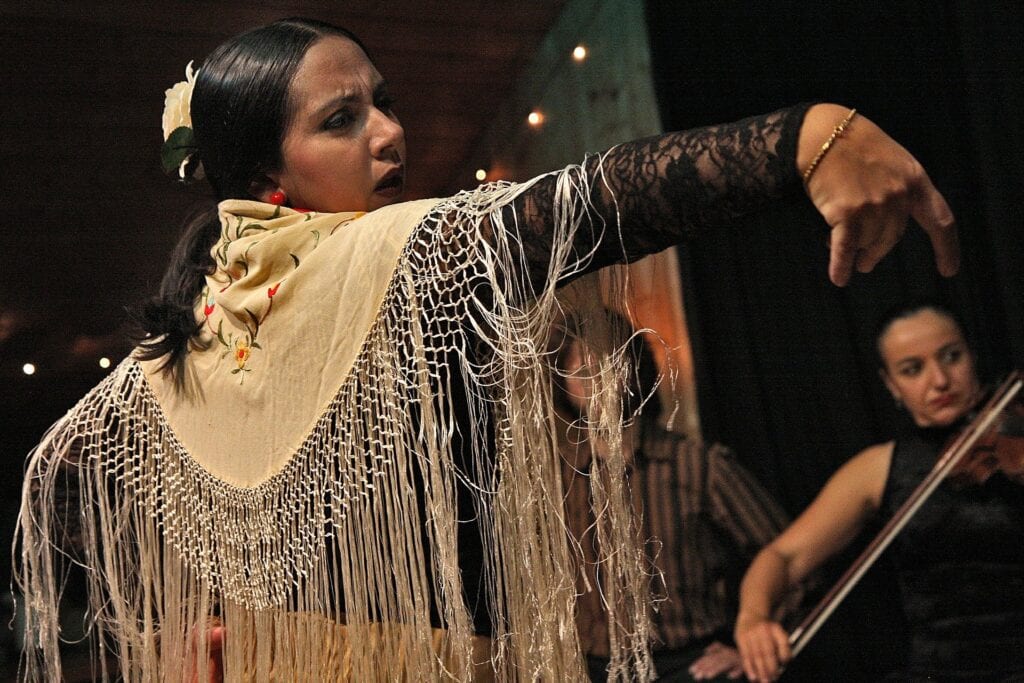
The intense facial expressions in flamenco reflect fiereza (fierceness) or concentración (concentration) rather than anger. Particularly in serious palos like soleá or siguiriya, dancers embody profound emotions requiring physical and facial intensity. This stern demeanour represents emotional commitment and the seriousness with which performers approach the art form. In lighter styles like alegrías or bulerías, dancers often display more playful expressions.
What are polka dots on flamenco dresses called?
The polka dots are called lunares in Spanish. These spots became popular during the café cantante period and are now iconic in flamenco fashion, though not all flamenco dresses feature them. Traditional performances, particularly of serious palos, often use solid colours or simpler patterns to maintain focus on movement rather than costume.
Is clapping in flamenco simply keeping time?
No. Palmas (rhythmic hand-clapping) constitutes a sophisticated musical element in flamenco. Two main types exist: palmas sordas (muffled claps produced by cupping hands) and palmas claras (sharp claps with flat hands). These combine in complex patterns that contribute to the overall compás (rhythmic structure) of the performance. Skilled palmeros improvise variations whilst maintaining the underlying rhythm, creating polyrhythmic textures supporting dancers and singers.
Can flamenco be performed without guitar?
Yes. The oldest flamenco forms, including tonás and martinetes, were performed a cappella with only palmas and possibly anvil percussion (in the case of martinetes, originally sung by blacksmiths). While guitar is now central to most flamenco performances, some traditional styles maintain this guitar-less format, emphasising cante’s primacy.
What should I wear to flamenco class?
Beginners should wear comfortable clothing allowing free movement—fitted tops and stretch pants or skirts work well. Hard-soled shoes are necessary from the start, as sneakers prevent proper foot articulation. As students progress, they typically invest in proper flamenco shoes (zapatos de baile), which feature nails in heel and toe for percussion. Women often wear practice skirts to develop skirt manipulation techniques.
Is improvisation important in flamenco?
Improvisation is fundamental to flamenco’s essence. While choreographed sections exist, particularly in theatrical performances, spontaneous interaction between musicians and dancers remains crucial. Even in structured choreography, performers typically incorporate improvisational elements, responding to musical cues and emotional impulses. This improvisational aspect distinguishes flamenco from more rigidly choreographed dance forms and contributes to each performance’s uniqueness.
What is the meaning of shouts during flamenco performances?
These vocalizations, called jaleo, constitute traditional expressions of appreciation and encouragement rather than random enthusiasm. Common phrases include “¡olé!”, “¡eso es!” (that’s it!), “¡así se canta!” (that’s how to sing!) and “¡toma!” (take that!). Jaleo timing requires sophistication—knowledgeable audience members interject at moments of particular intensity or technical achievement without disrupting rhythmic flow.
How long does flamenco mastery require?
Flamenco mastery represents a lifelong journey. Basic competence in simple palos might be achieved within 2-3 years of dedicated study. However, true proficiency requiring deep understanding of compás, technique and emotional expression typically demands at least 10-15 years of serious training. Many professional performers continue studying throughout their careers, as flamenco’s depth permits infinite exploration.
Is flamenco only performed by Gitanos (Roma)?
While Roma communities played the foundational role in flamenco’s development and continue contributing disproportionately to its preservation and innovation, flamenco is not exclusively Gitano. Non-Gitano Andalusians (payos) have always participated in flamenco, and contemporary flamenco includes performers from diverse backgrounds. However, the Roma community’s historical and ongoing contributions deserve recognition and respect, and questions about cultural authenticity and appropriation remain subjects of ongoing discussion within the flamenco community.
Conclusion: Flamenco’s Living Tradition
Flamenco endures as one of humanity’s most powerful artistic expressions—a living tradition connecting contemporary performers and audiences to centuries of cultural evolution, human emotion and artistic innovation. Its journey from marginalised folk expression to UNESCO-recognised cultural heritage demonstrates art’s capacity to transcend social barriers whilst maintaining authentic connection to origins.
The art form’s current vitality reflects successful navigation of tradition and innovation tensions. While purists continue preserving historic palos and performance practices, experimentalists push boundaries, ensuring flamenco remains relevant to contemporary experience. Both approaches prove essential: preservation maintains cultural memory and technical foundations, whilst innovation attracts new audiences and explores flamenco’s untapped possibilities.
Whether experienced in Granada’s ancient caves, Madrid’s prestigious tablaos, community peñas or international concert halls, flamenco retains its capacity to generate profound emotional experiences. The click of heels against wooden floors, the raw power of a singer’s quejío, the guitarist’s fingers dancing across strings – these elements combine to create moments of artistic transcendence that justify flamenco’s description as one of Spain’s most precious gifts to world culture.
For audiences encountering flamenco, approaching with open hearts and patient ears reveals depths that superficial viewing cannot access. Flamenco demands emotional engagement and temporal investment, but rewards this commitment with experiences of unparalleled intensity and beauty. As the art form enters its next chapter, navigating digital transformation, globalisation and generational change, its essential character – that mysterious duende rising from life’s depths – remains constant, ensuring that flamenco will continue moving audiences for generations to come.


Amazing performances. There’s nothing like it elsewhere.
Gypsies must adapt it from Tandav (the one of the Indian dance form) in which Bhairava (Male) & Bhairavi (Female) dance with different emotions
it’s beautiful to see how they modelled in into a more stylish form