The Christian Reconquest of Spain, also known as the Reconquista, was a pivotal period in European history which spanned nearly eight centuries. This protracted struggle, lasting from the early 8th century until the fall of Granada in 1492, was a complex and multifaceted series of military, political and religious campaigns aimed at reclaiming the Iberian Peninsula from Islamic rule. The Reconquest profoundly shaped the cultural, religious and political landscape of medieval Spain, leaving an indelible mark on European history and setting the stage for Spain’s emergence as a global power.

Origins of the Christian Reconquest
The Islamic Conquest of Iberia
The roots of the Reconquest can be traced to the early 8th century when Berber forces under the leadership of General Tariq ibn Ziyad, representing the Umayyad Caliphate, crossed the Strait of Gibraltar in 711 AD. Their invasion was remarkably swift, capitalizing on the internal political fragmentation of the Visigothic Kingdom, which was weakened by ongoing civil conflicts and power struggles. Within just seven years, by 718 AD, the Muslim forces had conquered most of the Iberian Peninsula, leaving only isolated Christian strongholds in the rugged northern mountainous regions.
Early Christian Resistance
The initial phase of Christian resistance began almost immediately after the arrival of the Moors. Despite the overwhelming success of the Islamic conquest, pockets of Christian resistance persisted in the northern mountainous regions of the peninsula. The rugged terrain of Asturias, Cantabria and the Pyrenees provided a natural stronghold for the Christian kingdoms which would later play a crucial role in the Reconquista.
A key figure in this early resistance was Pelayo (also known as Pelagius), a Visigothic nobleman who became the first King of Asturias. According to tradition, Pelayo led a band of Christian rebels who refused to submit to Muslim rule. In 722 CE, the Battle of Covadonga in the Cantabrian Mountains marked the first significant Christian victory against Muslim forces. This battle, led by Pelayo, is often considered the starting point of the Reconquest and the foundation of the Kingdom of Asturias.
Pelayo’s victory, while likely small in scale, took on mythical proportions in later Christian chronicles. He became a symbol of Christian resistance and the beginnings of the Reconquista. Although the battle’s historical significance has been debated by modern historians, it symbolised the beginning of organized Christian resistance and the slow process of reclaiming territory from Muslim rule. Pelayo’s legacy as the initiator of the Reconquista would inspire future generations of Christian rulers in their efforts to expand their territories southward.
Phases of the Christian Reconquest of Spain
Early Reconquest (8th-11th centuries)
The Reconquista began as a slow and fragmented process, driven by the Christian kingdoms of northern Iberia, such as Asturias, Navarre, Aragon and the Catalonian counties. These kingdoms gradually expanded southward, often exploiting internal divisions within Al-Andalus. Early successes were primarily due to intermittent skirmishes and small-scale raids rather than large-scale military campaigns.
One notable milestone was the capture of Girona in 785 by Charlemagne and the Franks, followed by Barcelona in 801. These conquests established the Marca Hispánica, a buffer zone governed by the Counts of Barcelona on behalf of the Franks. Over time, this region grew into the culturally significant and politically autonomous area of Catalonia. By the late 10th century, Catalonia emerged as a dominant region and in 1150, its ruling count married the heiress of Aragon, uniting these territories.
Meanwhile, the Umayyad Emirate and later the Caliphate of Córdoba, struggled with internal rebellions, which the northern Christian states exploited. The discovery of Saint James the Apostle’s relics in Galicia in 813 served as a spiritual turning point. Santiago de Compostela became a vital spiritual and cultural rallying point, with Saint James venerated as “Matamoros” (Moor-Slayer). His legacy inspired Christian resistance and unity throughout the Reconquista.
Navarra, with its capital in Pamplona, also played a significant role, forging alliances and expanding its territories at the expense of Muslim domains. By the late 10th century, the Kingdom of Castile, under leaders like Fernando I, began asserting dominance in northern Iberia.
A major event during this period was the emergence of Rodrigo Díaz de Vivar, better known as El Cid. A celebrated figure in Spanish history, El Cid’s exploits against Muslim forces, often atop his white horse Babieca, became legendary. Though modern historians view him as motivated more by personal ambition than religious zeal, his contributions had a lasting impact on the Christian cause. His sword, Tizona, remains a symbol of his legacy and is displayed at the Army Museum in Madrid.
The turning point of this phase came in 1085 with the capture of Toledo by Alfonso VI of León and Castile. Toledo, a former Visigothic capital, held immense symbolic and strategic importance. Its conquest marked a significant shift in the Reconquista, ushering in a more aggressive phase of Christian expansion and profoundly altering the political landscape of the Iberian Peninsula.
The Almohad Period (12th-13th centuries)
The 12th century marked the rise of the Almohad dynasty from North Africa, which briefly reversed the tide of Christian advances. The Almohads succeeded in uniting Muslim-controlled territories under their rule and launched several counteroffensives against the Christian kingdoms. Their initial successes stalled Christian expansion, creating a temporary balance of power on the Iberian Peninsula. However, the Almohads’ strict interpretation of Islam and harsh policies alienated many local Muslims and Jews, weakening internal cohesion.

The turning point came in 1212 at the Battle of Las Navas de Tolosa in Andalucía. A combined force from the Christian kingdoms of Castile, Aragón and Navarra dealt a crushing defeat to the Almohads. This decisive victory shattered Muslim power in Iberia, opening the door for rapid Christian expansion.
Late Reconquest (13th-15th centuries)
Following the victory at Las Navas de Tolosa, Christian forces quickly gained momentum. Territories across Extremadura, the Balearic Islands and Valencia were brought under Christian control. In 1236, Ferdinand III of Castile, later known as “El Santo” (the Saint), captured Córdoba. This conquest was particularly symbolic, as Córdoba had been a major centre of Islamic culture and power. The city’s Mezquita (Great Mosque) was reconsecrated as a cathedral, marking a dramatic shift in religious dominance.
Twelve years later, in 1248, Ferdinand III captured Seville, aided ironically by the Muslim Emirate of Granada, which sought to weaken its Andalucían rival. This victory further solidified Christian dominance and by the mid-13th century, Christian territory had more than doubled.
The Reconquista reached a significant milestone in 1249 when Portugal expelled the remaining Muslim forces from its territory. By then, Moorish political control was reduced to the Emirate of Granada, which would remain the last Muslim stronghold in Iberia.
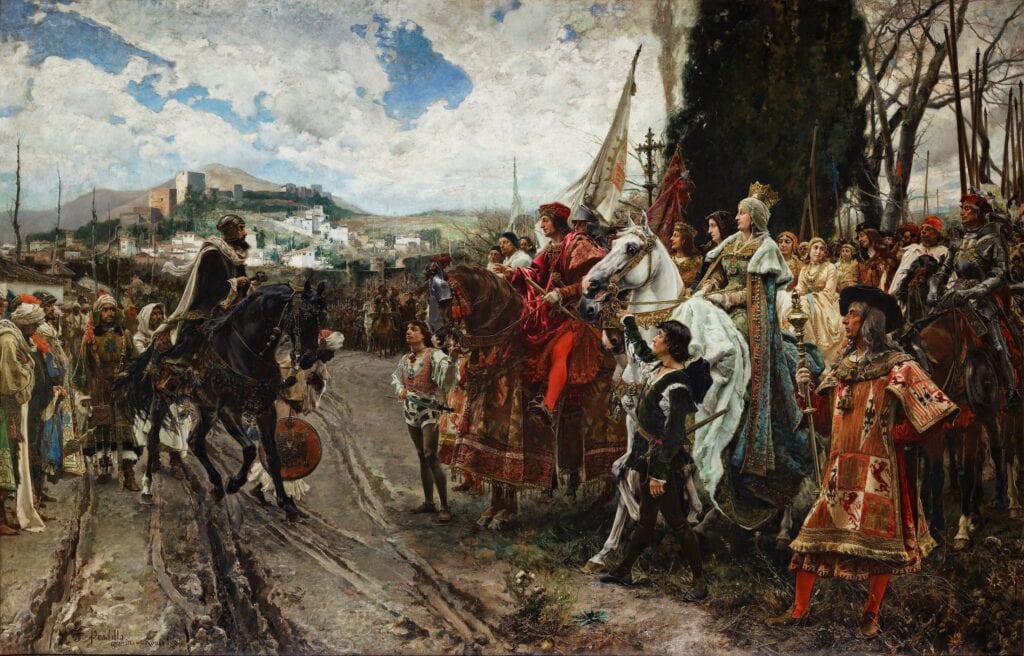
The final phase of the Reconquest lasted for over two centuries, as Granada managed to survive through a combination of diplomatic manoeuvring, payment of tribute and occasional military resistance. The process culminated in 1492 when the Catholic Monarchs, Isabella I of Castile and Ferdinand II of Aragon, conquered Granada, bringing the Reconquest to its conclusion, some 771 years after it began.
Impact of the Christian Reconquest
Religious Dimension: Both sides viewed the conflict as a religious war. Christians saw it as a holy mission to reclaim lands from Muslim rule, whilst Muslims framed their resistance as a religious struggle (jihad) to defend their territories. The Pope even granted indulgences similar to those given during the Crusades, which helped attract external support.
Cultural Complexity: Despite the conflict, this period wasn’t just about fighting. There was significant cultural exchange. Christian kingdoms actually absorbed many aspects of Islamic and Jewish culture, including important advances in science, philosophy and architecture. The city of Toledo, for instance, became a crucial centre for translating Arabic texts into Latin, which helped spread knowledge across medieval Europe.
Social Impact: The Reconquista dramatically changed the peninsula’s social landscape. Muslims and Jews faced increasing pressure to convert or leave. Those who stayed often endured harsh treatment and heavy taxation. By 1492, Jews were expelled and Muslims were eventually forced to convert.
Political Transformation: The conflict was crucial in creating a unified Spanish identity. The marriage of Ferdinand and Isabella symbolised the consolidation of Christian power. Different kingdoms like León, Castile, Aragón and Portugal developed their own identities during this period, eventually forming the foundation of modern Spain.
Long-term Legacy: The strategies and institutions developed during the Reconquista would later influence Spain’s colonial activities in the Americas. Historians now recognise it as a complex process driven not just by religion, but also by political and economic motivations.
By 1492, the Christian Reconquista had definitively ended Muslim political control in Iberia, fundamentally transforming the peninsula’s religious, cultural and political landscape. This watershed moment laid the groundwork for Spain’s subsequent emergence as a global imperial power