
Spain stands as a cornerstone of Western art history, offering an extraordinary legacy that spans from prehistoric cave paintings to 20th-century avant-garde movements. The Iberian peninsula’s complex cultural heritage – shaped by Phoenicians, Greeks, Romans, North Africans and Visigoths – has produced an artistic tradition of remarkable diversity and depth. This rich tapestry reflects Spain’s unique position at the crossroads of European and North African influences, creating distinctive artistic expressions that have profoundly influenced the global art canon.
The country’s artistic evolution mirrors its complex political and cultural history, from the multicultural expressions of Mozarabic art created by Christians under Moorish rule to the later Mudéjar aesthetic developed by Muslim artists working under Christian patronage. This cultural interchange created a uniquely Spanish artistic vocabulary that would later influence the country’s “Golden Age” and beyond, as elements of Spanish identity – including bullfighting, flamenco and profound religious devotion – became recurring motifs in the world of Spanish art and artists.
Prehistoric and Medieval Art
Spain’s artistic heritage begins with some of the world’s most significant prehistoric art. The cave paintings at Altamira in Cantabria, dating to approximately 12,000 BCE, represent some of humanity’s earliest artistic expressions. These sophisticated animal depictions demonstrate remarkable technical skill and observation, challenging modern assumptions about prehistoric artistic capabilities. Less frequented but equally important are the paintings in Cueva de la Pileta near Ronda in Andalucía, which offer visitors a more intimate experience with these ancient works.

The medieval period saw the development of distinctive Spanish artistic traditions influenced by the peninsula’s complex religious and cultural landscape. Mozarabic art flourished among Christians living under Islamic rule, whilst the Mudéjar style emerged after the Christian Reconquista when Muslim craftsmen continued working under Christian patrons. These cross-cultural artistic exchanges created uniquely Spanish expressions that blended Islamic geometric patterns with Christian iconography, particularly visible in architecture and decorative arts throughout the country.
The Spanish Golden Age (16th-17th Centuries)
El Greco (1541-1614)
The Spanish “Golden Age” of painting began during the reign of Philip II, coinciding with the arrival of Doménikos Theotokópoulos, known as El Greco. Born in Crete and trained in Italy, El Greco settled in Toledo around 1577, where he developed his distinctive style characterised by elongated figures, dramatic lighting and intense emotional expressiveness. Alalthough his highly individual approach failed to win royal patronage from Philip II, El Greco found support from ecclesiastical patrons in Toledo, where he produced numerous altarpieces that perfectly captured the religious fervour of Counter-Reformation Spain.

Among El Greco’s masterpieces is “The Burial of Count Orgaz” (1586), created for the Church of Santo Tomé in Toledo, where it remains today. This extraordinary work depicts the legendary burial of a 14th-century Toledan nobleman, whose body is laid to rest by Saints Stephen and Augustine whilst his soul ascends to a densely populated heaven filled with angels, saints and contemporary figures. The painting’s division between earthly and heavenly realms exemplifies El Greco’s unique ability to blend realistic portraiture with mystical vision, creating a work that transcends conventional Renaissance representation.
Diego Velázquez (1599-1660)
Diego Velázquez emerged as arguably the greatest painter in Spanish history and one of the most influential European artists of the 17th century. Born in Seville but spending most of his career as court painter to Philip IV in Madrid, Velázquez developed an unparalleled mastery of technique that allowed him to create works of remarkable psychological depth and visual complexity. although primarily known for his portraiture, Velázquez also produced religious paintings, mythological scenes and genre paintings depicting everyday life with a revolutionary naturalism.

Velázquez’s masterpiece, “Las Meninas” (The Maids of Honour, 1656), housed in Madrid’s Prado Museum, represents the pinnacle of his achievement and remains one of the most analysed paintings in Western art. This complex group portrait of the royal family includes Velázquez himself at his easel, creating a meta-artistic reflection on representation, reality and the act of painting. Through innovative composition and subtle play with perspective and light, Velázquez transformed a seemingly straightforward court scene into a profound meditation on art and perception.
Other Golden Age Masters
The Spanish Golden Age also produced other significant artists who deserve recognition. Bartolomé Esteban Murillo (1617-1682) became renowned for his religious paintings that combined idealised beauty with naturalistic observation, particularly in his representations of the Immaculate Conception. Francisco de Zurbarán (1598-1664) created austere religious works characterised by strong contrasts of light and shadow and a powerful sense of mysticism. Jusepe de Ribera (1591-1652), although working primarily in Naples, maintained Spanish connections and developed a dramatic style influenced by Caravaggio’s tenebrism.
18th Century: Francisco Goya (1746-1828)
Following the artistic heights of the Golden Age, Francisco Goya emerged as an isolated genius who bridged the 18th and 19th centuries. Beginning his career as a court painter producing elegant portraits and tapestry designs, Goya’s work evolved dramatically following a serious illness that left him deaf in 1793. His later works grew increasingly dark and psychologically penetrating, anticipating many artistic developments of the 19th and 20th centuries.

Goya’s artistic output was remarkably diverse, encompassing royal portraits, the satirical “Los Caprichos” print series, the harrowing “Disasters of War” etchings documenting Napoleon’s invasion of Spain and the disturbing “Black Paintings” created in his final years. Works like “The Third of May 1808” (1814) revolutionised history painting with its unflinching depiction of war’s brutality, whilst the enigmatic “Saturn Devouring His Son” demonstrates his exploration of humanity’s darkest impulses. Throughout this evolution, Goya maintained technical brilliance whilst developing an increasingly personal and visionary approach that defied convention.
19th Century: From Romanticism to Impressionism
After Goya, Spanish painting entered a period of relative decline on the international stage, although several painters of merit emerged. Joaquín Sorolla (1863-1923) developed a vibrant, light-filled style influenced by Impressionism that captured the distinctive Mediterranean light of his native Valencia. His beach scenes, with their dazzling depictions of sunlight on water and lively figures, earned him significant recognition, though his reputation has historically been stronger within Spain than internationally.

The 19th century also saw Spanish artists grappling with Romanticism, Realism and academic traditions. Mariano Fortuny (1838-1874) achieved international success with his technically brilliant, exotic scenes, whilst Federico de Madrazo (1815-1894) established himself as an important academic portraitist. though not reaching the heights of previous eras, these artists maintained Spanish painting traditions whilst engaging with broader European movements.
Early 20th Century: The Spanish Avant-Garde
Pablo Picasso (1881-1973)
The 20th century witnessed an extraordinary resurgence of Spanish art on the world stage, beginning with Pablo Picasso. Born in Málaga and trained in Barcelona, Picasso spent most of his adult life in France but maintained strong connections to his Spanish heritage. His unparalleled creative fertility and willingness to reinvent his approach repeatedly made him perhaps the most influential artist of the 20th century and one of the most prolific creators in history.
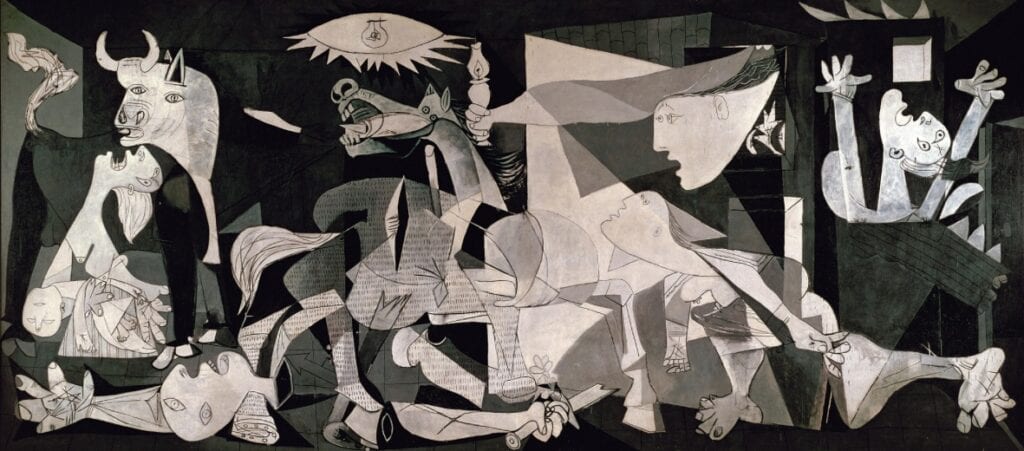
Picasso’s artistic journey encompassed numerous styles and periods, from the melancholy Blue Period (1901-1904) to the warmer Rose Period (1904-1906), before his revolutionary co-development of Cubism with Georges Braque around 1907. Throughout his career, Spanish themes and imagery – particularly bullfighting – remained important in his work. His monumental painting “Guernica” (1937), created in response to the bombing of a Basque town during the Spanish Civil War, stands as one of the most powerful anti-war statements in art history and can be viewed at Madrid’s Centro de Arte Reina Sofia.
Juan Gris (1887-1927)
Though less well-known than his compatriot Picasso, Juan Gris made significant contributions to Cubism and modernist painting. Born in Madrid but working primarily in Paris, Gris developed a more systematic and analytical approach to Cubism than Picasso or Braque. His still lifes, characterised by harmonious composition and subtle colouring, refined Cubist principles into a distinctive personal style that emphasised structure and clarity. Although his career was cut short by his early death, Gris’s intellectual rigour and formal elegance established him as an important figure in early 20th-century art.
Joan Miró (1893-1983)
Joan Miró emerged as one of Spain’s most distinctive artistic voices, creating a personal visual language that blended Surrealism with abstraction. Though connected to the Paris avant-garde, Miró maintained strong ties to his native Catalonia, drawing inspiration from the landscape around Barcelona and later Mallorca. His work evolved from early, detailed landscapes to increasingly abstract and symbolic compositions populated by biomorphic forms and celestial imagery.

Miró’s mature style – featuring simplified forms, bright colours and playful, dreamlike imagery – has become instantly recognisable. Works like “The Farm” (1921-1922) demonstrate his deep connection to the Catalan landscape, whilst later paintings explore an increasingly abstract vocabulary without completely abandoning representation. Throughout his long career, Miró remained extraordinarily prolific and experimental, working across painting, sculpture, ceramics and printmaking.
Salvador Dalí (1904-1989)
The Catalan artist Salvador Dalí, stands as one of the most recognisable and controversial figures in 20th-century art. Born in Figueres, Dalí developed a flamboyant public persona matched by his meticulously detailed Surrealist paintings exploring dreams, sexuality and the unconscious. His precise technique, influenced by Renaissance masters, allowed him to create hyper-realistic renderings of impossible scenes and melting, transforming objects.

Dalí’s most famous work, “The Persistence of Memory” (1931), with its iconic melting watches, has become one of the most recognised images in modern art. Throughout his career, Dalí remained connected to his Catalan roots, establishing the Teatro-Museo Dalí in his hometown of Figueres, which houses a significant collection of his works and remains one of Catalonia’s most visited cultural attractions. Beyond painting, Dalí worked in film, sculpture, photography and fashion, creating a multimedia legacy that continues to fascinate and provoke.
Where to See Spanish Art
Madrid’s Golden Triangle
Madrid stands as Spain’s premier destination for art lovers, anchored by the “Golden Triangle” of museums. The Prado Museum houses one of the world’s finest collections of European art, with particular strength in Spanish painting. Here visitors can trace the development of Spanish art through masterpieces by El Greco, Velázquez and Goya, whose works span his entire career from court portraiture to the dark visions of his later years.
The Thyssen-Bornemisza Museum complements the Prado with a comprehensive collection that fills historical gaps, offering a broader European context for Spanish art. Originally a private collection rivalling that of the British Royal Family, it provides a more encyclopaedic approach to Western painting. Completing the triangle is the Centro de Arte Reina Sofia, Spain’s national museum of 20th-century art, which houses Picasso’s monumental “Guernica” alongside works by Miró, Dalí and contemporary Spanish artists.
Barcelona and Catalonia
Barcelona offers another essential destination for understanding Spanish art, particularly the modernist movements of the early 20th century. The Picasso Museum contains one of the most extensive collections of the artist’s work, with particular emphasis on his formative years and Blue Period. The National Art Gallery of Catalonia (MNAC) houses an outstanding collection of Romanesque and Gothic art alongside works by Catalan modernists, all displayed in the magnificent Palau Nacional.
The Fundació Joan Miró, designed by Josep Lluís Sert, provides insight into the full range of Miró’s creative output in a spectacular setting on Montjuïc hill. For those interested in Salvador Dalí, a day trip to the Teatro-Museo Dalí in Figueres offers an immersive experience into the artist’s surreal imagination, as the museum itself was designed by Dalí as a total artwork.
Beyond Madrid and Barcelona
Spanish art extends far beyond the two major cities. The Guggenheim Museum in Bilbao, Frank Gehry’s revolutionary architectural achievement, has transformed the former industrial city into a cultural destination. Whilst focusing primarily on international contemporary art, the museum’s design – inspired by Bilbao’s shipbuilding and fishing heritage – has become an artistic landmark in itself.
Valencia’s Museo de Bellas Artes houses an important collection of Spanish paintings, particularly works by regional artists. In Seville, the Museo de Bellas Artes showcases Andalucían masters Murillo and Zurbarán alongside other Spanish painters. Málaga honours its famous son with the Picasso Museum, located in the artist’s birthplace.
Beyond painting, Spain offers remarkable collections of Roman art, particularly at Mérida’s National Museum of Roman Art, which ranks among the finest outside Italy. For those interested in prehistoric art, the cave paintings at Altamira (now primarily accessed through a replica to preserve the originals) and the less visited Cueva de la Pileta provide extraordinary glimpses into humanity’s earliest artistic expressions.
Contemporary Spanish Art
Contemporary Spanish artists continue the country’s rich artistic tradition whilst engaging with international movements and technologies. Artists like Antoni Tàpies (1923-2012) developed abstract styles incorporating unusual materials that reflected post-Civil War Spanish experience. Younger artists including Miquel Barceló (b. 1957) have achieved international recognition whilst maintaining connections to Spanish cultural traditions.
The democratisation of Spain following Franco’s death in 1975 led to a cultural flowering that continues today, with cities across the country establishing contemporary art museums and cultural centres. Madrid’s Matadero and Barcelona’s MACBA represent major institutions supporting experimental contemporary practices, whilst smaller centres throughout the country nurture regional artistic developments.
Spanish Art and Artists: A Final Word
From the mystical visions of El Greco to the revolutionary innovations of Picasso and the surreal dreamscapes of Dalí, Spanish artists have made extraordinary contributions to Western art history. The country’s unique cultural position – at once European and influenced by North African traditions, deeply Catholic yet historically multireligious – has fostered distinctive artistic expressions that continue to resonate globally.
Spain’s artistic landscape remains as diverse as its geography, offering visitors an unparalleled opportunity to experience masterpieces in settings ranging from world-class museums to intimate chapels and prehistoric caves. Whether exploring the Golden Age masters at the Prado, contemplating Picasso’s “Guernica” at the Reina Sofia, or marvelling at Gaudí’s architectural fantasies in Barcelona, Spain continues to offer artistic experiences of exceptional quality and emotional power that have rightfully secured its place as one of the world’s great artistic nations.


Hi Gerry
Just to show that this is a small world regardless of some distances.
My grandfather on my father’s side, Antonio Campos Rueda, was also born in 1881 as was Pablo Picasso.
Living not far from each other, they did know each other. However, when my grandfather turned 17 in 1898, his two uncles that had an established business in Manila, Philippines asked him and his two brothers to move to the Philippines and help with their growing business. Eventually, when the 3 Campos Rueda brothers were old enough, they sold the business and the uncles returned to Malaga to retire.
Unfortunately, after the move to the Philippines my grandfather and his brothers lost all contact with Don Pablo. My grandfather never went back until 1949 but I guess it never occurred to him then to look for him. Pity, because since I turned 21 in 1957, I visited Madrid and Malaga often.
Tony Campos
Thanks for this story Tony.
Wouldn’t it have been great if your grandfather could have met up with his old friend Pablo for a few glasses of sweet Malaga wine in Picasso’s famous old drinking haunt at Antigua Casa de Guardia (Alameda Central, 18). Guess he’s have moved on to Paris and Barcelona at that stage in his life.
Regards
Gerry
Just back from Spain, loved the Prado with its splendid “educational” captions in Spanish and English. Example: notice the torsos of the four forge workers in this painting are positioned to allow the artist to show his skill with all angles of the human torso. Just a magnificent museum. Remind your readers that seniors with proof of eligibility may be admitted at reduced price to museums.
Thanks for this tip Marian
You must add Antonio Tapies to your list. A fantastic Barcelona and world renown artist who died last year, Tapies captures the true Catalonia experience in a post modern abstract venue.
I so look forward to visiting Spain; to be able to look at it’s amazing beauty and experience walking the streets my family once walked and so many greats before them.