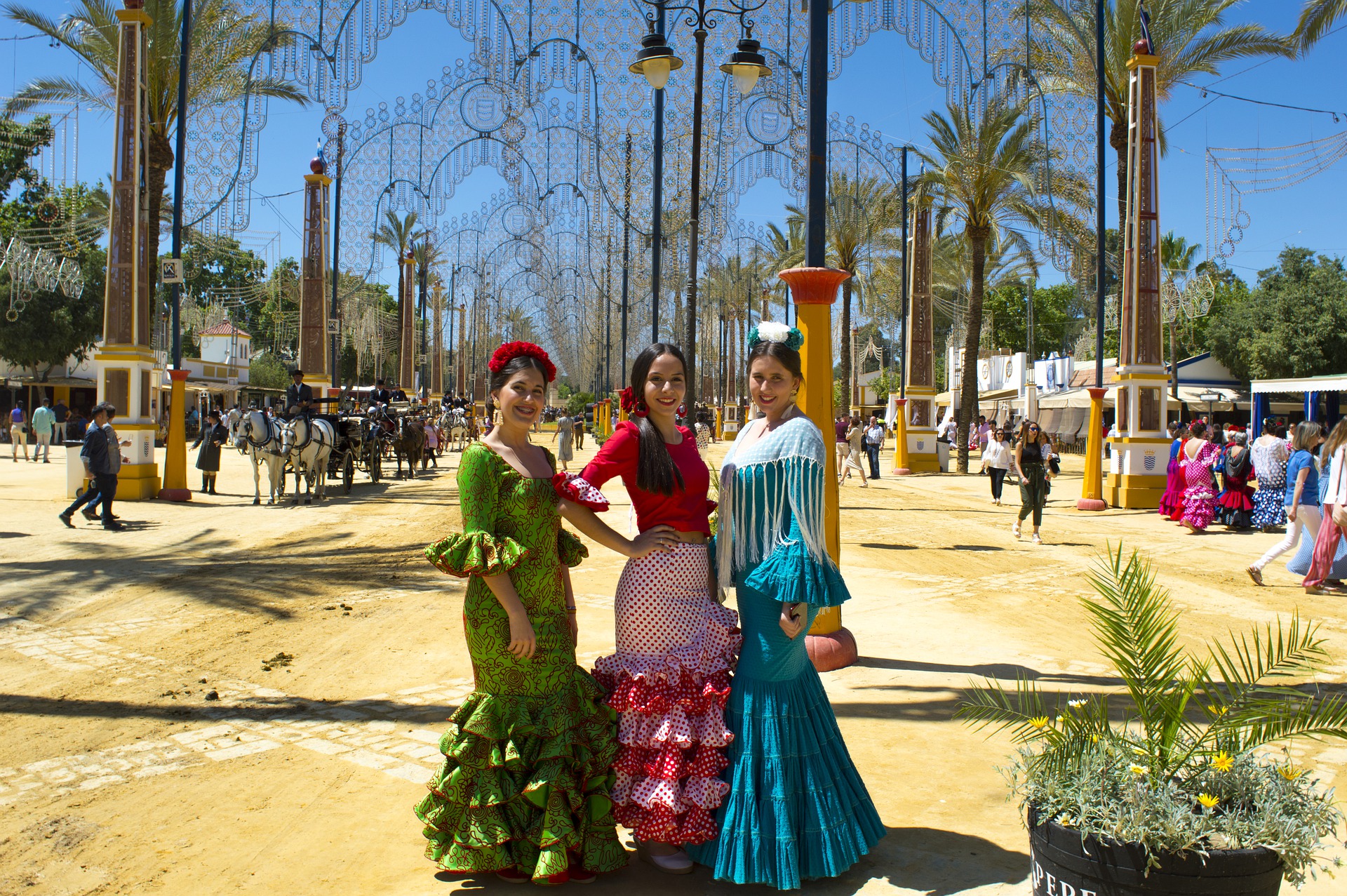
Jerez’s sherry festival takes place on the first Saturday of September every year as part of “Las Fiestas de la Vendimia y Otoño”. This is a three week party involving sherry, horses and flamenco. The origin of the festival is the annual celebration of the grape harvest. Jerez de La Frontera, one of Spain’s three sherry producing towns, celebrates its wine harvest with an abundance of colour and joie de vivre on the weekend closest to 8th September, with the feast of the Nativity of Our Lady.

The festivities kick off with a flying start as the Andalusian, usually eye-catching, queen of the vintage occupies her seat of honour with her handmaidens in tow. This queen of sherry, responsible for every auntie’s favourite aperitif, is raised onto her glorious wagon draped with all manner of pleats, flora and succulent grapes. Within a very short time children tail the cart hoping to catch sweets and goodies tossed into the air from mask-wearing courtiers. The masses converge on the Plaza de Arenal to pay further respects to the queen as the bodegas (sherry houses) let the sherry flow.
You should try to book a hotel in Jerez well in advance as they tend to fill up very quickly.
Be sure to stick around for a packed program of parties, bullfights, motorcycle races, exhibitions, concerts and flamenco dances; and not to forget the church mass followed by the blessing of the vines.
Jerez has the good fortune of lying in the Albarriza zone, renowned for its chalk-rich and sandy sun-baked earth, that provides more than adequate growing conditions for the sherry that ends up on your auntie’s table. The grape is Palomino. Very ordinary really but let us not forget that it is the process that makes Sherry not just the grape.
Once pressed it is stored in oak butts. Soon flor (yeast) naturally appears on the surface, miraculously preventing oxidisation whilst giving the wine its distinct flavour. Note that a sherry from San Lúcar will taste different to one from Jerez or El Puerto de Santa María precisely for its flor. Sherry from San Lúcar is also distinguished due to the area’s salty breezes that modify the sherry into a fine, fine fino, manzanilla. The fortification process is the most important part. Thereafter, the sherry is blended with other wines of different ages through the soleras and criaderas and then stored.
Click here for the dates of the next Jerez Sherry Festival. Unfortunately the site is only in Spanish at the time of writing.