
The festival of San Fermín, or the Running of the Bulls in Pamplona, as it’s more commonly known outside Spain, officially begins at midday on 6th July every year with the ‘Chupinazo’ which takes place on the balcony of the Casa Consistorial in Pamplona. Thousands of people congregate in the square awaiting the mayor’s official announcement that the fiestas have begun, a rocket is launched and the partying begins.

History of the Running of the Bulls in Pamplona
Origins of the Festival
The origins of the running of the bulls in Pamplona is not certain. There is evidence of the festival from as far back as the 13th century when it seems the events took place in October as this coincided with the festival of San Fermín on October 10th. It seems that the modern day celebration has evolved from this as well as individual commercial and bullfighting fiestas which can be traced back to the 14th century.
Over many years the mainly religious festival of San Fermín was diluted by music, dancing, bullfights and markets such that the Pamplona Council proposed that the whole event be moved to July 7th when the weather is far more conducive to such a celebration. To this day San Fermín remains a fixed date every year with the first bullrun at 8am on July 7th and the last at the same time on July 14th.
The joining together of the religious, commercial and bullfighting festivals and the move to July 7th led to the first official celebration of Sanfermines in 1591. This inaugural fiesta was a low key affair in comparison to the modern day running of the bulls as it only lasted two days although there was much merriment involving music, a procession and a bullfight. Dancing and fireworks became features of the festival over the next few years and the event was extended to July 10th.


The Emergence of the Bull Run
The tradition of running with the bulls likely began as a practical necessity when herders needed to guide bulls from corrals to the bullring. Over time, the practice morphed into a daring spectacle, drawing thrill-seekers who sought to prove their bravery by running alongside the animals.
By the 18th century, the festival’s fame began spreading beyond the region of Navarra and its reputation for partying attracted visitors from across Spain. However, it wasn’t until Ernest Hemingway’s 1926 novel, ‘The Sun Also Rises’, that San Fermín gained international notoriety. Hemingway’s vivid descriptions of the bull run and its intoxicating mix of danger, camaraderie and celebration drew generations of foreigners to Pamplona.
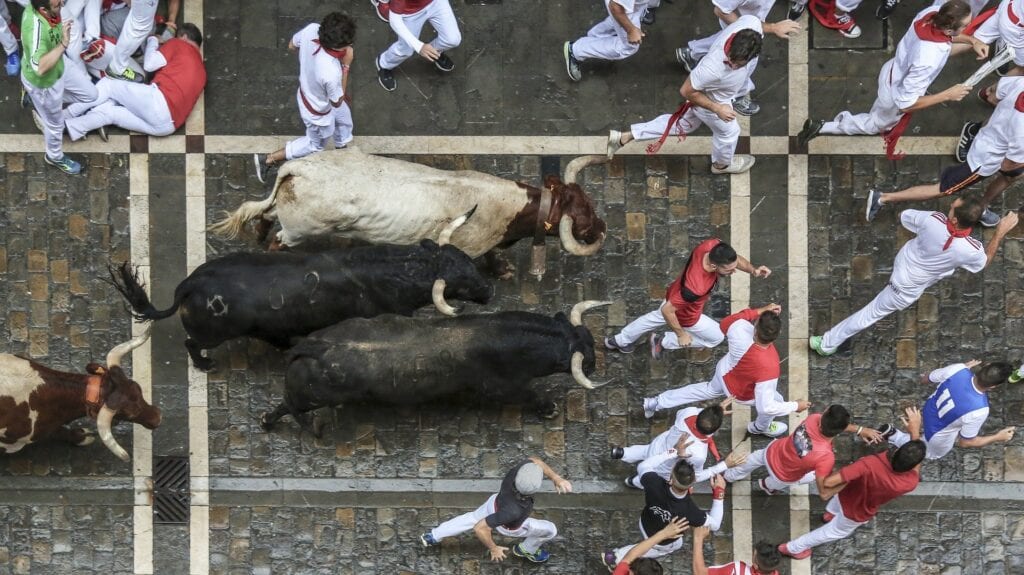
The first evidence of these foreigners turning up in Pamplona for San Fermín are recorded in chronicles from the 17th and 18th centuries when reference is made to the local clergy being concerned about “the abuse of drink and the permisiveness of young men and women”. By now there was plenty music, dancing, drinking, street theatre and bull-running as the religious focus of the occasion took a back seat.
By the 19th century all kinds of fairground attractions were making their way to Pamplona including human cannonballs and circus animals. The actual route of the bull run didn’t have a double security wall as is the case today so the bulls were able to escape, creating chaos in the streets of Pamplona.
The Bull Run: Route, Rules and Runners
When Does the Bullrun Begin?
The Pamplona bull run takes place at 8am every morning from 7th to 14th July (eight runs in total). Runners must be in the running area by 7.30am. The actual run stretches from the corral at Santo Domingo where the bulls are kept to the bullring where they will fight that same afternoon. The length of the run is 825 metres and the average time of the run from start to finish is between three and four minutes. The streets through the old town which make up the bull run are walled off so the bulls can’t escape. Each day six fighting bulls run the route as well as six steers (castrated bulls).

The tension builds as the release of the bulls approaches and at 8am on the dot a rocket is fired to confirm that the gate has been opened at the Santo Domingo corral. Runners dressed in white with a red handkerchief around their necks pray to San Fermín then a second rocket announces that the bulls have left. The bulls and the runners then begin the ‘encierro’.
Route of the Pamplona Bull Run
The bull run begins at the corral on Calle Santo Domingo and ends in the Plaza de Toros, Pamplona’s bullring. The route is divided into sections, each with unique challenges:
Santo Domingo: The steep incline of Santo Domingo is the first and one of the most perilous sections. Bulls quickly gain speed here and runners chant prayers to Saint Fermín for protection before the gate opens.
Ayuntamiento Square: This flat stretch near the town hall is a gathering point for runners. Its narrow passage creates a bottleneck which increases the risk of pile-ups.
Calle Mercaderes and Estafeta Corner: The sharp, cobblestone turn at Estafeta Corner is infamous for causing bulls to slip and slide which often results in dramatic collisions.
Calle Estafeta: This is the longest section, offering runners a chance to pace themselves. However, its narrow confines leave little room for error.
Telefónica and Plaza de Toros: The final stretch runs along Calle Duque de Ahumada into the bullring. Ths section is very risky as the route leads into a dead end street providing access to the Bull Ring which results in some runners being trampled if they don’t stay on their feet.
A third rocket is set off once all the bulls have entered the bullring and the fourth and final rocket means that the bulls are now in the bullpen and the bullrun has finished. The vast number of people taking part in the bullrun nowadays adds to the already considerable danger of running alongside wild bulls weighing in the region of 700kg each.
Map of the Pamplona Bullrun

- Corralillos
- Cuesta de Santa Domingo
- Plaza del Ayuntamiento
- Curva de Mercaderes hacia Estafeta
- Calle Estafeta
- Curva de Telefónica
- Callejón
- Plaza de Toros
- Plaza del Castillo
Dangers of the Bull Run
With the drinks flowing and the party in full swing you could be forgiven for forgetting that running the bulls is an extremely dangerous activity. Under no circumstances should you even consider running if you’ve been drinking alcohol. Not only are drunken people a risk to themselves they are also a risk to everyone else.
Since record-keeping began in 1924, 16 people have died and over 200 been seriously injured. Aside from the risk of death, there are hundreds of runners every year who sustain injuries ranging from minor scrapes to severe goring and trampling.
The local authorities take extensive measures to minimise risks, including the deployment of medical teams, fencing along the route and strict policing. However, the dangers remain very real, particularly for inexperienced runners or those who underestimate the physical and mental demands of the event.
Safety Tips for Runners
Experienced runners recommend understanding the route, staying alert and knowing when to step aside. The festival’s party atmosphere can be intoxicating, but sobriety is essential for anyone considering participating in the run. A few key tips are well worth bearing in mind:
Avoid alcohol and drugs before the run: Intoxication is both illegal and extremely dangerous.
Wear appropriate clothing: White attire with a red sash and scarf is traditional and practical.
Stay alert and know the route: Never attempt to outrun the bulls. Instead you should dodge to the side when they approach.
How to Watch the Running of the Bulls as a Spectator
For those who prefer to watch the running of the bulls rather than participate, Pamplona offers multiple vantage points.
Street Viewing
You can stand behind the fences that mark the route of the bullrun but you need to arrive by around 6.30am to get the best spots on the top of the fence directly overlooking the run. Another good spot is in front of the museum on Calle Santo Domingo where there isn’t a fence but the best spots here are usually taken before 6am leaving you with a cold two hour wait before the run starts.

Balcony Rentals
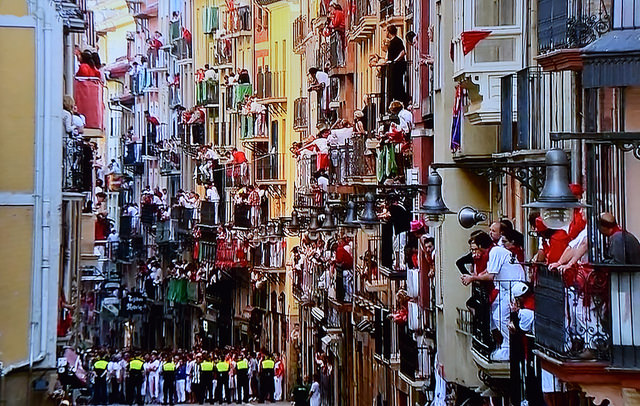
Renting a balcony overlooking the bullrun in Pamplona is one of the best ways to experience the ‘Encierro’ safely whilst enjoying an unparalleled view of the action. Balconies along the route are privately owned and many residents rent them out to visitors during the San Fermín Festival. To secure a spot, start your search well in advance, ideally several months before July, as demand is incredibly high. Numerous agencies and online platforms specialise in balcony rentals, offering spots on key stretches of the route such as Calle Estafeta or Plaza Consistorial. For late planners, the tourist office in Pamplona sometimes has last-minute information about available balconies.
Plaza de Toros
Your only other options are to go to the bullring and watch the end as the bulls (and some terrified runners) arrive in the arena. Alternatively, you could head for a bar and watch the bull run which is shown live every morning on national TV.
Watching the Bullfights
On every evening of the fiesta beginning at 6.30pm on 7th July there is a bullfight in the Pamplona bullring. Tickets for the bullfights are sold out well in advance as the arena only holds 12,500 people. Every evening after the day’s bullfight some tickets go on sale for the next evening’s event at the ‘taquillas’ at the bull ring. You’ll usually find ticket touts operating around the Plaza de Toros during the day and before the bullfight selling at elevated prices.




San Fermín: Frequently Asked Questions
Every year in the run-up to San Fermín we receive the same questions about the fiestas. Here they are together with answers:
How to Get to Pamplona?
Whilst there are no international flights into Pamplona Airport, you can fly to Madrid then take a connecting domestic service with Iberia to get there. The airport is only 6km from the city centre. There are regular train services from Barcelona, Madrid and San Sebastián to Pamplona as well as frequent bus services. For more detailed information on how to get to Pamplona take a look at our comprehensive Pamplona Travel Guide.
Where to Stay in Pamplona?
Hotels and Hostels: The city of Pamplona simply isn’t big enough to accommodate the vast number of people who flock there during Sanfermines. It’s more or less impossible to book Pamplona Hotels at short notice so if you want the comfort of a hotel bed you should consider booking many months in advance. Similary budget accommodation in hostels gets fully booked a long time before the event so planning your visit some time ahead is crucial.
Campsites: My personal preference is to book a place on the Ezcaba campsite near Pamplona which lies about 7km from the city centre. Whilst it is also packed throughout the week of the fiestas they do take security seriously and offer bus transport in and out of town. The free campsite that appears near this campsite during the fiestas is another option but isn’t recommended for security reasons as petty crime is rife during San Fermín. Similarly sleeping in parks along with many others should be avoided for the same reason.
Other Cities: An alternative to staying in Pamplona is to book a hotel in San Sebastián, Vitoria-Gasteiz, Logroño or Estella and make the early morning trip to the bull run from there. The trouble is that getting public transport early enough in the morning to see the bullrun can prove impossible so this option is only really viable if you have your own vehicle.
How Much Does it Cost to Run with the Bulls?
Whilst this does come as a surprise to many people who ask this question, there is no need to pay to run the bulls or even register for that matter. All you have to do is head for Plaza Consistorial near the start of the route preferably before 7am. Don’t turn up just before 8am as you’ll be too late to get a spot and don’t wait along Calle Estafeta as the police will clear everyone off this street before the bullrun commences.
Can Women Run With The Bulls?
Yes, there is nothing to stop women from participating although they tend to be very few in numbers. It’s very rare to see any Spanish females running, the majority normally seem to be Aussies!

Please do not send me any more disgusting rubbish relating to bullfighting or their torture. I hope the Spanish government do the decent thing and ban it. It only appeals to the lowlife from our country on package holidays.
Michael Waugh, you have absolutely no idea about Spanish culture, it’s traditions or lifestyle. Bullfighting has been an integral part of the culture for centuries. You have the personal choice not to attend the corridas or festivals, but do NOT try to force your personal bigoted opinions on others in order to try to influence their choices. Many of us who live in Spain enjoy the fiestas and bullfights. Long may it be so!
Shame on Spain for still allowing this to happen – somewhat contradictory to their animal welfare laws. There should be no place for barbaric acts in this day and age – irrespective of tradition or culture – we are supposed to now be in a civilised age. The majority of Spanish people I know abhor such practices.
In the UK we used to stick children up chimneys – do supporters of the cruel traditions suggest the British go back to that too?
Shame to on “Spanish Fiestas” for promoting the torture and killing of animals too.
Please note the name of this website … “Spanish Fiestas”
This is a barbaric tradition.
Human lives are more important then animal lives. It says so in most every religions holy text. Even if your not religious, most people would still agree human lives are more important. Its why firefighters save the children before their pet turtles. Bull fighting is part of Spanish culture and should be aloud to be practiced safely by anyone who wishes too.
RUBBISH ITS AS SIMPLE AS THAT. YOU’RE BRUALISING YOUR CHILDREN AND YOUR BRUTES YOURSELVES. WHY CANT YOU SEE THAT ????
In areas of the middle east it is a “cultural tradition” to beat (tenderizes the meat) then skin and/or cook dogs and cats while they are still alive. I suppose since it is a “cultural tradition” that’s just fine also.
Excellent reply to the silly comment that bullfighting is OK since it’s a part of culture. Also, it’s a part of culture in some countries to beat women and to kill them in the name of honor. Such utter rubbish. Ban it NOW!
TORTURE IS NOT CULTURE!!! AND TRADITION DOES NOT MAKE IT RIGHT!!!!! ITS A DISGUSTING ARCHAIC TRADITION WHICH NO CIVILISED SOCIETY WOULD ENDORSE!
Bullfighting is already banned by law in many countries, including Argentina, Canada, Cuba, Denmark, Italy and the United Kingdom,Costa Rica, Mexico City.
Even 72%spaniards hate the animal abuse ,the mexicans at 84%. 78% of Colombians and 73.5 percent of Peruvians are against bullfighting due to animal cruelty!!!
Bull running is not only stressful for the animals involved, but dangerous as well.
Since this happens openly in the streets of the town, CHILDREN are also a witness to the HORRIFIC and VIOLENT scene of a panic-stricken bull!!!!VIOLENCE BRINGS VIOLENCE!
KEEP IN MIND FREEDOM OF SPEECH TO VOICE AN OPINION IS STILL ALLOWED IN 2016!!! AND THERE ARE PEOPLE IN THIS WORLD LIKE MYSELF WHO CARE ABOUT THE BULLS!!!
These are the virtues you want to teach future generations,to torment innocent animals??????
TORTURE IS NOT CULTURE!!!!!!!!!!!!!
Bullfighting does not happen in the streets, the running of the bulls does. It began because they were running them to the market. From what I learned years ago (it could have changed), they are still running them to the market. As for the actual bullfights, yes I agree they are cruel, but the bull’s meat is actually being used/sold so it isn’t a complete loss. Children are not exposed to bullfights unless they purchase a ticket to go to the event inside a closed arena or watch it on television.
Totally agree but I think its teaching children to be brutes too.
Have you seen the “Toro de Jubilo” Festival pictures ??? I actually couldn’t believe it at first that man could be so cruel. I googled it and I thought bull fighting was bad enough. I’m afraid I’ve gone off anything Spanish.
shame on Spain
FIFTEEN PEOPLE HAVE DIED! DIED! 200 HAVE BEEN INJURED!!! Do you think that that’s okay? And what about the bulls? They don’t exactly get to choose whether or not they participate that barbaric sort of thing! Tradition is tradition, but a life is a life! Death is irreversible. Just think about that.
People have died. Powerful, majestic bulls have been tortured to death against their will. 200 are injured. And still, you are convinced it is the right thing? I’m disgusted. And I feel I am not the only one who is.
Your so wrong. How can you “enjoy” hurting these innocent creatures. Just because it is tradition or cultural doesn’t mean its right or humane.
We used to burn witches in Scotland but obviously this was wrong just as bullfighting and burning bulls is wrong and inhumane.
Do unto others as you would be done to yourself is the rule of life and this includes all Gods creatures. Surely.
You’re bringing your children up to be brutal. Is that really what you want ???
The truth is its all down to money where your government is concerned.
I actually couldn’t believe the brutality of “Toro de Jubilo” when I saw pictures of it and I thought bull fighting was bad. Its all so sadistic and brutal on the part of man. You are the brutes in the eyes of the modern World.
shutup feminazi
now u people are trying to shut a Hispanic tradition and culture when you all claim that you are for inclusiveness
This is truly barbaric and outdated cruelty to animals. All traditions and culture are not necessarily good. I cannot understand how civilized men and woman can partake in these medieval events. ITS ANIMAL CRUELTY AT ITS WORST. There’s enough cruelty in the World.
Tourist organisations should all boycott these events and not advertise them.
We girls got ourselves from Greece to the 1981 Running of the Bulls except women were forbidden to run. We stayed in the free camping area along with 50 odd Kombi vans. Each day my friends and I would catch the bus or walk in the beautiful morning air. Dressed in NRL football jerseys of their home suburbs we Australian girls would stand on the fences perching for hours. The boys would run past wearing their red scarves and sashes. We sat in the bullring picking out the colorful jerseys. It was raw traditional culture. The beer and sangria literally turned the streets red. The music was loud, the procession of costumes with large heads making us feel like we were on another planet. Never to be forgotten. We had to leave after a week as the sanitation and the cleanliness of the stream we all bathed in and washed our dishes in began to affect our health. But Pamplona had only whet our appetite for our fabulous adventures in Spain. For another 10 weeks we travelled, stayed for ferias, drank sherry, learned to Sevillian dance, learned to ride a donkey and lived in a mill for 3 weeks. Hasta La Vista España!
Wow – what a great time you had in Spain. The fiestas are more popular than ever with Aussies. Thanks Karen.
Good for you !!!! So you had a good holiday never mind the suffering of the bulls. Spain should be ashamed of its cultural and traditions like this.
These fiestas are despicable and cruel. People like you are keeping this brutal tradition going. You should be ashamed.
I think the San Fermines Festival is one of the many festivals that are unique to Spain, while visiting you can also visit the neighbouring towns of interest like Sanguesa and of course, the castle of San Javier.
Thanks Vanessa … I guess few visitors to the fiestas take the time to discover the lovely region of Navarra
I have lived in Spain for 10 years and I have witnessed horrendous cruelties inflicted upon bulls and other animals, what sort of people would tie fireworks to the horns of bulls and laugh when they go crazy, bullfighting is a cowards way of fighting as they cut the tendons in the bulls neck before the “brave” matador gets near it so’s it can’t toss its head to the side only up and down, try fighting the bull without mutilating it first.
For me, any bullfighter or runner that gets killed or injured is a great big hooray for the bull, Spain is a cruel country as I’m sure Gerry you will know what I’m talking about.
lets agree to disagree
i agree with you!!! may the bulls find justice and gore each and every runner or bullfighter to shreds!!!!
I too prefer ‘Death in the Afternoon’ for a fascinating read about Hemingway’s love affair with bullfighting
Having seen many bullfights in my youth back in the 70s, and having studied it extensively I considered myself a true ‘aficionado’. Now much more mature, married with children, and a broader understanding of the ethics I do think it’s a cruel ‘sport’ that such a magnificent animal can be reduced to nothing in 15 minutes. Having said that, my wife and I went to Madrid a couple of years ago and couldn’t resist going to a corrida at Las Ventas to soak up the atmosphere, the pageantry, the skill…..and alas the cruelty. I guess I have to admit to being a hypocrite.
I agree. Culture Smelter — torturing bulls for your own human whim is ………… let’s say, bull-shit. Bullfighting in its current form should be illegal. Fight the bull without any weaponry and pointed objects; just you and the bull. And once the dance ends hopefully with human and bull intact, go your merry way to live another day.
¡QUE VIVAN LOS SANFERMINES!
“. . . suenen parches y clarines.”
Feria que honra a San Fermín,
glorificado, . . . sin fin,
patrono fiel de Navarra,
mártir de la fe bizarra.
Pamplona, se cuece aparte,
sede del taurino arte,
Pompeyo, su fundador,
por designio del Creador.
Fiesta, júbilo, alegría,
seis de julio, mediodía,
la Casa Consistorial,
sobria, de rancio historial.
Contengamos el aliento,
balcón del Ayuntamiento,
voz, envuelta de promesas:
“Pamploneses, pamplonesas”.
(grito), ¡Viva San Fermín!,
(grito), ¡gora San Fermín!,
estruendo del chupinazo
que preludia un agasajo.
El “Riau-Riau”, siempre se extraña,
costumbre que nos hermana,
portando rojo pañuelo,
la gente cumple su anhelo.
Respetuosa procesión,
San Fermín, una oración,
religiosidad, fervor,
la paz, candoroso amor.
Con danzas tradicionales,
los trajes originales,
gigantes y cabezudos,
muchos de ellos “sombrerudos”.
Lindo recital de jotas,
escuchen que bellas notas,
las mulillas, caballeros,
que desfilan muy sinceros.
Suenan Bandas Musicales,
sus tonadas celestiales,
sublime Teatro de Calle,
toro de fuego, . . . no falle.
Las luces artificiales,
centellas, truenos cordiales;
¡las ocho de la mañana!,
el corazón es campana.
Cánticos de los ancestros,
suelten toros, los cabestros,
“encierros” de largo trecho,
que no haya humano maltrecho.
Sorteando cuernos y retos,
más de ochocientos metros,
muchos pies trotan de prisa,
sudor, en la frente . . . brisa.
San Fermín, destreza, suerte,
si no, las heridas, muerte,
peñas van comprometidas,
entusiastas, encendidas.
Marejada, corredores,
a la Plaza entran Señores,
¡que vivan los Sanfermines!,
arenas que son jardines.
España, la madre patria,
su cultura, su prosapia,
leyenda, verbena, magia,
¡que venga la tauromaquia!
Las velas, pañuelos, manto,
albricia se vuelve llanto,
“Pobre de mí”, entristecida,
la canción de despedidas
Autor: Lic. Gonzalo Ramos Aranda
México, D. F., a 06 de julio del 2015
Reg. SEP Indautor No. (en trámite)
Shame on you Spain for letting this still happen. These bulls go through horrendous torture and it’s disgusting. Animal cruelty should have no place in today’s society and why some awful people want to watch this happen is beyond me!
I totally agree. Bullfighting in its current form is repulsive and not an indicator of bravery. Just the opposite. Those that participate and support bullfighting are cowards. Reverse the position — humanfighting and see much you’d like that.
Can anyone tell me if they still feed the audience and give them wine? In 1960 I was at Pamplona fights (saw Dominguin) and they passed out food and red wine. It was helpful as we camped and did not have easy access to food
Bull fights are harsh yes. The bull run itself (which is what this article is abort) isn’t cruel to the Bulls. They run, knock people over, then run through to an arena. The Bulls can be pardoned by the arena to be spared from killing, otherwise they are killed humanity. They are treated like royalty up until this run, which is a lot better than slaughterhouse animals.
Sick sick culture- the people that enjoy terrorising and ultimately inflicting a long cruel death on these quiet calm animals. Torture Voyeurs are those that are involved in supporting the bull runs, fiestas and fights. Culture, tradition, stupidity are not valid reasons for continuing torturing any animals
most awesome bullfighting festival in Portugal
https://www.youtube.com/watch?v=cEa7BVPosZ8
awesome bullfighting festival,bull fighting accidents
https://www.youtube.com/watch?v=kkztN3km0uU
This is a great resource about running of the bulls. We just went to Pamplona for San Fermin for the first time and had a blast – here is a brief video if anyone is interested https://youtu.be/arS5m1CPKDE
Ran in 2012. What an awesome experience. When I arrived in the arena, the sky was bluer and the sun brighter. Wow!
The bullfighting and atmosphere was so incredible that my wife demanded we go again the next day. Incredible. Viva Espania!
If you want to be informed about animal cruelty, then go visit any of the hundreds of corporate poultry, dairy or pig farms throughout the US that every grocery store buys from. Now that’s incredible cruelty.
I did the running of the bulls in 2013. We stayed in an airbnb which was a 10 minute bus ride away from the town centre. Would have been handy to have read up your insightful blog before going. Thought I would leave you with my personal account: https://www.travelendar.com/event/running-of-the-bulls-san-fermin/
Please note that they are not simply torturing these animals, the bulls are treated very well, in fact. Corridas de Toros are art, it’s a dance of life and death, don’t forget that toreros die too, not just the bulls. I’m sorry you grew up all prim and proper because real-life includes things like this. There’s a really great war writer named Tim O’Brien, and one of his articles was about how war is beautiful, in a horrible way of course. It’s foolish of you to just write them off because they have different ideas.
Hi! Here’s a helpful link about the history of the Pamplona bullfights! It does a great job explaining how the bullfights evolved into what they are today.
https://bullbalcony.com/blogs/news/why-are-bulls-so-important-in-spain-1