One of Spanish football’s greatest success stories in recent times has been the promotion of Sevilla FC into European royalty. Their victory on penalties over Roma in the final of the Europa League in May 2023 was the 7th time they have won the competition since 2006. In that period they have also won two Copas del Rey and the Spanish Super Cup. All this is a long way from March 8th, 1890 when the first official football match took place in Spain between Sevilla FC and Huelva Recreation Club. Most players on the pitch that day from both teams were British expatriate workers together with a few local Spanish players.
Seville FC Stadium
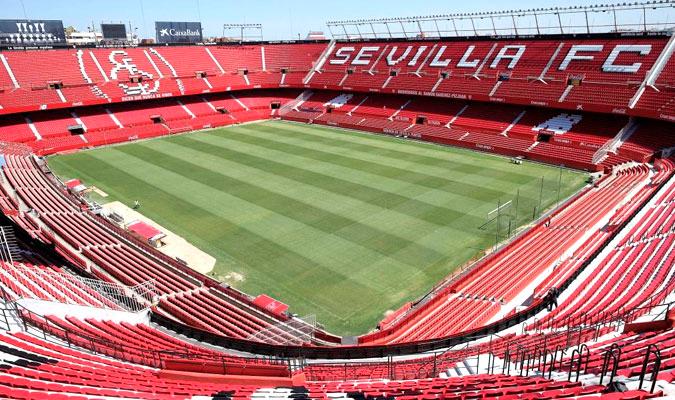
Sevilla Fútbol Club play at the 43,883-seater Sánchez Pizjuán Stadium located in the city’s upmarket district of Nervión. It is named after Ramón Sánchez Pizjuan who twice served as the club’s president from 1932 until 1942 and from 1948 until 1956. The stadium replaced the former Estadio de Nervión and held its first official match at the start of the 1958-59 season against Real Betis with a capacity crowd of more than 70,000.
Seville FC are known as “Los Nervionenses” because of the neighbourhood in which their stadium is located.
With a slightly reduced capacity the stadium hosted the infamous World Cup semi-final game between Germany and France in 1982. Major refurbishment during the 1990’s saw the stadim’s capacity reduced to current levels in a modern, all-seater arena. The stadium has a certain fame in Spain as it has proven to be a fortress for the national team who have never lost a game there.

Getting There: The Estadio Ramón Sánchez Pizjuán lies less than 3km east of Seville Cathedral and can be reached on foot in around 30 minutes. Many bus routes go to the Nervión district where the stadium is located including lines 27, 24, 21, B3, 28, 29, C1, C2, 32, EA (Airport Shuttle), 5, 22 and 23. There is also a one line Metro service with stops at Nervión and Gran Plaza.
Seville FC Stadium Tours
There are stadium tours of the Estadio Ramón Sánchez Pizjuán on Thursday, Friday, Saturday and Sunday from 10am until 9pm. However, these tours do not operate on match days or the day before a match. The tours include a visit to the club’s museum, the trophy room, changing rooms and more.
How to Get Seville FC Tickets
Few games at the Sánchez Pizjuán Stadium sell out so you usually can buy Seville football tickets at the ticket office next to entrance 28 on the day of the match from 10am or in the few days leading up to the game. Online ticket sales are also available through the club’s official website and customers can collect their tickets at the main ticket office on matchday. You can also pick up tickets at the reseller offices found on C/Tetuan, usually at 20% above face value. Matches against FC Barcelona, Real Madrid and city rivals Real Betis are the ones most likely to sell out.
History of Sevilla FC
Sevilla Fútbol Club was founded in 1890 by Scotsman Edward Farquharson Johnston from Elgin who was the British vice-consul to Seville and the club’s first president. Most players were British expatriates who were employed by shipping and manufacturing companies in the city and their captain was Hugh Maccoll from Glasgow.
Although this Seville team won this inaugural fixture against Recreativo de Huelva, the club wasn’t officially formed until 1905. The British influence, however, was still strong; hence the anglicised Sevilla FC instead of the more Spanish CF – club de fútbol.
Although many Andalusian titles were won during the early years, Sevilla FC was not elected to La Liga until the 1934-35 season, partly because local rivals Real Betis Balompié were already members of the league. Coming fifth in their first season was accompanied by victory in the Copa del Rey competition, beating CE Sabadell 3–0 in the final. After coming second twice, their one and only League title was captured in 1946.
For many years, it seemed as if these were destined to be Sevilla’s best days. Despite moving to the impressive 45,000 capacity Ramón Sánchez Pizjuán Stadium in 1958, Sevilla became the archetypical mid-table team, with the occasional brush with relegation. The club’s finances required that some of their best players had to be sold as they struggled to pay off their new stadium and they were relegated in both 1968 and 1972.
Seville’s return to the top flight from the beginning of the 1975-76 was the beginning of some stability which saw them remain in the first division for twenty-two consecutive seasons. In that time they enjoyed sixteen top-10 finishes. Sevilla FC returned to their roots for the 1986-87 season when they appointed Scotsman Jock Wallace as manager. Wallace had been very successful as manager of Glasgow Rangers but his stay at the club only lasted for that single season. Another fleeting visit to the club was made by Diego Maradona who joined Sevilla from Napoli for the 1992–93 season. His stay was short and not too sweet as he suffered frequent injuries and clashed with fellow Argentinian coach, Carlos Bilardo.
The lowest point for the club in the modern era came at the end of the 1990s when they were relegated twice, spending three out of four seasons in the second division before returning to the top flight for the beginning of the 2001-02 season. This was a major turning point in the fortunes of Seville FC and they have remained in the top division of Spanish football ever since.
Seville FC in the 21st Century
Seville fans will tell you that this turning point was largely achieved thanks to two new faces at the club. The first was José María del Nido, the club president, who brought a new degree of financial stability to the club. The other was Joaquín Caparrós who was appointed as manager for the 2000/01 season and won the second division title at the first attempt. Caparrós was a volatile and charismatic leader, born just outside the city, who introduced fast, attacking football which helped cement their place in La Liga.
During his five seasons in charge he was also responsible for bringing through some first-class youngsters including José Antonio Reyes and Sergio Ramos and made some excellent signings such as Júlio Baptista and Daniel Alves. The sale of Reyes to Arsenal and Ramos to Real Madrid was devastating for the fans but gave the shrewd del Nido the funds to further strengthen his already impressive squad. This work done by Caparrós provided a foundation from which the club would become a successful club on the European stage.
Having qualified for the UEFA Cup, Joaquín Caparrós was replaced by Juande Ramos before the start of the 2005-06 season. In the semi-final against FC Schalke 04 it was Antonio Puerta who scored the winning goal which supporters called ‘el gol quenos cambió la vida’ – the goal that changed our lives. In a staggeringly one-sided final, Sevilla beat Middlesbrough 4-0 and became the first ever team from Andalucía to lift a European trophy.
The following season the team continued to gather silverware. The UEFA Super Cup was won against FC Barcelona. Then they beat Espanyol to retain the UEFA Cup and went on to win their first Copa del Rey for 59 years against Getafe. By winning the traditional pre-season opener of the 2007-08 season, the Supercopa de España, with a thrilling 5-3 away victory at Real Madrid, Sevilla collected their fifth trophy in a breathtaking 15 month period.
Death of Antonio Puerta
Immediately after Seville’s Supercopa victory in 2007 came the tragedy of Antonio Puerta’s collapse on the pitch in the first league match of the season and his subsequent death in hospital. Seville, indeed the whole of Spain, was devastated by the untimely end of such a popular player and man. Puerta’s number 16 shirt was ‘retired’ by the club and it took a long time for many players to fully recover from the shock. Puerta’s great friend and the former Sevilla defender Sergio Ramos proudly and poignantly displayed his memorial t-shirt at the climax of Spain’s European Championship celebrations in the summer of 2008.
Perhaps the only positive aspect of this whole sad episode was the new feeling of respect that developed between the presidents and supporters of Sevilla and Betis, whose bitter rivalry had been getting progressively more destructive during the previous seasons.
In October 2007 Juande Ramos, seemingly always at loggerheads with del Nido, left Sevilla to join Tottenham and was replaced by Manolo Jiménez who at the time was the manager of Atlético Madrid. Jiménez was the ideal replacement at the time having played 354 league games for Sevilla between 1983 and 1997 as he was perhaps the one person able to revitalise the club following the death of Antonio Puerta.
European Footballing Royalty
Under Manuel Jiménez’s leadership Seville reached the group stages of the Champions League in the 2007–08 and the 2009–10 seasons. Following his departure in March 2010 they managed to add further silverware to their trophy cabinet by beating Atlético Madrid 2–0 in the final of the 2009-10 Copa del Rey. They also finished 4th in La Liga to qualify for the following season’s Champions League but went out in the early season play-off against Braga. In spite of that defeat, Seville FC had now established themselves as serious contenders for honours both domestically and on the European stage.
Seville would continue assault on Europe in the coming years with regular appearances in the group stages of the Champions League but never got further than a a quarter-final against Bayern Munich in 2018. Once again it was in the Europa League that they came up trumps by winning the trophy four more times. The first of these was in 2014 under Spanish coach Unai Emery when they beat Benfica on penalties. The following season they retained the trophy against Dnipro Dnipropetrovsk and quite remarkably they won the trophy for a 3rd consecutive season when they beat Liverpool in the 2016 final.
Former Spanish national coach Julen Lopetegui took charge of the team in the summer of 2019 and added his first silverware in August 2020 when Sevilla beat Inter Milan 3-2 in the Covid-19 final inside an empty stadium in Cologne. This was the 6th time that Seville FC have won the UEFA Europa League making them the most successful club in the tournament’s history. They went on to win their 7th Europa League title in Budapest at the end of the 2022-23 season.
UEFA Cup – Europa League Wins
| Season | Winners | Runners-up | Venue |
| 2005–06 | Sevilla | Middlesbrough | PSV Stadion, Eindhoven |
| 2006–07 | Sevilla | Espanyol | Hampden Park, Glasgow |
| 2013–14 | Sevilla | Benfica | Juventus Stadium, Turin |
| 2014–15 | Sevilla | Dnipro Dnipropetrovsk | National Stadium, Warsaw |
| 2015–16 | Sevilla | Liverpool | St. Jakob-Park, Basel |
| 2019–20 | Sevilla | Inter Milan | RheinEnergieStadion, Cologne |
| 2022-23 | Sevilla | Roma | Puskás Aréna, Budapest |
Useful Links:
Seville FC Official Website: Learn all about the club and check the latest information on fixtures and kick-off times.