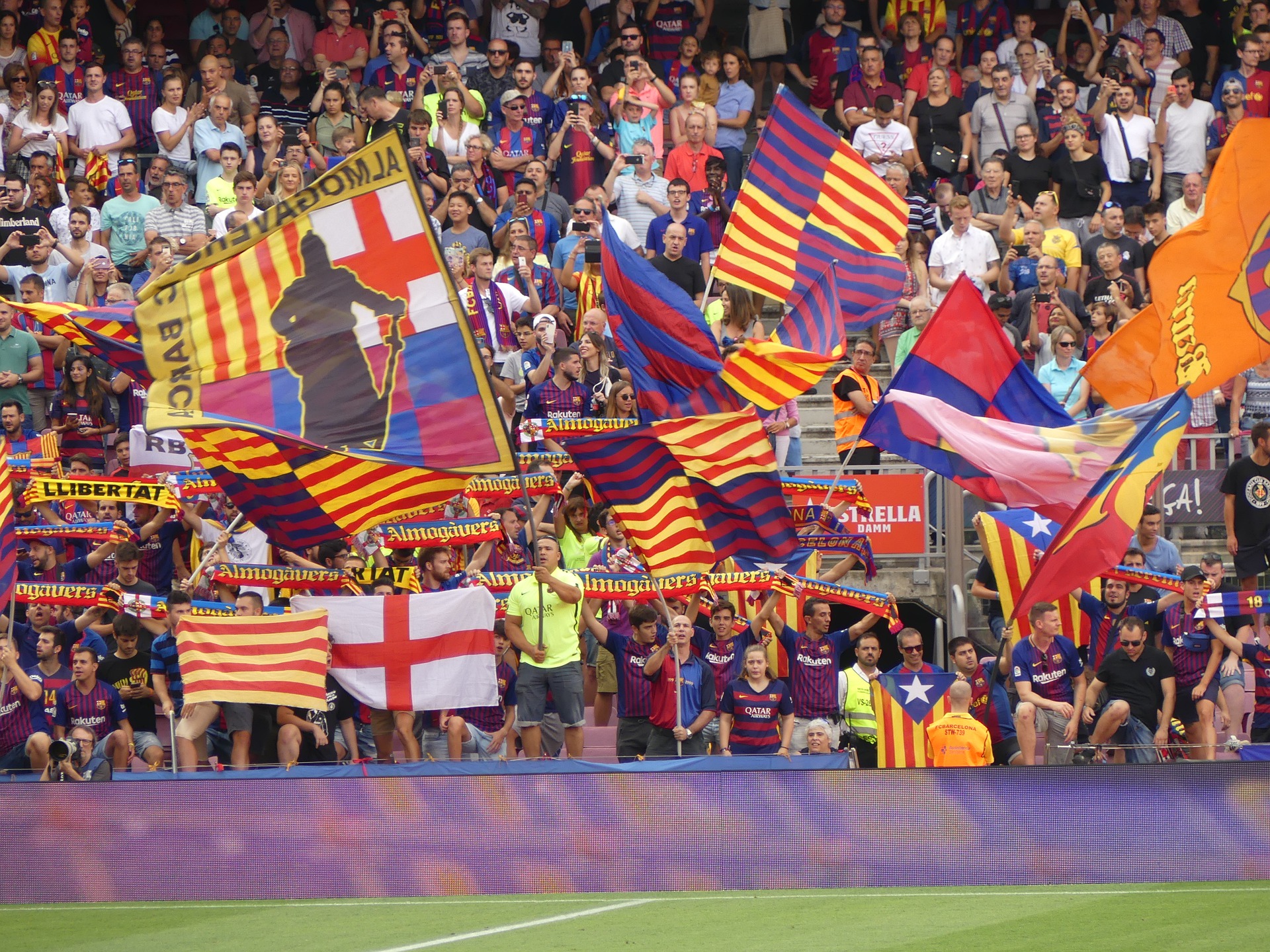
FC Barcelona has long been a favourite football club for fans all over the world. This popularity is thanks to its long standing reputation for uniting some of the world’s greatest footballers who are drilled in playing open and attractive football in the club’s famous blue and claret shirts. Fans of “the beautiful game” are also attracted by the membership structure of the club that gives ordinary supporters a say in the election of their presidents and historically Barça earned enormous respect within the international community for their stance as an ‘anti-Franco’ club.
For every home game throughout the season there are football fans from all over Europe who make their way to Barcelona to watch a match at the legendary Nou Camp stadium.
History of FC Barcelona
Origins of Barcelona Football Club
Founded in 1899, when the Swiss-born Hans Gamper established a team made up of Swiss, English and Catalan players, the club quickly established itself as a focal point of the city and the region. Gamper is an integral part of the early history of the club scoring 103 goals between 1901 and 1903 and then becoming the president until his death in 1930. It was he who enabled the club to purchase their first ground in 1909 with a capacity of just 6,000 people. Gamper then oversaw the development of the Les Corts stadium which initially had room for 30,000 before it was later doubled in size. And, the year before his death, he was able to see his club become the first ever Spanish League champions.

By this time, with in excess of 10,000 members, Barcelona was already attracting star footballers from overseas – the Uruguayan striker Hector Scarone being the first of many big money signings. Perhaps the most famous of Barcelona’s players in this era was the goalkeeper Ricardo Zamora who is still remembered today for two reasons: Firstly, he has given his name to the trophy awarded to the best goalkeeper in La Liga each season; and secondly, he was the first player to tread that dangerous transfer path from Barcelona to Real Madrid.
FC Barcelona Under Franco
The notorious and long standing rivalry between Spain’s two major football teams has always been keenly felt. This came to a head during the Franco era. Barcelona was the emblematic capital of the region of Catalonia and Franco banned both the Catalan flag and its language. The club was also forced to change its name to Club de Fútbol Barcelona and it wasn’t allowed to display the Catalan flag on its crest.
Barcelona Football Club became the only place where large groups of people could gather and speak in their native language and the claret and blue of Barcelona became a recognisable substitute for the red and yellow of Catalonia.
Josep Suñol, the president at the time, was murdered by Nationalist soldiers in 1936 and a bomb was dropped on the Barcelona social club in 1938. On the pitch events reached their nadir in 1943 when Barcelona were ‘instructed’ by Franco’s director of state security to lose the 2nd leg of the Copa del Generalísimo semi-final against Real Madrid. They did, in fact, lose the match by 11 goals to 1 in protest – and then saw their goalkeeper banned from football for the rest of his life. This sorry episode is eminently described in Tom Burns’ “Barça: A People’s Passion”.
In the Shadow of Di Stefano’s Real Madrid
During the 1950s and 1960s Barcelona were somewhat overshadowed by the famous Real Madrid team of Puskas, Di Stefano et al, but they still managed to win the league four times in the fifties. The sixties, however, were a much more difficult time for the club, just winning the Spanish Cup in 1963 and 1968 and the Inter City Fairs’ Cup – later to become the UEFA Cup and now the Europa League – in 1966.

Beginning of the Johan Cruyff Era
In 1973 the legend that was Johan Cruyff joined the club from Ajax stating that he chose Barcelona in preference to Real Madrid because he could never play for a club associated with Franco. Alongside his compatriot Johan Neeskens they immediately took the club to their first title for 14 years – defeating Real Madrid 5 – 0 at the Santiago Bernabéu Stadium in the process. Cruyff was pronounced European Footballer of the Year and gave his son a Catalan name, Jordi. His iconic status was forever assured.

By the time the club’s 75th anniversary came round in 1974 there were 70,000 members and the Camp Nou Stadium, which had opened in 1957, was full to its 90,000 capacity for every home game. To this day few Barcelona tickets are available to the general public as there are more club members than there are seats available. In 1975 Franco’s dictatorship ended and the club was able to once again call itself Futbol Club Barcelona and revert to its original crest.
Josep Lluís Núñez for President
Josep Lluís Núñez was elected club president in 1978, a post he was to keep until the end of the millennium. It was he who brought great financial stability and supreme overseas players to the Nou Camp. Players such as Diego Maradona, Bernd Schuster, Gary Lineker, Ronaldo, Gheorghe Hagi, Ronald Koeman, Michael Laudrup, Mark Hughes, Hristo Stoikov, Romário, Rivaldo and Luis Figo – not many defenders there, you’ll notice – and managers such as César Luis Menotti, Terry Venables, Luis Aragonés, Bobby Robson and, most successfully, Cruyff himself, all brought continued success in the form of league titles, Copa del Rey victories, Spanish Supercups, UEFA Cups, the European Cup in 1992 and the European Super Cup in 1992 and 1997.
In 1999 the club celebrated its centenary year by winning La Liga and Rivaldo became the fourth Barça player to be voted European Footballer of the Year. A poor start to the new millennium saw Núñez replaced by Joan Gaspart and the unimaginable transfer of the club’s idol, Luis Figo, to Real Madrid. Three seasons of decline both on and off the pitch under Gaspart called for a major shake-up at the Nou Camp.
Joan Laporta & the Modern Era
In 2003 a new, young and politically astute president, Joan Laporta, took the helm at Barcelona and with his appointment of Frank Rijkaard as manager the club enjoyed a time of great success. By signing some of the world’s very best players – Ronaldinho, Deco and Eto’o – and combining them with a strong Catalan influence from the likes of Puyol, Iniesta, Xavi and Valdés, Barça were able to not only win La Liga but also, in 2005-2006, the UEFA Champions League. Highlights of this exciting era were the Larsson inspired victory over Arsenal and an amazing evening in Madrid when, after as comprehensive a 3-0 away win as you could ever see, the Real Madrid fans rose in unison to acclaim the unbelievable Ronaldinho.
Pep Guardiola & the Greatest FC Barcelona Team
Internal divisions which began to emerge during 2006 – 2007 really came to the fore during the following season leading to the departure of Rijkaard and the break up of his squad. Former player Pep Guardiola took charge in June 2008 and led the club into a period of unprecedented history. A team consisting of Lionel Messi, Xavier Hernández and Andrés Iniesta together with a seemingly endless supply of home grown talent saw FC Barcelona transformed into the world’s greatest football team.

During Guardiola’s four years in charge FC Barcelona won 14 major honours including three La Liga titles, two Champions Leagues, two Copas del Rey and two World Club Championships. Having become Barcelona’s most successful coach of all time, Guardiola stepped down from his role to take a sabbatical at the end of the 2011–12 season. He would later return to management with Bayern Munich and Manchester City.
Messi the Legend
Following Guardiola’s departure FC Barcelona continued to enjoy considerable success on the pitch thanks largely to the genius of Lionel Messi who has gone on to win six Ballon d’Or titles as the world’s greatest footballer. Over the next eight seasons Barcelona won 15 major titles, nine of which came under the management of former player, Luis Enrique, who managed the club from 2014 to 2017. These honours included two La Liga titles, one Champions League, three Copas del Rey and one World Club Championship.
When Luis Enrique stepped down he was replaced by Athletic Bilbao manager Ernesto Valverde who won two La Ligas and one Copa del Rey before he was sacked in January 2020 following some poor performances. His successor, Quique Setién, only survived until the end of the season before being replaced by Ronald Koeman who scored the only goal when FC Barcelona won their first European Cup Final against Sampdoria in 1992. Club captain Lionel Messi continues to perform miracles on the pitch in his 17th season in Barcelona’s first team. At the time of writing he is approaching 500 first team appearances in which he has scored almost 450 goals. His trophy haul at FC Barcelona currently stands at thirty-four which is made up of the following:
- La Liga Titles: 10
- Copas del Rey: 6
- Spanish Supercups: 8
- Champions Leagues: 4
- UEFA Super Cups: 3
- World Club Championships: 3