
Bullfighting is the most traditional of Spanish Fiestas. The Spanish people consider them art forms which are intimately linked with their country’s history, art and culture. Pressure groups attempt to lobby against bullfighting yet the King of Spain himself has allegedly stated that the day the EU bans bullfighting is the day Spain leaves the EU.

Bullfighting can be traced back to ancient days. They were popular spectacles in ancient Rome, but it was in the Iberian Peninsula that these contests were fully developed by the Moors from North Africa who overran Andalucia in AD 711. Bullfighting developed into a ritualistic occasion observed in connection with feast days, on which the conquering Moors, mounted on highly trained horses, confronted and killed the bulls.
Whilst bullfighting maintains strong support in its heartlands of Madrid, Andalucia and Extremadura it has been banned in Catalonia.
Bullfighting Arenas
A Spanish bullfighting arena is called the Plaza de Toros. All major Spanish cities have impressive bullrings but probably the most outstanding are those in Madrid, Seville, and Ronda.
Madrid’s Bullring
La Plaza de Toros de Las Ventas was built in 1929 and was first used in 1931. It is the most important bullring in the world with a capacity of 25,000. Every seat is taken every evening during the world renowned San Isidro Bullfighting festival in June.
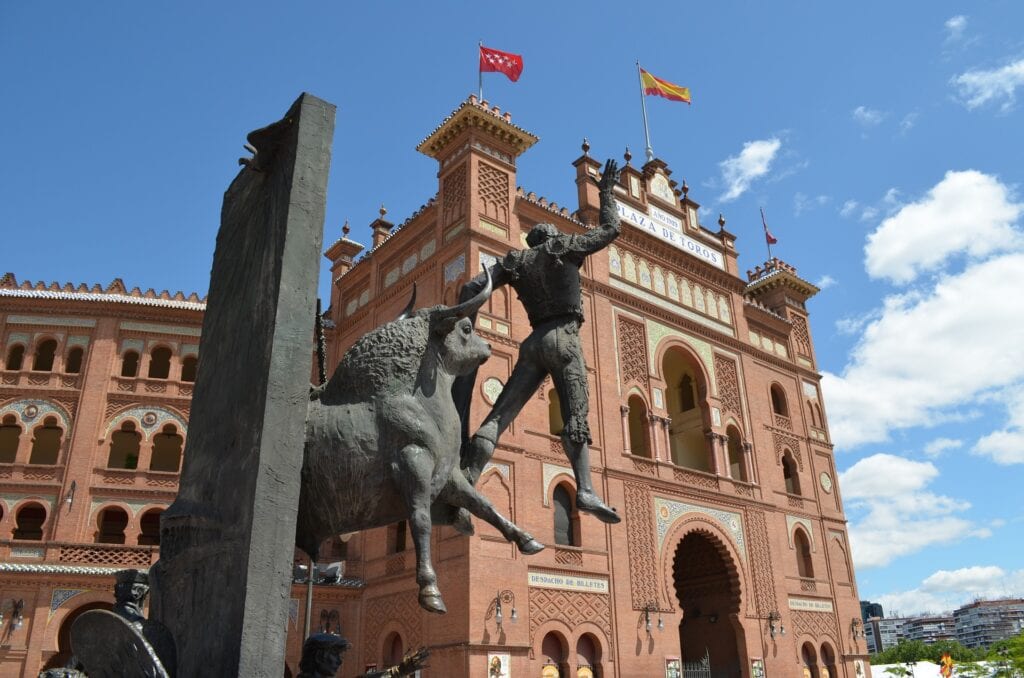
Seville Bullring
Building of the Maestranza Bullring in Seville began in 1758 making it Spain’s oldest Plaza de Toros. The origin of modern day bullfighting on foot (rather than horseback) can be traced back to here and Ronda. It is one of the most charming bullrings in the country and although its capacity is only 12,500, it attracts the top bullfighters. You can watch bullfights in Seville from April (during Seville’s Feria de Abril) through to October. Check the bullfight calendar as they don’t take place every weekend.

Ronda Bullring
The Ronda bullring was built in 1785 and is one of the oldest and most beautiful in Spain. Previously it had been Philip II’s centre for horsemanship training (Real Maestranza de Caballeria). Bulls were used in this training and when one day an aristocrat fell from his horse one Francisco Romero came to his help by using his hat to distract it. The hat was replaced by a cape and modern day bullfighting was born. Romero’s grandson, Pedro Romero, developed all the passes and moves which to this day are seen at a bullfight. He retired in his eighties after killing more than 5,600 bulls without ever being hurt. Thus Ronda is considered the home of bullfighting.

You can visit the bullring in Ronda which houses a small bullfighting museum. The bullfighting season in Ronda is from April to October though fights are quite infrequent. Check with the tourist office next to the bullring.
Bullfighting Tickets
Bullfight tickets vary in price according to their position in the bullfighting arena. The ones in the shade (sombra) are more expensive than the ones in the sun (sol). Some seats are designated as sun and shade (sol y sombra) because they begin in the sun but move to shade as the afternoon progresses. Seats located closest to the bullfight are also more expensive than those near the back. So ones near the ringside barrier (barrera) which are also in the shade are the most expensive.
Buying tickets at the actual arena can prove a major hassle as it is difficult to work out which ticket window (taquilla) you should go to and without a very good level of Spanish it is almost impossible to explain or find out which tickets you wish to buy. Just study the poster of the event in advance to decide where you want to sit then ask for those seats or simply copy the name of the seating area and show it to the ticket seller.
More Useful Bullfighting Information:
- History of Bullfighting: Read about the development of bull fighting from ancient times.
- Bullfighting in Madrid: Madrid’s bullring, Las Ventas is the world’s top venue for bullfighting
- Bullfighting in Seville: Calendar of bullfights in Seville including the April Fair ….
- The Great Manolete: Of all the bullfighters who have died in bullfights, Manolete was the greatest.