
The spectacle of bullfighting has existed in one form or another since ancient days. For example, a contest of some sort is depicted in a wall painting unearthed at Knossos in Crete, dating from about 2000 BC. It shows male and female acrobats confronting a bull, grabbing its horns as it charges and vaulting over its back. Bullfights were popular spectacles in ancient Rome but it was in the Iberian Peninsula that these contests were fully developed. The Moors from North Africa who overran Andalusia in AD 711 changed bullfighting significantly from the brutish, formless spectacle practised by the conquered Visigoths to a ritualistic occasion observed in connection with feast days on which the conquering Moors, mounted on highly trained horses, confronted and killed the bulls.

As bullfighting developed the men on foot, who by their capework aided the horsemen in positioning the bulls, began to draw more attention from the crowd and the modern corrida began to take form. Today the bullfight is much the same as it has been since about 1726, when Francisco Romero of Ronda, Spain, introduced the estoque (the sword) and the muleta (the small, more easily wielded worsted cape used in the last part of the fight).
Bullfighting: The Spectacle
Six bulls, to be killed by three matadors, are usually required for one afternoon’s corrida and each encounter lasts about 15 minutes. At the appointed time, generally 5 PM, the three matadors, each followed by their assistants, the banderilleros and the picadors, march into the ring to the accompaniment of traditional paso doble (“march rhythm”) music. The matadors (the term toreador, popularized by the French opera Carmen, is erroneous usage) are the stars of the show. They wear a distinctive costume consisting of a silk jacket heavily embroidered in gold, skintight trousers, and a montera (a bicorne hat). A traje de luces (“suit of lights”), as it is known, can cost several thousand pounds; a top matador must have at least six of them a season.
When a bull first comes into the arena out of the toril, or bull pen gate, the matador greets it with a series of manoeuvres, or passes, with a large cape; these passes are usually verónicas, the basic cape manoeuvre (named after the woman who held out a cloth to Christ on his way to the crucifixion).

The amount of applause the matador receives is based on his proximity to the horns of the bull, his tranquillity in the face of danger and his grace in swinging the cape in front of an infuriated animal weighing more than 460 kg (1,000 lb). The bull instinctively goes for the cloth because it is a large, moving target, not because of its colour; bulls are colour-blind and charge just as readily at the inside of the cape, which is yellow.
Fighting bulls charge instantly at anything that moves because of their natural instinct and centuries of special breeding. Unlike domestic bulls they do not have to be trained to charge nor are they starved or tortured to make them savage. Those animals selected for the corrida are allowed to live a year longer than those assigned to the slaughterhouse. Bulls to be fought by novilleros (beginners) are supposed to be three years old and those fought by full matadors are supposed to be at least four.
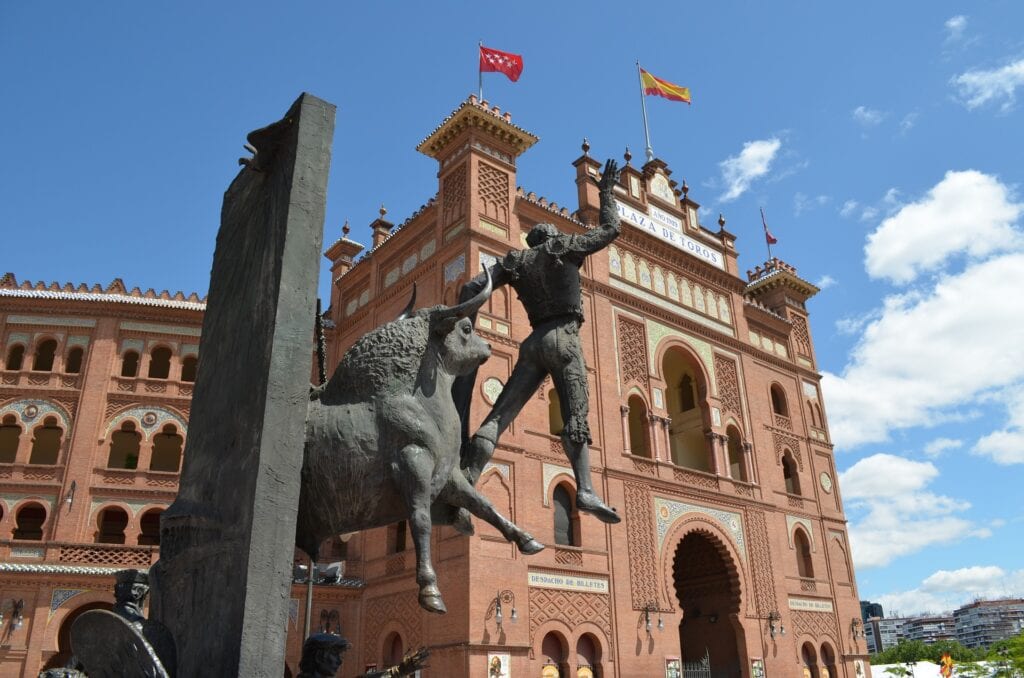
The second part of the corrida consists of the work of the picadors, bearing lances and mounted on horses (padded in compliance with a ruling passed in 1930 and therefore rarely injured). The picadors wear flat-brimmed, beige felt hats called castoreños, silver-embroidered jackets, chamois trousers and steel leg armour. After three lancings or less, depending on the judgment of the president of the corrida for that day, a trumpet blows, and the banderilleros, working on foot, advance to place their banderillas (brightly adorned, barbed sticks) in the bull’s shoulders in order to lower its head for the eventual kill. They wear costumes similar to those of their matadors but their jackets and trousers are embroidered in silver.
After the placing of the banderillas, a trumpet sounds signalling the last phase of the fight. Although the bull has been weakened and slowed it has also become warier during the course of the fight sensing that behind the cape is its true enemy; most gorings occur at this time. The serge cloth of the muleta is draped over the estoque, and the matador begins what is called the faena, the last act of the bullfight. The aficionados (ardent fans) study the matador’s every move, the ballet-like passes practised since childhood. (Most matadors come from bullfighting families and learn their art when very young.) As with every manoeuvre in the ring, the emphasis is on the ability to increase but control the personal danger, maintaining the balance between suicide and mere survival. In other words, the real contest is not between the matador and an animal; it is the matador’s internal struggle.

The basic muleta passes are the trincherazo, generally done with one knee on the ground and at the beginning of the faena; the pase de la firma, simply moving the cloth in front of the bull’s nose while the fighter remains motionless; the manoletina, a pass invented by the great Spanish matador Manolete (Manuel Laureano Rodríguez Sánchez), where the muleta is held behind the body; and the natural, a pass in which danger to the matador is increased by taking the sword out of the muleta, thereby reducing the target size and tempting the bull to charge at the larger object—the bullfighter.
After several minutes spent in making these passes, wherein the matador tries to stimulate the excitement of the crowd by working closer and closer to the horns, the fighter takes the sword and lines up the bull for the kill. The blade must go between the shoulder blades; because the space between them is very small, it is imperative that the front feet of the bull be together as the matador hurtles over the horns. The kill, properly done by aiming straight over the bull’s horns and plunging the sword between its withers into the aorta region, requires discipline, training, and raw courage; for this reason it is known as the “moment of truth”.
Whilst bullfighting isn’t as dangerous as it used to be, thanks to medical care and safety measures, some 534 professional bullfighters have been killed in the ring over the centuries.