
Pablo Picasso was one of the most revolutionary artists of the 20th century, transforming modern art through relentless experimentation across multiple styles. From Realism and Symbolism to Cubism, Surrealism and Neo-Expressionism, his innovations challenged artistic conventions and influenced generations of artists. With a career spanning over seven decades, he produced more than 50,000 works, including paintings, sculptures, ceramics and prints.
This article provides a comprehensive examination of Picasso’s artistic evolution, the cultural and historical influences that shaped his work and his enduring impact on contemporary art. It also explores his deep connections to Málaga and Barcelona, two cities integral to his early development and lasting legacy.
Biography of Pablo Picasso
Early Life and Artistic Formation
Born on 25th October 1881 in Málaga, Pablo Picasso demonstrated remarkable artistic talent from an early age. His father, José Ruiz Blasco, a painter and art professor, provided his first lessons in drawing and painting. Recognising his prodigious ability, the family moved to Barcelona in 1895, where Picasso enrolled at La Llotja School of Fine Arts. Completing the entrance examination in a single day – an accomplishment that typically took students a month – he quickly surpassed his instructors in technical skill.

Although Picasso mastered traditional academic techniques, he grew frustrated with the rigid formalism of academic training. Drawn to emerging modern movements, he immersed himself in Barcelona’s avant-garde community, particularly at Els Quatre Gats café, where he encountered Symbolism, Post-Impressionism and Catalan Modernisme. These influences profoundly shaped his early works and artistic outlook.
Move to Paris and Early Success (1900–1904)
At the turn of the century, Picasso made his first visit to Paris for the 1900 Exposition Universelle, where he was introduced to the city’s vibrant artistic scene. Captivated by the energy of Montmartre, he soon relocated there, sharing a dilapidated studio known as Le Bateau-Lavoir with fellow struggling artists and poets. He befriended figures like Max Jacob, who helped him learn French and met influential artists such as Henri Toulouse-Lautrec and Edgar Degas.
Paris at the time was the centre of artistic innovation, with Impressionism, Post-Impressionism and Symbolism shaping the avant-garde movement. Inspired by these influences, Picasso experimented with new styles while still producing works grounded in Spanish themes. His early Parisian period was marked by dark, expressive paintings, including Moulin de la Galette (1900), reflecting his fascination with bohemian nightlife. However, his artistic outlook darkened after the tragic suicide of his friend Carlos Casagemas in 1901, leading to the introspective and melancholic works of the Blue Period.

The Blue and Rose Periods (1901–1906)
The Blue Period (1901–1904)
Following the suicide of his close friend Carlos Casagemas in 1901, Picasso entered a deeply introspective phase. His paintings from this period, including The Old Guitarist (1903) and La Vie (1903), convey themes of melancholy, isolation and human suffering. Dominated by monochromatic blue tones and elongated figures, these works bear the influence of El Greco and Symbolist art. Many depict beggars, the blind and prostitutes, underscoring Picasso’s concern with social marginalisation and existential despair.
The Rose Period (1904–1906)
A dramatic shift occurred as Picasso’s palette brightened, transitioning to the warmer hues of the Rose Period. Now based in Paris and influenced by his relationship with Fernande Olivier, he depicted circus performers, harlequins and acrobats, as seen in Boy with a Pipe (1905) and Family of Saltimbanques (1905). Though lighter in tone, these works maintained an undercurrent of introspection, exploring themes of performance, identity and transience. His brushwork became looser and he experimented with compositional structures that anticipated Cubism.
The Birth of Cubism (1907–1914)
Les Demoiselles d’Avignon (1907)
Picasso’s Les Demoiselles d’Avignon (1907) signalled a seismic shift in modern art. Influenced by African tribal masks, Iberian sculpture and Cézanne’s geometric simplifications, this radical painting abandoned traditional perspective in favour of fractured, angular forms and multiple viewpoints. Depicting five distorted female figures inspired by prostitutes in Barcelona, the work challenged conventions of beauty and representation, laying the foundation for Cubism.

Analytical and Synthetic Cubism
Developed alongside Georges Braque, Cubism evolved through two distinct phases:
- Analytical Cubism (1909–1912): This phase deconstructed subjects into geometric planes, employing muted colours and overlapping facets to convey multiple perspectives simultaneously (Portrait of Ambroise Vollard, 1910).
- Synthetic Cubism (1912–1914): Marking a shift towards abstraction, this phase introduced collage techniques, integrating real-world materials such as newspaper clippings (Still Life with Chair Caning, 1912), thus expanding artistic possibilities beyond paint and canvas.
Picasso and Surrealism (1920s–1930s)
Although Picasso never formally joined the Surrealist movement, his work frequently aligned with its themes of dreamlike distortion, mythological symbolism and subconscious exploration. Paintings such as The Three Dancers (1925) and Minotauromachy (1935) reflect his engagement with Freudian psychoanalysis, eroticism and violence, resonating with Surrealist ideals.
Guernica (1937) and Political Engagement
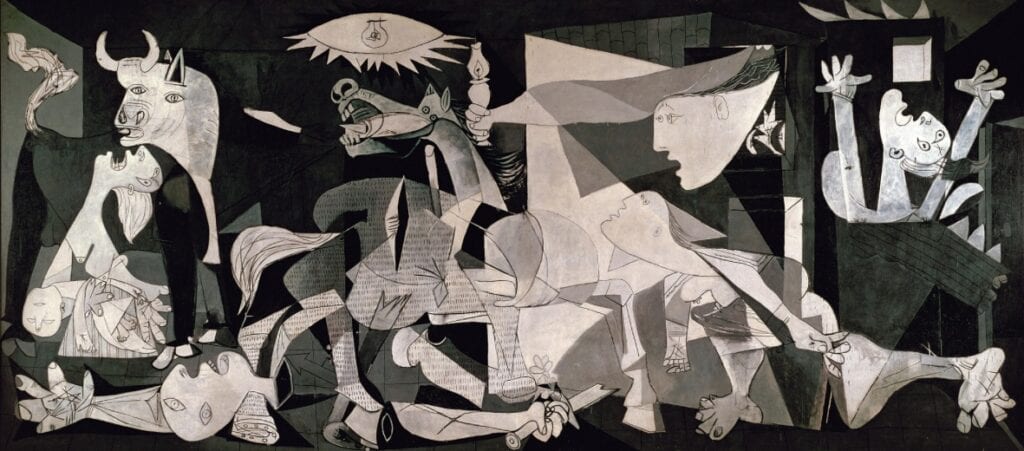
The Spanish Civil War profoundly impacted Picasso, culminating in his most politically charged work, Guernica (1937). Created in response to the bombing of the Basque town by Nazi forces, the painting’s chaotic composition, distorted figures and stark monochrome palette serve as a powerful anti-war statement. Today, Guernica remains an enduring symbol of political protest and human suffering.
Later Years, Final Works and Death (1940s–1973)
Despite his already legendary status, Picasso remained restless, constantly reinventing his approach. The aftermath of World War II saw him turn towards expressive, vivid compositions, such as Women of Algiers (1955), which anticipated Abstract Expressionism. He also embraced sculpture and ceramics, producing hundreds of inventive pieces in Vallauris, where he lived during the late 1940s and 1950s.
His later years were also characterised by an obsession with reinterpreting the Old Masters, particularly Velázquez and Manet, in works such as his Las Meninas series (1957). Even in his 80s, he continued to paint with undiminished energy, creating bold, erotic compositions reflecting his relationship with Jacqueline Roque, his last muse and wife.

Picasso died on 8 April 1973 at his home in Mougins, France, at the age of 91. His passing marked the end of an era, but his influence remained undiminished. Controversy surrounded his legacy – not only due to his artistic dominance but also because of his complex personal life, particularly his often controversial treatment of women. Today, his works continue to command global attention, with exhibitions, record-breaking auction sales and scholarly debate cementing his position as one of the most influential artists in history.
Picasso’s Personal Life and Relationships
Throughout his life, Picasso’s relationships deeply influenced his art, with each muse marking a new phase in his creative output. His first major companion, Fernande Olivier, was by his side during the transition from the Blue Period to the Rose Period, appearing in numerous works from this time.
In 1918, he married the Russian ballerina Olga Khokhlova, whose elegant presence led to a more classical style in his paintings. However, their marriage was troubled and by the late 1920s, Picasso had fallen for Marie-Thérèse Walter, a young woman who became the inspiration for some of his most sensual and vibrant works, including Le Rêve (1932).
His tumultuous relationship with photographer Dora Maar coincided with the creation of Guernica (1937), where her emotional intensity and political awareness influenced his depiction of war and suffering. Later, Françoise Gilot, a young artist, became his partner in the 1940s, but she eventually left him, writing a revealing memoir about their time together. His final companion, Jacqueline Roque, became his devoted wife, appearing in countless late works until his death in 1973.
Picasso’s personal life remains a subject of fascination and controversy, with many of his muses suffering emotional turmoil due to his domineering personality. Nonetheless, his relationships undeniably shaped the themes and intensity of his work, making them integral to understanding his artistic evolution.
Viewing Picasso’s Most Famous Paintings
Les Demoiselles d’Avignon: Housed in the Museum of Modern Art (MoMA) in New York, this 1907 painting revolutionised modern art by introducing Cubism. Its fragmented forms and multiple perspectives challenged traditional representation and paved the way for abstract art.
Guernica: Displayed at the Museo Reina Sofía in Madrid, this 1937 mural is one of history’s most powerful anti-war statements. Created in response to the bombing of Guernica during the Spanish Civil War, its stark black-and-white composition and distorted figures convey the horrors of war.
The Weeping Woman: Found at Tate Modern in London, this 1937 painting expands on the themes of Guernica, portraying a grief-stricken woman with sharp, fragmented features. It symbolises the universal suffering of war, with vivid colours intensifying its emotional impact.
La Vie: Displayed at the Cleveland Museum of Art, this 1903 masterpiece from Picasso’s Blue Period explores themes of poverty and despair. Its melancholic figures and muted tones reflect a deep emotional intensity, influenced by the suicide of Picasso’s close friend.
Girl Before a Mirror: Located at MoMA in New York, this 1932 portrait of Marie-Thérèse Walter is a vibrant example of Picasso’s Surrealist period. The distorted reflection symbolises duality and self-perception, with bold colours adding psychological depth.
La Rêve: Privately owned, formerly in the collection of Steve Wynn, this 1932 dreamlike portrait of Marie-Thérèse Walter is characterised by soft, curvilinear forms and a sensual, abstracted style. It remains one of Picasso’s most celebrated depictions of his muse.
Three Musicians: Two versions exist – one at MoMA in New York and another at the Philadelphia Museum of Art. Painted in 1921, this masterpiece of Synthetic Cubism features three masked figures inspired by Italian commedia dell’arte, blending vibrant colours and geometric shapes.
The Old Guitarist: Housed at the Art Institute of Chicago, this 1903 painting from Picasso’s Blue Period depicts a blind, impoverished musician. Its somber colour palette and elongated figure convey themes of hardship, isolation and artistic suffering.
Picasso Art Museums in Spain
Picasso Museum in Málaga
Although Picasso left Málaga as a child, the city has since embraced his legacy with significant dedication. The Museo Picasso Málaga, housed in the Renaissance-style Palacio de Buenavista, opened in 2003, fulfilling a long-standing effort to establish a major collection of his works in his birthplace. The museum features a permanent collection of over 200 pieces, donated primarily by members of Picasso’s family, showcasing his artistic evolution across various styles, including classicism, cubism and surrealism.
The Fundación Picasso Museo Casa Natal, located at his birthplace in Plaza de la Merced, preserves documents, photographs and personal artifacts related to his early years, providing insights into his formative influences. Beyond these institutions, Málaga celebrates Picasso’s legacy through public art installations, cultural events and educational initiatives dedicated to his work and artistic impact.
Other notable sites connected to Picasso include the Church of Santiago, where he was baptized in 1881, and Terminal 2 of Málaga-Costa del Sol Airport which is named “Pablo Ruiz Picasso” in tribute to the city’s favourite son.
Picasso Museum in Barcelona
Few cities can claim as deep a connection to Pablo Picasso as Barcelona. Though born in Málaga, it was in Barcelona that he honed his artistic skills, developed his early style and immersed himself in the city’s vibrant avant-garde circles. His studies at La Llotja School of Fine Arts and his time at Els Quatre Gats, a hub for Catalan modernists, provided him with a creative foundation that would shape his artistic trajectory.
Today, Barcelona continues to honour his legacy through the Museu Picasso, one of the city’s most visited cultural landmarks. Established in 1963 and located in the historic El Born district, the museum houses over 4,000 works, offering a comprehensive look at his artistic evolution, particularly his formative years. Key pieces from his Blue Period and his groundbreaking Las Meninas series highlight his deep engagement with Spanish artistic traditions. Through its thematic displays and rotating exhibitions, the museum remains a vital source of inspiration for new generations of artists and art enthusiasts.
Beyond the museum, Picasso’s influence is woven into Barcelona’s artistic fabric. His legacy is celebrated through cultural events, temporary exhibitions and ongoing scholarly research. The city’s bohemian energy, which Picasso once embodied, continues to thrive in neighbourhoods like El Raval and La Ribera, where street art, contemporary galleries and modernist architecture reflect his lasting impact.

Picasso’s Legacy and Influence
Picasso’s impact extends far beyond the world of painting. His radical approaches to abstraction, collage and multi-perspective composition influenced countless artists, but his legacy also permeates other disciplines, including literature, cinema and fashion.
Writers such as Gertrude Stein, whose portrait he painted in 1906, were profoundly affected by his fragmented, Cubist approach to form. In cinema, directors like Jean-Luc Godard and Federico Fellini cited Picasso’s reinvention of perspective as a source of inspiration. His imagery appears in everything from fashion – where designers such as Yves Saint Laurent incorporated Cubist motifs – to street art, with Jean-Michel Basquiat and Banksy drawing on his techniques of distortion and symbolism.
Despite his enduring influence, Picasso’s legacy is not without controversy. In recent years, debates have emerged regarding his treatment of women, as accounts from his former partners paint a picture of emotional manipulation and control. This aspect of his life continues to spark discussions on the intersection of artistic genius and personal morality.
Nonetheless, Picasso’s contributions to modern art remain unparalleled. His ability to continually reinvent himself ensured his status as one of history’s most defining figures. His works remain central to the study of art, commanding attention in the world’s most prestigious museums and auction houses, securing his place as one of the most significant artists of all time.
Because Pablo Picasso opposed the Franco regime in Spain and lived in Puerto Rico for this reason, his painting, Guernica, hung in the Metropolitan Museum of Art in New York until Franco’s death.
How very interesting that his painting of his first wife was realistic and after they split up his art became so bazar and abstract. The breakup of his true love had to have had a drastic impact on his emotions and mental health.