
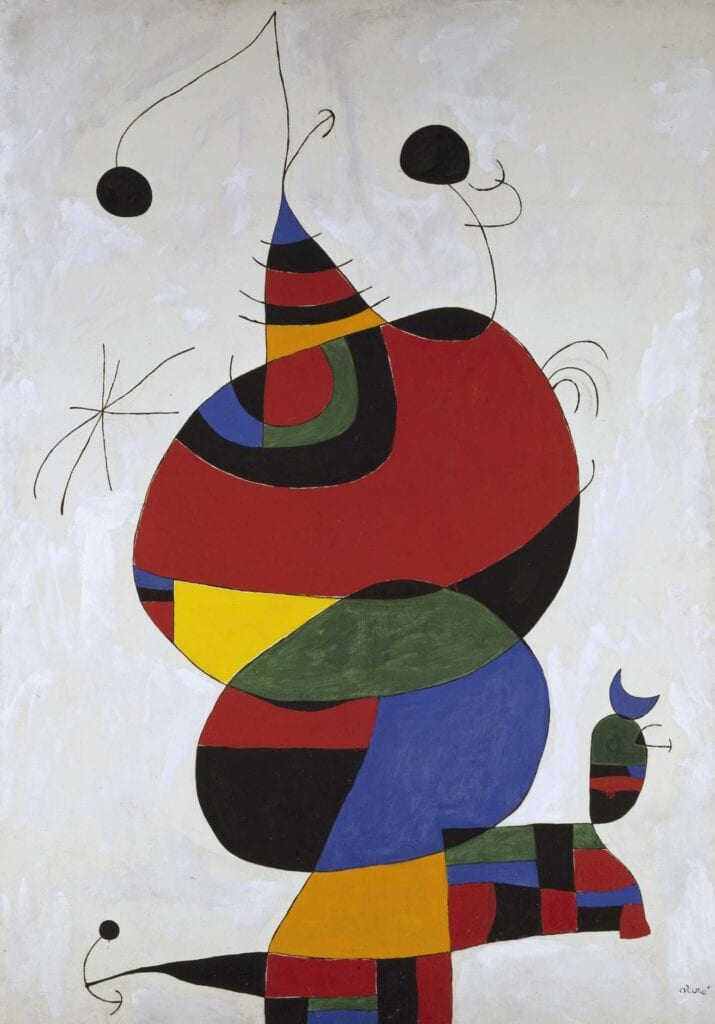
Joan Miró was one of the most innovative and influential artists of the 20th century, known for his unique fusion of surrealism, abstraction and Catalan identity. His paintings, sculptures and prints pushed the boundaries of artistic expression, blending dreamlike imagery with bold colours and a distinct sense of playfulness. This article explores his life, artistic evolution and lasting impact on modern art.
Biography of Joan Miró
Early Life and Training
Joan Miró i Ferrà was born in Barcelona in 1893 to a family of artisans. From a young age, he showed a strong inclination towards art, enrolling at the La Lonja School of Fine Arts in Barcelona at the age of 14. However, his traditional training was at odds with his creative instincts, leading him to experiment with different styles.
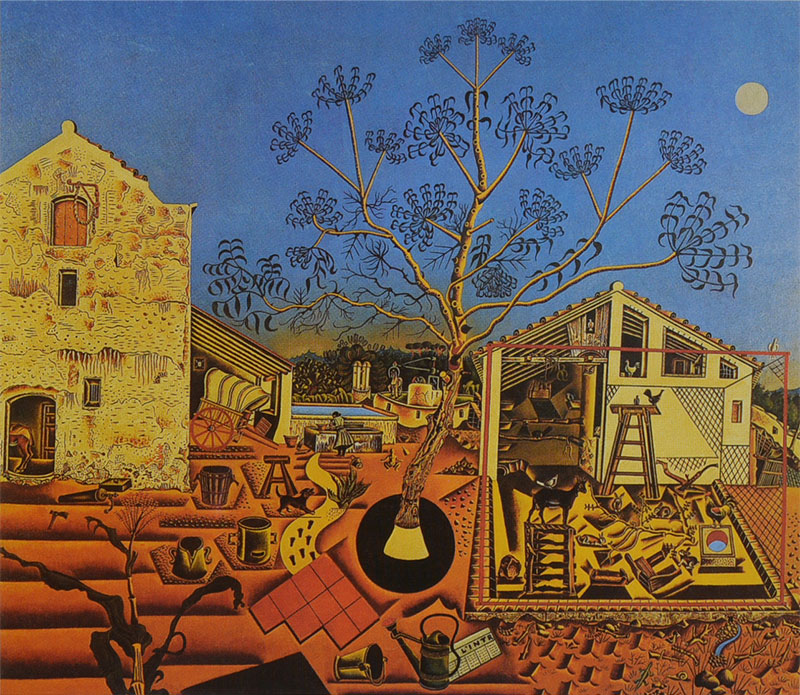
After suffering a nervous breakdown in his early twenties, Miró retreated to Mont-roig, a rural village in Catalonia. The landscape and folk traditions of this region profoundly influenced his art, instilling in him a deep connection to nature and a fascination with symbolism. His early works, such as The Farm (1921–1922), blend meticulous detail with a growing sense of abstraction, foreshadowing his later style.
The Paris Years and Surrealist Influence
In 1920, Miró moved to Paris, where he became part of the avant-garde artistic community. He formed friendships with Pablo Picasso, André Breton and other leading figures of the Surrealist movement. Inspired by the dream theories of Sigmund Freud and the automatic writing techniques of the Surrealists, Miró developed a distinctive artistic language that relied on subconscious imagery and spontaneous creation.
During this period, he produced works such as Harlequin’s Carnival (1924–1925), a vibrant composition filled with whimsical, biomorphic shapes. This painting exemplifies his move towards surrealism, where he abandoned traditional perspective in favour of a freer, more symbolic approach.
Artistic Maturity and Experimentation
By the 1930s, Miró had established himself as a leading figure in modern art. He experimented with different media, including collage, ceramics and sculpture, constantly pushing the boundaries of artistic convention. His work from this period became increasingly abstract, featuring fluid lines and a simplified colour palette that emphasised primary hues.
During the Spanish Civil War (1936–1939), Miró’s work took on a more political tone. His painting Aidez l’Espagne (Help Spain) (1937) was created in support of the Spanish Republic, while his Constellations series (1940–1941), produced in exile in France, reflected the turbulence and uncertainty of the war years.
Post-War Recognition and Monumental Works
Following World War II, Miró gained international recognition, with major exhibitions in New York and Europe solidifying his reputation. He turned his attention to large-scale projects, creating monumental murals and public sculptures that showcased his playful yet sophisticated aesthetic.
Notable works from this period include The Mural of the Sun and the Moon (1958) at UNESCO headquarters in Paris and Personnage et Oiseaux (1972) at Barcelona’s Joan Miró Foundation. His bronze sculptures, often featuring fantastical creatures and abstract forms, further demonstrated his innovative approach to material and space.
Life in Mallorca and Later Years
In 1956, Miró settled permanently in Mallorca, where he built a studio in Palma. The island’s landscape and tranquillity provided him with an ideal environment for creativity, allowing him to focus on his work without the distractions of urban life. His time in Mallorca was highly productive, leading to some of his most iconic pieces in painting, sculpture and printmaking.
He remained prolific until his final years, continuing to innovate with new materials and techniques. He established the Fundació Joan Miró in Barcelona in 1975, ensuring that his work and artistic vision would be preserved for future generations. He passed away in 1983 at the age of 90, leaving behind a vast and influential body of work.
Miró’s Most Famous Works and Where to See Them
Many of Miró’s masterpieces are housed in major museums and collections around the world. Some of his most celebrated works and their locations include:
- La Masia – ‘The Farm’ (1921–1922) is a seminal early work depicting Catalan rural life, now in the National Gallery of Art in Washington D.C.
- Carnaval d’Arlequí – ‘Harlequin’s Carnival’ (1924–1925) is a surrealist masterpiece, displayed at the Albright-Knox Art Gallery in Buffalo, New York.
- El Naixement del Món – ‘The Birth of the World’ (1925) is one of his most iconic paintings, found at the Museum of Modern Art (MoMA) in New York.
- Sèrie Constellacions – Pieces from ‘The Constellations series’ (1940–1941) are displayed in numerous art museums including the Fundació Joan Miró in Barcelona.
- Dona i Ocell – ‘Woman and Bird’ (1982) is a towering public sculpture in Barcelona’s Parc de Joan Miró, exemplifying his later work in three-dimensional forms.
Fundació Joan Miró in Barcelona
Standing on Montjuïc Hill, the Fundació Joan Miró is one of Barcelona’s most important cultural institutions, offering a deep dive into the world of the celebrated Catalan artist. Established by Miró himself in 1975, the foundation was designed to be more than just a museum – it serves as a dynamic space for artistic exploration, staying true to his lifelong passion for innovation and creativity.

The museum houses one of the most extensive collections of Miró’s work, including paintings, sculptures, drawings and textiles that span his entire career. Visitors can see some of his most famous pieces, gaining insight into his evolving artistic style, from early surrealist experiments to his later, more abstract compositions. The collection also highlights his fascination with colour, form and symbolism, elements that define his unmistakable visual language.
Beyond the permanent collection, the Fundació Joan Miró hosts rotating exhibitions that showcase contemporary artists who share Miró’s experimental spirit. The museum itself, designed by architect Josep Lluís Sert, is a masterpiece of modernist architecture, featuring open spaces flooded with natural light that perfectly complement Miró’s vibrant works.
With its stunning hilltop location, breathtaking views over Barcelona and world-class art, the Fundació Joan Miró is an essential stop for anyone wanting to experience the depth and imagination of one of the 20th century’s most visionary artists.
Legacy of Joan Miró
Joan Miró’s legacy extends far beyond the canvas, influencing generations of artists across disciplines – from contemporary painters and graphic designers to street artists who draw inspiration from his bold colours and playful forms. His relentless experimentation and refusal to conform defined a career that spanned surrealist dreamscapes, Catalan-inspired compositions and monumental public works. Yet, beneath the apparent spontaneity of his art lay a profound symbolic language that continues to captivate and inspire. Miró’s work remains as fresh and enigmatic today as when it was first created, securing his place as one of the most visionary and celebrated artists of the 20th century.
Frequently Asked Questions About Joan Miró
Who was Joan Miró?
Joan Miró (1893–1983) was a Spanish-Catalan artist renowned for his surrealist paintings, sculptures and prints. His work is characterised by a unique visual language that blends abstraction with symbolism, often evoking a sense of playfulness and spontaneity. Over his long career, he pushed artistic boundaries, influencing modern art movements and becoming one of the most important figures of the 20th century.
What artistic movements was Miró associated with?
Although often linked to Surrealism, Miró’s artistic journey spanned several movements. Early in his career, he was influenced by Fauvism’s bold colours and Cubism’s fragmented forms. He later became involved with the Surrealists, adopting automatic drawing techniques and dreamlike imagery. Despite these influences, Miró ultimately developed a highly personal style that defied strict categorisation, influencing later movements such as Abstract Expressionism.
What are the characteristic elements of Miró’s style?
Miró’s work is instantly recognisable due to its fluid, organic forms, bright primary colours and playful yet deliberate compositions. His paintings often feature stars, birds, moons and abstract human figures, all rendered in a style that appears spontaneous yet carefully composed. He used delicate yet expressive line work, creating a sense of movement and balance. His works frequently blur the line between abstraction and representation, encouraging viewers to interpret them in multiple ways.
What techniques did Miró use?
Miró experimented across various artistic media, demonstrating his versatility and innovative spirit. In painting, he used oil and acrylic with textured surfaces, sometimes incorporating sand or other materials. He was also a master printmaker, producing intricate lithographs and etchings. His ceramics, often created in collaboration with artisans, brought his playful imagery into three-dimensional form. He also worked on large-scale murals and sculptures, incorporating bronze, wood and found objects. His interest in textiles led to the creation of striking tapestries, further expanding his artistic reach.
How did Miró create his distinctive imagery?
Miró’s visual language emerged from a combination of automatic drawing, structured composition and deep inspiration from nature, Catalan folk art and prehistoric cave paintings. He often started with recognisable objects or figures, gradually reducing them to their most essential, abstract forms. His use of automatic drawing – a technique favoured by Surrealists – allowed his subconscious to guide the initial stages of his work, which he then refined with careful planning.
What do the symbols in Miró’s work mean?
Miró developed a highly personal system of symbols, many of which appear throughout his career. Stars and constellations represent cosmic forces and spirituality, while birds symbolise freedom and the connection between earth and sky. Women, often depicted with exaggerated curves, embody fertility and the nurturing aspects of life. Ladders suggest escape or spiritual ascension, while eyes convey awareness and consciousness. His abstract lines often act as pathways, linking different elements within a composition.
Why is his work considered important?
Miró’s work is significant because of its originality, emotional depth and impact on modern art. He created a distinct visual language that merged abstraction with symbolism, influencing multiple generations of artists. His ability to move fluidly between different media, from painting and sculpture to murals and ceramics, showcased his versatility. He maintained artistic independence while engaging with major 20th-century movements, leaving behind a body of work that continues to inspire.
How should viewers approach Miró’s abstract works?
Rather than looking for literal meaning, viewers should focus on Miró’s use of form, colour and composition. Recurring symbols provide clues to his themes, but much of his work is open to interpretation. His bold use of colour can evoke different emotions, while his playful yet precise compositions create a sense of movement. Titles of his works often suggest ideas or narratives that can help guide the viewer’s understanding. Ultimately, his art is best appreciated with an open mind, embracing its imaginative and dreamlike qualities.
How did Catalan culture influence Miró’s work?
Miró’s Catalan heritage deeply influenced his artistic vision. He often referenced the landscapes of Catalonia, with its rolling hills, Mediterranean light and rustic architecture. Folk art, with its bold patterns and handcrafted qualities, shaped his aesthetic sensibilities. His political engagement with Catalan identity and independence also played a role, particularly during Franco’s dictatorship, when Catalan culture was suppressed. Additionally, he embraced traditional Catalan materials and techniques, incorporating them into his diverse artistic practice.
How did political events affect his art?
Historical events had a profound impact on Miró’s work. During the Spanish Civil War (1936–1939), he produced politically charged works, including the powerful anti-fascist poster Help Spain. World War II and his self-imposed exile in France led to the creation of the Constellations series, a meditation on war and cosmic order. Under Franco’s dictatorship, he navigated political repression by embedding subtle political themes into his work. The later rise of Catalan nationalism reinforced his commitment to his cultural roots, which he expressed through his art.
Where can I see Miró’s work in person?
Major collections of Miró’s work can be found worldwide. The Fundació Joan Miró in Barcelona houses an extensive collection, offering deep insight into his artistic evolution. The Fundació Pilar i Joan Miró in Mallorca provides a more intimate view of his later works. In Paris, the Centre Pompidou features key pieces, while New York’s Museum of Modern Art (MoMA) holds some of his most famous paintings. Spain’s Reina Sofia Museum in Madrid also has a notable collection of his works.
How has Miró influenced contemporary art?
Miró’s impact extends beyond fine art, influencing Abstract Expressionists like Jackson Pollock, as well as modern graphic designers and illustrators. His bold use of colour and simple, expressive forms have inspired children’s book illustrations and contemporary branding. His innovative approach to public art paved the way for integrating large-scale artworks into urban spaces. Additionally, his printmaking techniques have influenced modern artists working with mixed media and experimental printing methods.
Why does Miró’s work remain relevant today?
Miró’s art continues to resonate because of its timeless themes of freedom, imagination and the subconscious. His ability to create work that is both playful and profound allows it to connect with audiences across generations. His influence can be seen in contemporary painting, sculpture, design and public art. Additionally, his belief in artistic experimentation encourages new generations of artists to push creative boundaries.
Was Miró’s work purely spontaneous?
Despite its free-flowing appearance, Miró’s work was carefully considered. He often began with automatic sketches but refined his compositions meticulously. He worked through multiple drafts and experimented with different techniques before finalising a piece. His method combined spontaneity with discipline, resulting in works that felt alive yet deliberate.
Was he only a painter?
No. While painting was central to his practice, Miró explored numerous artistic disciplines, including sculpture, printmaking, ceramics, murals and textile design. He saw himself as a creator rather than a painter, constantly pushing the limits of artistic expression.
Was his work purely abstract?
Not entirely. Although Miró’s work is highly abstract, it retains elements of recognisable forms, often simplified into symbols. His art exists in a space between abstraction and representation, allowing multiple interpretations while maintaining a connection to the real world.


