
From 711 to 997 …
The word Moors derives from the Latin mauri, a name for the Berber tribes living in Roman Mauretania (modern day Algeria and Morocco). It has no ethnographic meaning but can be used to refer to all Muslims, Berber or Arab, who conquered the Iberian Peninsula. These Moors, who were religious fanatics, arrived in Spain in the year 711 and thus began a period of history which would shape Iberia differently than the rest of Europe as the land adapted to a new religion, language and culture. Hispania became a part of the caliph of Damascus which was the capital of the Muslim world.
This Moorish land was known as Al-Andalus and included all of the Iberian Peninsula except for the extreme north-west from where the Christian Reconquest would originate.
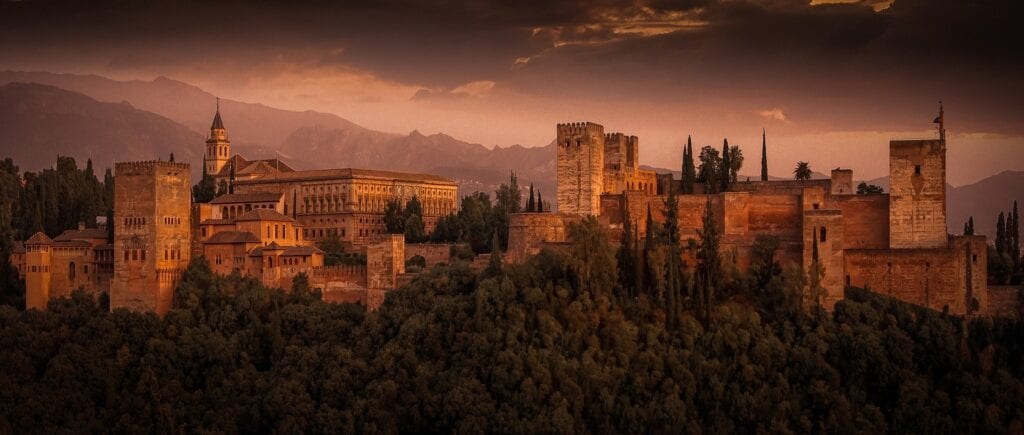
Internal divisions within Moorish rule largely explain why the Moors didn’t conquer the whole peninsula in those early days. Had they done so Spain may well have remained a Muslim state until today. Instead an Asturian mountaineer called Pelayo led a band of Christians to the first victory over the Moors at Covadonga in 718. The reconquest had begun.
Strangely Moorish Spain wasn’t really ruled by Arabs. It is true that many high positions were taken by Arabs but most of the Moors were Berbers. Later Muwallads (converted Christians) together with the offspring of the first invaders became dominant in Moorish Spain. The invaders brought no women so the second generation of Moors were already half Hispanic!
The first 40 years of Moorish rule was volatile and Al-Andalus needed order and unity which came in the form of Abd-er-Rahman who arrived in Almuñecar on the coast of Granada in 755. Within a year he became Emir of Al-Andalus and during his 32 year reign he would transform this land into an independent state which was the cultural light of Europe.
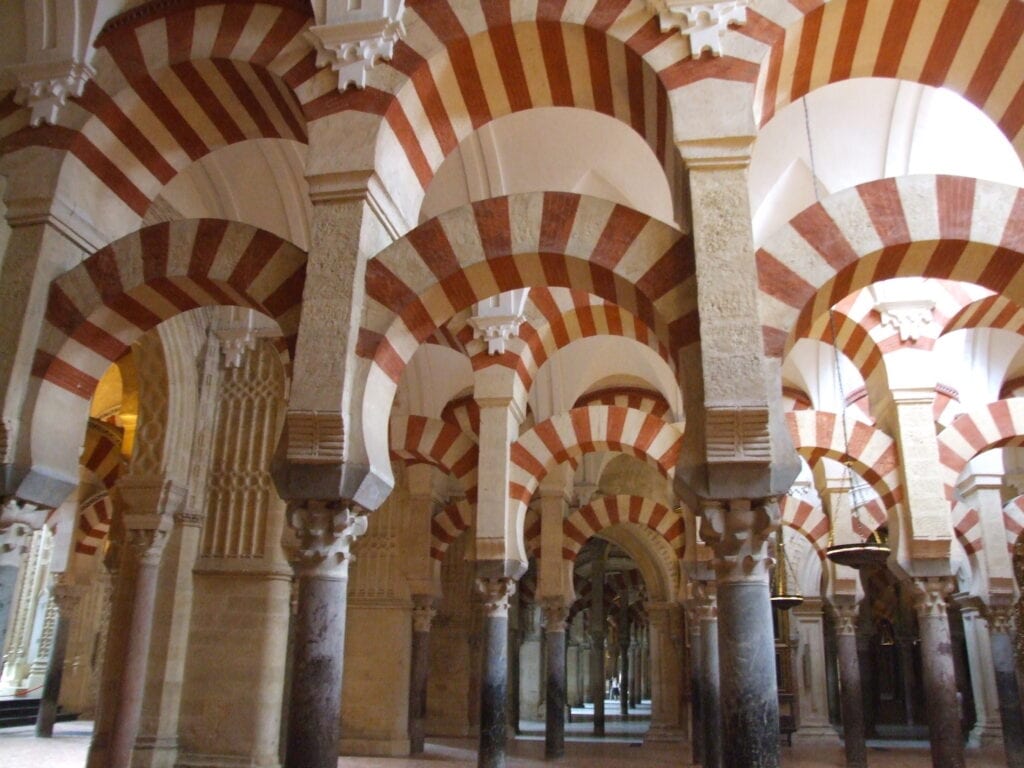
In Cordoba Abd-er-Rahman I founded the Mezquita in 785 when he purchased the Christian section of the San Vicente Church, a place the two faiths had shared for 50 years. The Mosque was expanded to its final glory over the next two centuries. This became the second most important place of worship in the Muslim world after Mecca.
The Moors expanded and improved Roman irrigation systems to help develop a strong agricultural sector. They introduced many new crops including the orange, lemon, peach, apricot, fig and pomegranate as well as saffron, sugar cane, cotton, silk and rice which remain some of Spain’s main products today.
The frontier in the north between the Moors and the Christians was constantly on a war footing and in St James (Santiago de Compostela), the Christians found their inspiration to battle against the Moorish invaders. Santiago became known as “Matamoros” (the Moor slayer) and to this day is Spain’s patron saint.
However, there was still a long way to go before the Reconquest would succeed. In the mid-10th century Al-Mansur appeared on the scene. He led many expeditions into Christian territory over a period of 20 years and in 997 his army captured Santiago de Compostela. They destroyed the shrine and prisoners took the basilica doors and bells to Cordoba where they would be placed in the Mezquita.
Centuries of painstaking Christian advance had been destroyed by Al-Mansur’s daring raid.
From 1010 to 1195 …
Al Mansur died in 1010 which led to the crisis in which Medina Azahara, the city palace of Abd ar-Rahman III, was destroyed by rampaging Berbers. Moorish Spain deteriorated rapidly into violent turmoil. The caliphate ceased to exist and Al Andaluz broke up into 20 taifas and unified rule came to an end. Seville and Granada were the most powerful of these small kingdoms followed by Cordoba, Almeria, Zaragoza, Badajoz and Toledo.
Along the Moorish/Christian frontier castles had been built to protect against Arab attack leading to the area being named Castile. The kingdom of Leon had lead the reconquest until Al-Mansur’s raid on Santiago then Navarra under Sancho III became the key force. Sancho gained control of Castile through marriage and placed his son Fernando on the throne. Fernando then occupied León and became emperor of the Spains. Castile would now dominate the reconquest.
When Fernando I died after taking lands from Valencia to Portugal, power was split between his sons, Alfonso in Leon and Sancho in Castile. Sancho was served by a young knight who would become known as El Cid Campeador. Sancho was murdered and his brother was suspected so El Cid made Alfonso swear under oath that he had no part in the murder. Alfonso became ruler of a united Castile and Leon and a few years later sent El Cid into exile after a dispute. In 1085 Alfonso’s army recaptured Toledo in the first crucial victory of the Reconquest.
This news didn’t go down well in Muslim north Africa and an army of Almoravids (Muslim nomads from the Sahara) was invited by the taifa of Seville to reassert the balance of power. They arrived in 1086 and annihilated Alfonso’s army. Fernando again turned to El Cid for assistance. In 1099 El Cid died and for a few years the Almoravids controlled southern Iberia from Marrakesh.
The tolerant society of the caliphate and the taifas disappeared as the Almoravids persecuted Christians and Jews. Another fanatical group, the Almohades, came from the Atlas mountains of Morocco and were natural enemies of the Almoravid desert tribes. They conquered Marrakesh then invaded Al-Andalus to again unite the region under one Muslim regime. These Almohades ordered the destruction of all churches and synagogues forcing Christians and Jews to swarm to the north.
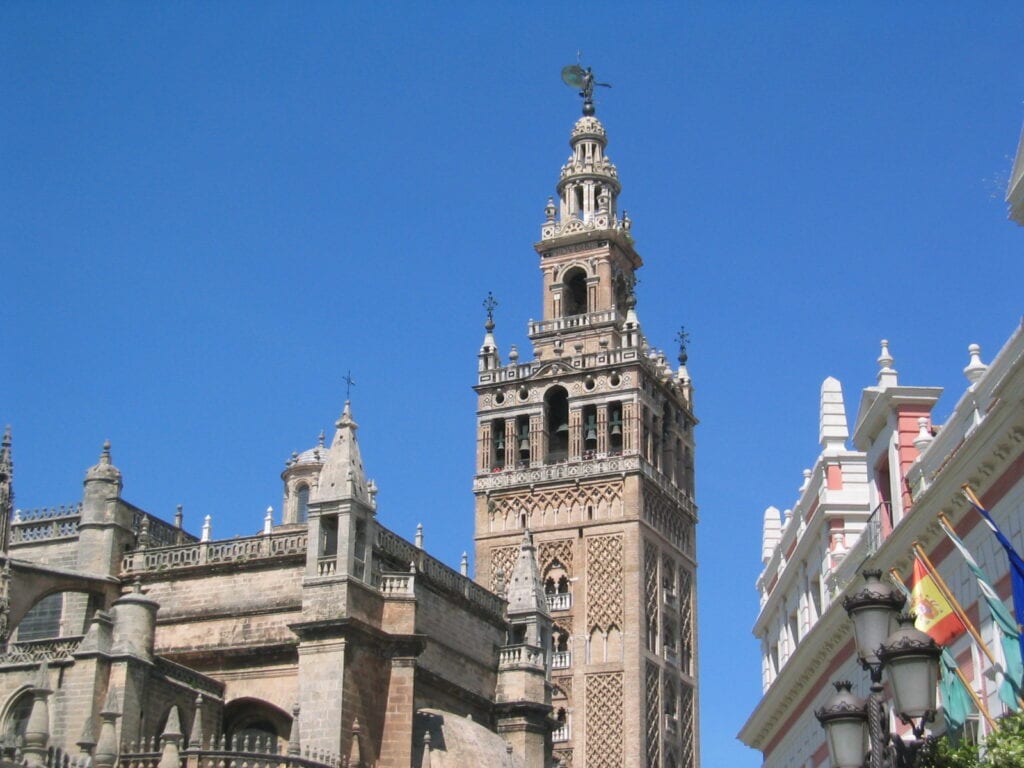
In spite of this fanaticism, a period of great cultural achievement occurred under the Almohades which was the brightest period between the caliphate and the glories of Granada centuries later. The minaret of the Seville mosque, La Giralda, was built during this period with wide ramps all the way up the tower which allowed the sultan to ride his horse to the top.
During the early reconquest the Christians spent too much time fighting amongst themselves. In 1195 the Christians were heavily defeated at Alarcos and from then on decided to cooperate against the Almohades, even more so when the pope called for a crusade against these invaders.
From 1212 to 1492 …
In 1212 a united army of Spanish and European soldiers utterly destroyed the Almohad army at Navas de Tolosa, an event which marked the beginning of the end for Moorish Spain. Fernando III (‘the saint’) captured Cordoba in 1236 and reconsecrated the mosque as the cathedral of Cordoba. He then made captured Muslims carry the bells, stolen by Al-Mansur two centuries earlier, back to the cathedral in Santiago.
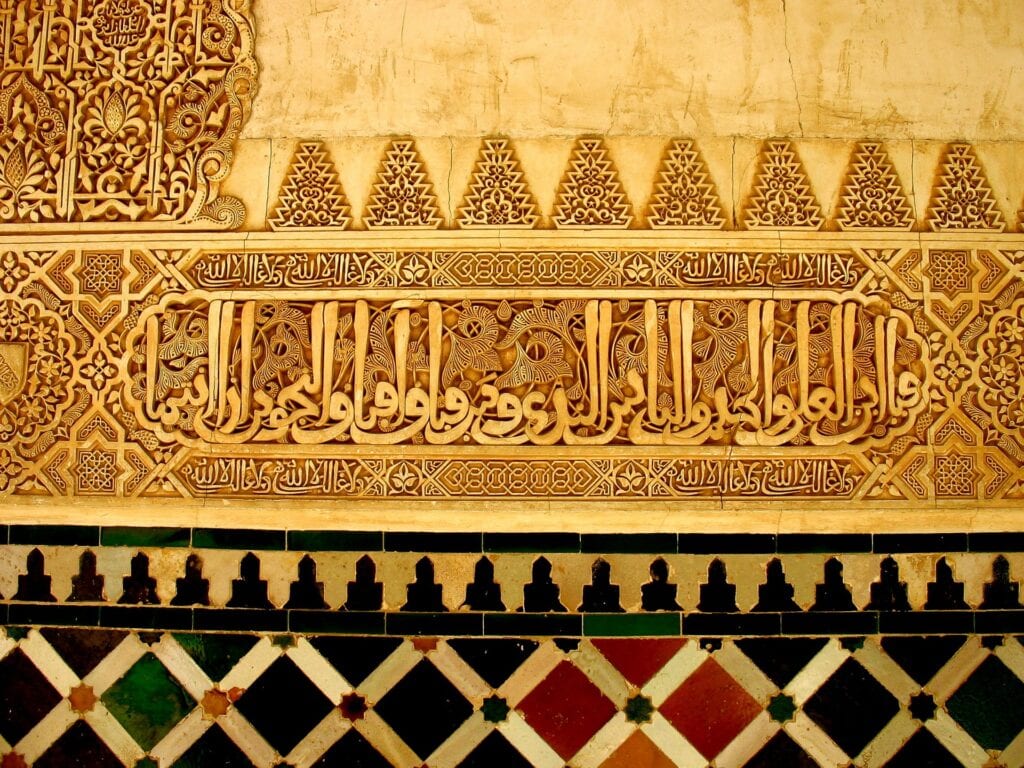
The ruler of Granada, Mohammed ibn-Alhamar, saw what was happening and approached Fernando to propose that in return for cooperating in the conquest of Muslim Seville, Granada would be granted independence as a subject of Castile. Fernando agreed and took Seville. On returning to Granada the embarrassed ibn-Alhamar announced “there is no victor but Allah” which can be seen inscribed all over the Alhambra Palace.
Many writers refer to Moorish rule over Spain spanning the 800 years from 711 to 1492 yet this is a misconception. The reality is that the Berber-Hispanic Muslims inhabited two-thirds of the peninsula for 375 years, about half of it for another 160 years and finally the kingdom of Granada for the remaining 244 years.
When Fernando III died the reconquest seemed to die with him and the deal struck over Granada would last for another two centuries. In 1479 the merger of the kingdoms of Castile and Aragon under Los Reyes Católicos (Fernando and Isabella) would soon lead to the fall of the kingdom of Granada and the end of Moorish rule in Spain.
The town of Santa Fé lies just outside Granada on the road to Malaga. It was set up in 1491 as a base camp from where to conduct the final conquest of Moorish Spain. The town represents the birthplace of modern Spain and it was here that Columbus received permission to begin his great voyage.
The kingdom of Granada included modern day Granada, Almeria and Malaga. Its rulers, the Nasrid dynasty, had retired to a pleasure seeking existence within the confines of the Alhambra palace. Jealousies stemming from the harem were the source of instability of Moorish Spain and would ultimately be influential in the fall of Granada.
Within the harem various sons could be born to different mothers each with equal rights to the throne. Granada was split between the supporters of Mulay’s wife, Aixa, and her son Boabdil on one side and a Christian slave called Isabel de Solís on the other. Isabel converted to Islam whilst in captivity and took the name Soraya. Civil war ensued when the sultan chose Soraya over Aixa and her son. Los Reyes Católicos couldn’t believe their luck as Granada slowly self-destructed. Aixa’s followers gained the upper hand and Mulay fled to the protection of his brother who was governor of Malaga.
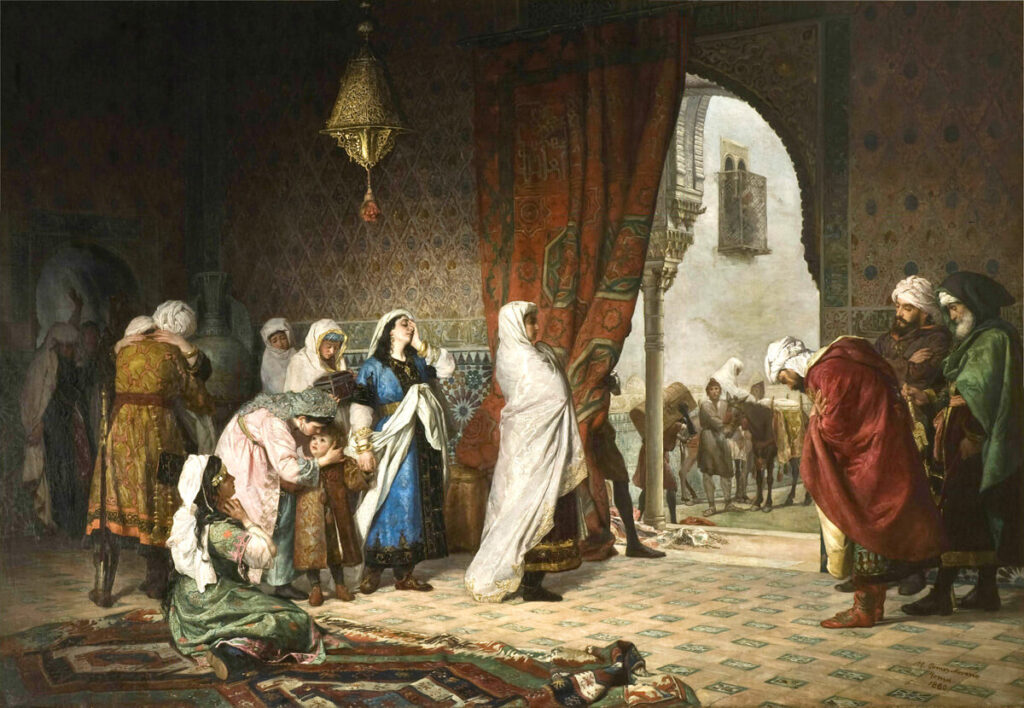
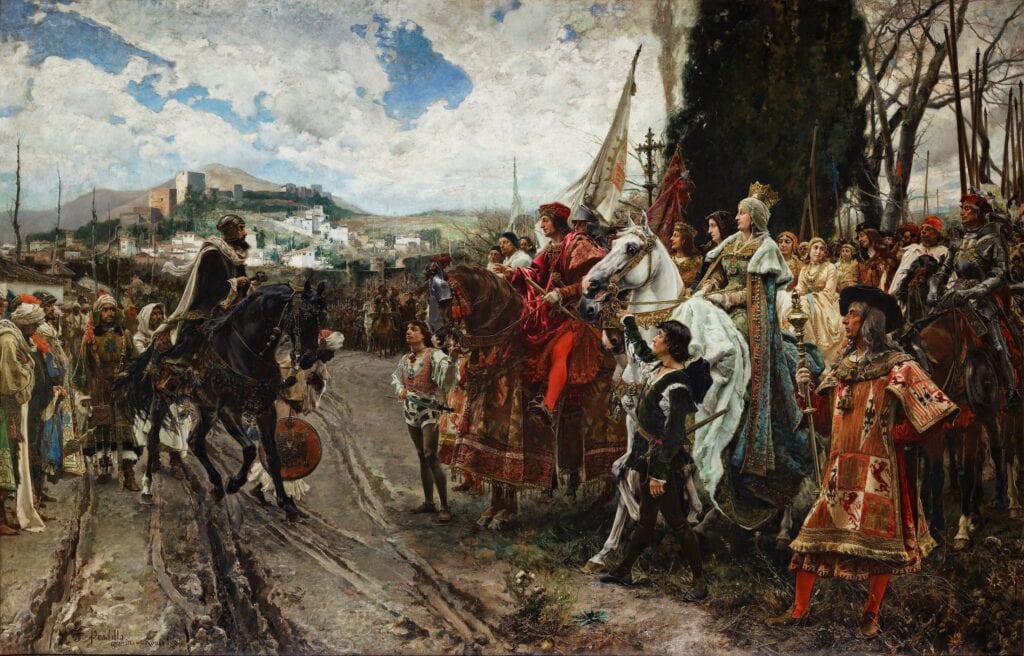
Boabdil was captured and made a deal with Fernando whereby he promised to surrender Granada once his father and uncle were vanquished. Malaga fell in 1487 and shortly after Almeria was captured but Boabdil refused to surrender Granada setting the stage for a final invasion. Rather than attack, Fernando chose to blockade Granada. After months of stalemate and negotiations Boabdil surrendered, in return for 30,000 gold coins, part of the Alpujarras mountains to the south of Granada and political and religious freedom for his subjects. On January 2nd 1492 Los Reyes Católicos marched into Granada and the last stronghold of Moorish Spain came to an end.
Moors were/are Black, Africans. Period. And they were NOT fanatics. They were organized with a rich culture that has been “scrubbed” away like most of African history throughout the world.
negroes were used as slaves and servants, they are depicted in paintings this way.
Show me in Paintings where the African Moor was a slave in the paintings? White Supremecy loves to denounce the African.
https://www.youtube.com/watch?v=NqgKHiOBwGo
http://moorishsociety.com/tag/moorish-paintings/
The Moors ruled the Iberia peninsula for over 500 years bringing art, science, geometry, and philosophy from North Africa and the Near East. They were Berbers, and spoke Arabic. The “blackness” of the term Moor became synonymous with anyone from Africa or the Ottoman Empire in Europe during that time and the centuries thereafter.
It’s in writings and literature such as Othello, the Moor of Venice, or Don Quixote by Cervantes. Yes, there were slaves, and they may have been called Moors, but Moor was specifically Islam and specifically Arabic. Not all Moors were slaves, and not all slaves were Moors. Eventually term meant anyone not of pure European descent, especially coming from Africa or the Near East (Persia, Turkey, Egypt, Jordan, etc.)
I’m just back from Morroco and they will proudly tell you that Berber are not Arabs and they speak Berber not Arabic.
They were also invaded by the Arabs however and converted to Islam.
Forcible conversion, of course! Islamists were really the original apostates. It is laughable to hear quasi illiterates – sword in hand – forcing those unfamiliar to recite passages from their confused writings by their chief illiterate. Was this 7th century 63 yr old man suffering from a brain malignancy? Is it justice to behead someone who can’t fathom the gobbledegook? These “illuminati” were as illuminated as a spent lightbulb.
excellent comments – and didn’t they preserve many of the classics that christians considered to be pagan?
The Slavs or the Slavic people of Europe were the first “slaves” and that’s were the name “slave” comes from… the word slave comes from the word Slav or Slavic … one must study Etymology (study of word origins) to come to certain level of understanding when studying history… http://www.etymonline.com/index.php?term=slave
I think you’d be far better referenced in your idea of Slavic = Slave by reviewing “what are Slavic countries”. If we use your analogy then only Yugoslavians would be slaves.
Check out the biblical Old Testament. To be a Slave, in many cases, was literally a job although a galley slave wouldn’t have been my forte. But slaves were valuable and good, loyal slaves held in high esteem by their masters. St. Paul letter to Philomon is about an escape slave who was converted but Paul knows he can’t keep him because his owner had not freed him.
SO, no, slaves came in all sizes, faiths, colors, languages, and countries. Next to prostitution, it is probably the 2nd oldest trade.
Yes, the Moors are black and most of the Moors are here in America. The person who wrote this blog left out the fact the Moors were African.
Not sub Saharan though. Big difference. Sub Saharan can’t even feed themselves let alone take over a country. Plus the kings of sub Saharan countries sold their captured enemies into slavery which was a business that kept the kings very wealthy until Victorian England ceased and the states followed shortly after. The more you know!
“Sub-Sahara had numerous great civilizations/Empires. Timbuktu was one of them and was located in West Africa and was once called the learning center of the world they had libraries and were knowledgeable in mathematics, science, and astronomy. Also, today approximately one million ancient manuscripts were discovered which were written by West Africans because they were hidden by African people who were afraid they would be destroyed by those who had colonized their countries. Today these manuscripts are being deciphered by black Africans because they are the only people who can read the manuscripts.
Timbuktu was a center of learning in West Africa well before the European Renaissance; if my memory is correct, it is located in the land now known as Mali. It was Islamic. My recollection from history courses is that most learning and culture west of Asia was Islamic during the Middle (or “Dark”) Ages, when European culture was virtually non-existent and sub Saharan Africa was composed of tribes, not nations in the modern form. Islam had spread across North Africa within, I think, 2 centuries (or less) of the Prophet’s death. Most Africans farther south followed traditional religions which we would regard as superstitious, and whose leaders were “medicine men.” I was a decent student, but I’m almost 70 and my memory is not as perfect as it was then. I don’t remember how Islam travelled to West Africa, but there was extensive trade, notably in salt, between the Saharan and Sub Saharan peoples, so that is one possible vehicle for its spread.
You have this thing about saying moors were black. Lots of them were black. maybe all of them. I dont think Spain was not ruled by black Moors. I’m not saying this because I am racist, I’m just saying than judging by how Spanish people look, there is little black ancestry.
I lived in Spain 5 years and saw “The christians and the moors”, a festival that happens every year. The Moorish warriors are black. Not just kind of black, I mean these guys had traditional military costumes that are straight out of Africa.
But if you think the age of enlightenment in Moorish Spain was due to SKIN COLOR, you are wrong. Where are the half black offspring, where is the influence of black africa in the genome of the Spanish people?
Take a look at the Caribbean. Take a look at Cuba. THERE you can see the ancestry of africans. They didn’t even conquer but there is an obvious black heredity.
And why would warlords from Africa with little in the way of written culture and little in the way of science be the reason Al-Andalus had a golden age?
I don’t believe it was because of islam, it was because the people of the iberian peninsula were at the heart of civilization, and the border of cultures. Islam is not a catalyst for science and invention but I think that with the conquest of Spain, it’s influence created something special for a time.
Does that justify the slaughter of spaniards and the rape of their women? History is ugly.
The Egyptians were not black africans either, i know that pisses you off, but its true. For some reason Africa has struggled to build a civilzation that can compete at the level of the west or the east. Africa is ruled by f****** warlords for f**** sake.
What about the North African slave trade? The selling of human beings at a market was invented by the north africans. You telling me they were black?
Anyway I don’t know why I am replying to you, but get over your fixation on skin color and do something positive in the world.
You said that “Islam is not a catalyst for science and invention,” but don’t forget that even the great civilization of Rome was adding sums using Roman numerals until they were taught to use Arabic numerals. This knowledge may also have been the source of science and invention in Al-Andalus.
It is commonly believed that the race of ancient Egyptians was the same as that of neighboring African countries – Sudan, Eritrea, Ethiopia, Libya. They are racially mixed people, but certainly principally African, as is the language and culture.
Berbers do not identify as Arab. Berbers range in color as do other north African peoples. Quora has analyzed the Berber genetically as mixed – https://www.quora.com/Were-the-North-Africans-known-as-Moors-black-Why-or-why-not
As far as black African genes in Spain, even Wikipedia admits “recent genetic studies conclude that significantly higher levels of admixture exist in areas of the Iberian Peninsula than in the rest of the continent.”
Ancient Egypt was comprised of mainly Semites with later only minor admixture of Berbers AKA Nubians in the south. The royalty, nobility and priestly elite were never at all comprised of such until a Nubian Queen ruled Upper Egypt for a time. Again, Nubians were NOT blacks. Blacks, as we know them today, did NOT exist in Africa until after the late Roman Period when the remanats of their failed experimental gorilla army were offloaded into Arabian Peninsula then driven INTO Africa by the Bedouins & Arabs residing there.
To answer the question “where is the black ancestry in Spain?”. It is very small because the Moors were given the option, as were the Jews, to either convert to christianity or be exiled or killed. about 80% of them chose exile and went headed back to muslim occupide northwest Africa. This migration began in 1501. In 1502 the transAtlantic slave trade began. So, all that black ancestry your wondering about got shanghied in the Med by Spanish and Portuguese merchants and sold in the Americas.
Just because they were African doesn’t make them black.the Sahara was the big divider between Northern Africa and subsharan africa.you can see the difference in the physical and genetic make up in the people’s even today.there may have some mixing over hundreds or even thousands of years but minimal.
The Moors are North Africans, not sub-saharan africans. Algerians and Moroccans are North Africans, and that was mentioned in the article.
Arabs not black !!!!!!!!!
As the blog points out, the term Moor shares its origin with Mauritania. It referred to Muslim peoples of various West Asian and North African origins, with a range of skin tones. The blog correctly describes Al Andalus as the “cultural light of Europe” at the time and the Moorish achievments in culture and science are well known. This is hardly scrubbing away. The idea that most of the Moors are in the USA is a new one to me. What is the basis of this assertion?
Moors are/were NOT “Black”…Peoples in NORTH Africa arn’t ‘black”, i.e. ‘negroid”…hence the term “Black Africa” for the tribes/peoples in the Middle and South of Africa.
Go visit, see for yourself!
Some people have seen Africans from North, Middle and South of continent, and many people from the North are clearly mixed with “black Africans” or “negroids”. There are even significant “unmixed” populations, particularly in in the South. Didn’t you see them, or did you forget to mention them?
That mixture and origin is also reflected in the DNA of North Africans. And since you have plagiarised the research of Deidra Ramsey McIntyre, an American who researches North Africa, you should not use twist her findings to promote your ends. She clearly states, from her research, that the Moors were “black”.
Also the peoples in Middle and South Africa aren’t one identical lump. There are 100s of ethncities in Africa. Go visit, see for yourself.
For an accessible, rich and balanced overview, see the documentary series “The Ascent of Civilisation” ( 2016) The last of the documentaries discusses the Ottoman Empire, and how with the final period of the reconquest of Spain, important libraries were aquired, and their intellectual riches assiduously translated from Arabic and Greek, the ‘Translator Movement’, leading the Renaissance period. Even the use of perspective in Italian painting, an important innovation, came from Arabic scholarship in optics.
When I went to school, none of this was acknowledged, and the Moors were just called ‘Infidels’. May I say that the writer of this article still seems fired with that old rivalry.
I agree that they were not “fanatics” (you can tell whoever wrote that nonsense was biased), but they were NOT black Africans either. Some were, but the vast majority were Berbers with an Arab minority.
Yes, indeed the Moors the good and the bad were not fanatics. They brought culture and civilization, cultur, universities, farming methods all to a people still in the Dark Ages. A good reference book: Golden Age of the Moors and They Came Before Columbus: The Afrikan Presence in Ancient America both by the Late Dr Ivan Van Sertima, (founder/publisher of Journal of African Civilizations).
They were not fanatics??? Why else did they cross the Gibraltar Strait with an army of 10000 soliders?
No they weren’t. Unless you define fanatics as any civilization that attempted to expand or conquer parts of the world, no they weren’t. Hint: that list would include basically all the great rulers in history that we know today. Christians are more fanatical than Muslims, or sorry, I mean 98% of Muslims. Look at the U.S., Europeans crossed the Atlantic Ocean only to nearly exterminate its native people and steal all their land.
It’s also a misconception to think the so-called “Dark Ages” were devoid of learning. There were monasteries busy transcribing Greco Roman texts while Irish monks were spreading Western civilization. Europe wasn’t sitting there waiting to be enlightened by Muslims. This is a typical apologist fantasy, politically motivated by leftists.
The Moors were Black. Why debate this fact the museums in Spain show that the moors were black. in addition, slavery didn’t start until 1501 when the pope authorize it.
Shaw,
Slavery started when one tribe won over another!!
Basically when people started too live in encampments and grew their own food, made their own wears, this caused envey in other Tribes, So let’s go kill them and take their stuff! and who we don’t kill we get them to do our work, and use their women to increase our Tribe!
Ta Da Slavery!
No the Negros weren’t/ aren’t Moors apart from Slaves and the decedents of slaves. Also just because you say “period” at the end of your statement doesn’t necessarily make it true. You also don’t understand the difference between racism and reality. Racism is wrong but Afrocentrism is wrong too because it’s also racist. It came out of jealousy, insecurity and anger and became an excuse to teach therapy instead of reality and to accuse anyone who would disagree with it as a racist. Even Moroccans on here are saying they weren’t negro, so that typical accusation of a white racist doesn’t fly here. Afrocentrism often uses lies, photo shopping and misinterpretations especially when it comes to ancient Egyptian and Mooring history. I have even seen Afrocentrists send me photo shopped images of things in Egypt which I’ve seen with my own eyes there, and I therefore have photographic proof that they are lying. Be proud of your West African roots such as the Nok and I go tribes instead of stealing the culture of others and blaming all your problems on others.
Todays Moroccans are late comers to the area. The moors were Black Africans. look on google. And look on images.
They wete NOT “black” (Sub-Saharan). They were Berbers, who can look quite dark but are of a different ethnicity than Sub-Saharan blacks.
Ivan Van Sertima was an Afrocentrist racist liar who had a number of scholars refute and criticize his findings and claims and many publishers would not publish his books including the one claiming the lie that negros had contact with the Americas prior to the Atlantic slave trade. These were consequences on account of the fact that he often left out and ignored certain historical findings and evidence while distorting it. The Universities the Arab and Berber Moors had created were more religion based. If anything it was Arabs, Asians and Europeans who brought the Negros out of their dark age.
mike is ignorant…what were blacks before they were enslaved?? know your history, because you see very small minded.
They were largely a tribal society that used spears and often lived in mudhuts as well producing art such as pottery.
Rico,
Which Mike you talking about?
What were native people before they were captured by their own trible enemies and sold into slavery to the Belgians? Just normal people going about their day to day lives, untill hell came calling!
The “Moors” in the Iberian Peninsula came from Northern Africa as the articles states. They most likely had many different skin tones, to be fair, but generally were not of the same skin tone as say, someone from present-day Zimbabwe. They were “fanatics” in the sense that the conquering of the Iberian Peninsula was part of a Jihad–a holy war by definition. They conquered many lands to spread their faith: Islam. Their history has never been forgotten completely in Spain as their architecture, art, culture, societal norms and even language (most words that being with “al” in Spanish come from Arabic) are present in many places in Spain (I would imagine the same is true for modern-day Portugal, but I am not familiar with Portugal). These have morphed through the centuries, of course, but their contribution to Spanish life is not forgotten. It is impossible, really after having a 700-year presence in Spain. By the same token, the Christians who started the “Reconquest” of the Iberian Peninsula were also “fanatics.” They wanted to spread their faith and waged a holy war to do so which extended to the Americas. Spain would not be Spain, and Spaniards would not be who they are without the immense contribution of the Islamic people(s) who lived there for centuries. There are ignorant people everywhere, but many Spaniards value their history–all of it. Take a trip to Andalusia some day, if you haven’t, to see the splendors of the Cordovan Caliphate and marvel at what was taken to the Iberian Peninsula. Truly amazing.
The Muslim rule of Spain was started by the Ummayads and Tariq bin Zaid was sent from Damascus with an army from the east Syria Arabia and Egypt, at no time were there black rulers of Spain. It was the Arabs and Berbers who spoke the Arabic and Shilha language of the Berbers who are an Asiatic people not negroid sub Saharan. Look at the Mosque of Cordoba, all scriptures are in Arabic, architecture is Persian, all science came from the east during that period. Paper from China was introduced in to the Muslim caliphs of Mecca during the second caliph Umr when he sent a delegation to China, silks from Asia mathematics algebra alchemy Persian. Blacks were the slaves or converts within the ranks. No black sub Saharan DNA in Spain look at the facts… Arabs were slavers even presented blacks as gifts to the Chinese. I don’t really know why black sub-Saharan Americans make such claims as even West Africans don’t…
Berber is a Romanized name given to Africans in a derogative way to say Barbaric.
Many people loosely use the word Arab when most of the people who speak Arab did not come out of Arabia.
Also for someone to say that Blacks did not rule Spain is stupid and uneducated because if you research “Arabs, Persians and so-called Berber” have Negroid blood like Ethiopians. Go look up Babylon ins and Assyrians, they are descendants of Cush and many over time blended with Asia tic groups called Shem or Semitic including Jews. Also as Jews were conquered by other European nations they also mixed in like the Moors. These groups have been around for centuries so how could some be so prejudice and degrading to think that Spain wasn’t ruled by Black people. The so-called Spaniards or Iberia which you should look up Hibernia is linked to other Celtic groups like Ireland and Scotland . The article above greatly supports that the offspring are Hispanic meaning a mixture of Morris blood and Spaniard.
“Also for someone to say that Blacks did not rule Spain is stupid and uneducated because if you research “Arabs, Persians and so-called Berber” have Negroid blood like Ethiopians..”
“Stupid and uneducated”? Please, if you lack facts, don’t bore with low-blow , irrelevant insults.
Firstly, genetically Arabs and indigenous North Africans are not gentically the same even if they may phenotypically resemble today. Indigenous North Africans or the Berber (which consist of many different ethnic names from Taureg, Zenata, Kabyle, Toubou, etc.) are Africans with men primarily in Haplogroup E (like the vast majority of Africans except for those of older African strands such as the Khoisan). The primary male Haplogroup of Arabs is J which is a recent “out of Africa” genetic shift.
However in terms of phenotype one can be phenotypically black and be genetically Arab and be mistaken for “sub Saharan African.” We know this because there are still genetic Arabs who are phenotypically black and the earliest literature by Arab Historians discuss a basic race conflict in the Eighth Century CE in terms of Arab identity based on skin color with one side arguing to be a true Arab one had to have black skin. Iraqi author Al-Jahiz (778-868 AD) wrote of the black skin of the Prophet Mohammad’s family as did Iraqi poet Ibn Al-Rumi (836-896 AD). Al-Jahiz was a black Arab. British historian Bertram Thomas, quoting anthropologist Arthur Keith, classified the oldest remains of the Arabian peninsula in his book “The Arabs” as “protonegroid.” All of this remains consistent with the early Greeks and Romans who called everyone who was black “Ethiopian” as they did with various Near East ethnic groups. In fact, the Greeks called the Libyans “Ethiopians” as well.
Which brings us to the indigenous North African population grouped under the name “Berber.” Indigenous North Africans were at the time of early Greek and Romans…. “nigri” (black) “adusti” (scortched) and “maurus” (black) as adjectives for the indigenous populations of North Africa. By the time of Moorish Spain, all the eyewitness accounts of invading Arab and Berber North Africans physically described them as “black as pitch,” “nothing white save their teeth,” and even “black as a cooking pan.” That is from the writings of Alfonso of Aragon’s “Cantigas de Santa Maria” and Charlemagne the Franc’s “Chanson de Roland” and both works had illustrations in which Moors/Saracens are shown as “black sub Saharan Africans.” Both those works were from the 12th Century or earlier. Not to mention the mural in Pernes, France, of the Saracen (read: Arab) Ysore the Giant being slain by a javelin to the throat by the French William of Orange. He is indistinguishable “black sub Saharan” even though he was a Moorish ruler hailing from Portugal and making attempts to keep hold of Sicily. So typically to be North African historically one would be black which is why the oldest mummified remains of a Libyan child is a black child.
The reason for the coastal change of North Africans has to do with invasions from Europe and Asian, the enslavement of (primarily) white women from Europe in the slave trade that was at its apex during Moorish Spain but most likely did not begin then, and migration.
Often the difference between darker hued Berbers and lighter hued Berbers is where their mothers originated. There is even a large percentage of Saami (Norwegian) mtDNA among some coastal Berbers and even Berbers who are mostly Western European on both sides of their family. Inland Berbers are African on both sides.
While it is true that Berbers and Arabs enslaved sub Saharan women for the same reason they enslaved European women, originally the Berbers and some of the Arabs were already black and indistinguishable from Sub Saharans from the onset.
Herodotus is quoted as describing various Libyan ethnic groups and how they different from one another. He also compared them to “Eastern Ethiopians” (who could have been people from the Horn of Africa or the Near East or India since Herodotus called them all “Ethiopians’). Of the Libyans, he wrote: “For the eastern Ethiopians have straight hair, while they of Libya are more woolly-haired than any other people in the world.” So from the ancient Greek perspective, the ancient Libyans (indigenous North Africans had wooly hair and black skin (since that would be the reason for a comparison to Ethiopians versus say Scythians who would have straight hair as well.)
Berbers are referred to as black or brown in some old European texts
Europeans used these words “brown’ and ‘black” differently back then. Brown was used to describe anyone with a moderate tan, black was a skin tone of a dark tan seen with black hair and dark eyes. Ladies and children had white skin. Europeans commonly called anyone with black hair and a heavy tan black, so believing that black in medieval/renaissance literature refers to a black African is incorrect. Old folk songs in Germany, such as ‘schwarz-braun ist die Haselnuss, schwarz-braun bist auch DU, which translates to “black-brown is the Hazelnut, black-brown just like you”) refers to a white skinned girl with dark brown hair and eyes, which is/was considered to be ‘exotic” and attractive to light -and dark blonde Europeans with blue or green eyes and white skin- in comparison. In fact, you can find references to Jews, Turks and Spaniards as being black. Gypsies were still referred to as black well into the 20th century.
(Moors, by the way, were Berber/Arab Muslims, Caucasians- not blacks as history and Wikipedia prove)
E3b aka E1B1 come from the parent clade DE wich originated in Asia about 55,000 Y; so , E is automatically of Eurasian origin not Somali rapeland XD, subclades E-M81 ,E-V65 ,E-V13 is the most common Y-chromosome haplogroup in North Africa,Europe and nearest regions.
It is thought to have originated in North Africa 5,600 years ago. now dont tell me that old nonsense about Somaliland XD. Among the main subclades of E1b1b E-M81 V13 and V65 are absent 0% from the Horn of Africa, and originated in northern Africa E-M81 (V65) or the southern Levant (V13).
Nowadays E1b1b is the only Mediterranean haplogroup consistently found throughout north Africa, Europe, even in Norway, Sweden, Finland and Baltic countries.
in more simple terms: E itself doesn’t matter- what DOES matter is the mutation like E-M81 or V65, if E itself did matter we would see nowadays black Greeks , Albanians etc…since then, E would reach 50% in this case, wich clearly we don’t see.
There is even a paper on Haplogroup E origins:
Recent origin of North African populations
E1b1b1b (E-M81) is the most common Y-chromosome haplogroup in North Africa, dominated by its sub-clade E-M183. It is thought to have originated in North Africa 5,600 years ago, not in sub-Saharan blacks.
So much incorrect “information”.
I don’t know why many African-Americans are so adamant about obviously incorrect statements, but if I had to guess most would say it’s a matter of inferiority complex rather than some lack of information about the region .
the truth is Arab are Semitic wich is a part of the caucasian race as tons of DNA tests says (although you may find some mixed”mulattos” due to slave trade years especially in Yemen and some Gulf countries) .
Mauritania , Sudan and Somalia are sub-Saharan Africans not Arabs (although they fit into the Arab category due to political matters)
Why there is such a continued, stubborn attempt to twist genetics, history, facts into the misinformation that, “negroid black Africans conquered and ruled Spain and Europe’ or “thought white people all they know”, or “brought civilization, Mathematics, Architecture, Science” and more to Europe and the rest of the world, boggles the mind and is, quite frankly, a majorly racist comment and theory in itself.
Did you lift/plagiarise most of your comment from Deidra Ramsey McIntyre? She researches North Africa and writes about it in Quora, and clearly proves the point that the Moors were black.
You have then used her words to go on and label black people as possessing nor more than an inferiority complex and not having any history to Moor, etc. You are fraud and a charlatan.
ALL Arabs who are phenotypically “black” are mixed-race Arab/Black which did not come about until after Late Roman Period dumping of Blacks into Arabian Peninsula. There were NO Negroid Blacks in Africa before that time. Khoisans/Ethiopians/Nubians, etc were all Berbers of varying tribal affiliations, therefore displaying a range of skin tones. Islam melded all races together, including Negroid Blacks in its conquest for new territory. Deidre Ramsey McIntyre is a race-baiting Afrocentrist & does not know true history, only that which her Socialist handlers dictate.
The historical fact is the Moors of North Africa conquered Spain for almost 800 years in the 10th century, Cordoba (Spain) had street lights, at least 50 hospitals with running water, 500 mosques and seventy libraries, these things didn’t exist in other parts of Europe. During Europe’s dark ages the majority population of Europe was illiterate, and even kings could neither read or write.
During the Christian Crusades, the Middle East had made gains in science, mathematics, algebra, chemistry, geography, and architecture and Europe had not. The fact of the matter is this: the Arabs collected, translated, vetted previous and existing knowledge and their knowledge/understanding in the sciences, mathematics, algebra, astronomy, etc. was taken in by Europe and led to its Renaissance. Christian throughout Europe took part of the Crusades which exposed them to the Middle East.
Europeans hadn’t preserved the writing or the knowledge of the ancient Greeks or the Romans and the Middle East had. Throughout, the Middle East were libraries which had contained the history and the knowledge of the Greeks and the Romans. Arab Scholars assisted Europeans in translating their books from Arabic to Latin and Europeans took this knowledge back to Europe.
Also, the Chinese had invented the compass and had been used in the Middle East forat least 300 years before Europeans and the Arabs had invented the astrolabe used in navigation for calculating latitude.
Ethiopians have a very small amount of Black African ‘L’ DNA genetics. They have the adamic ‘R’ of the Cushite caucasians. There also have some large ‘I’ nordic-Arian mix. Many are also of the ‘J’ DNA (Chaldean jew-Shi’ite-Kurd, with sub clads Lx, Ix) around Ethiopia. The mix of the ‘R’ and ‘J’ with some ‘L’ Black African are written as ‘E’ DNA genetic mutations of Africa.
North African ‘R’ DNA Sunni are the Berbers of herders and farmers. The Arabs that could be the ‘J’ Shi’ite Islam, brethren to the Phoenicians composed of maritime villages and independent city-states which lay along the coast of the Mediterranean Sea stretching through what is now Syria, Lebannon, and Iraq. Their maritime settlements stretched around the Mediterranean Sea. The ‘J’ ash-grey, light to dark skin, black hair, brown eye, short Shi’ites/Phoenicians and the light to reddish skin, Brown-reddish hair, blue light color eyes, taller adamic Berbers somewhat mixed and became known as the Moors that moved into Hispania. Most of the ‘R’ Berbers migrated down into Africa/ancient Libya from the Mediterranean Sea. Very small amount of Black African ‘L’ DNA genes can be found in some of the Moors in that period of the Moor’s invasion of Hispania. The Berbers were Herders and the Shi’ites were the Politicians, Doctors of Medicines-Alchemists, Scientists, and (Phoenicians) Masons that built majestic Temples and Cities.
To be fair the Islamic golden Age got the bulk of its ideas from the Romans, the Greeks and Byzantines. These ideas were merely looked after and brought back to Europe after the dark ages.
A good book to read is 1434 -The year a magnificent Chinese fleet sailed to Italy and ignited the Renaissance by Gavin Menzies.
This book claims that most of the ideas and high culture introduced to Spain by the Moors originated in China and were later adquired by the arabs/moors.
And in an interesting twist for Spanish history it also claims the Chinese and not Spain discovered America.
I’m Spanish myself but I have to admit I’m not always proud of my country’s history. After all most of the history we know was written by the winners and that includes Spain.
This book’s theories if not compeling evidence are certainly food for thought.
To be fair, the Romans, Greeks, and the Byzantines got most of their ideas from the Egyptians, Mesopotamians, and Phoenicians.
The fact is Europeans hadn’t preserved the knowledge or books of the Greeks or the Romans and the Middle East had and it was the Middle East that provided the bridge to Europe’s past that it had lost. The fact of the matter is this: the Arabs collected, translated, vetted previous and existing knowledge and their knowledge/understanding in the sciences, mathematics, algebra, astronomy, etc. was taken in by Europe and led to its Renaissance. Europeans studied in the Middle East libraries were the history of the Romans, and the Greeks had been stored throughout libraries in the Middle East.
It was the Middle East and the Moors of North Africa who propelled Europe out of its Dark Ages to its rebirth.
Subsaharan Africans did not rule Spain not is any Moorish architecture represented any where in Balck Africa. Bantus and thror descendants in America are not haplogroup e1b1b1 aka EM35. They point to paintings not even from the period made by the Dutch which is laughable. Islamic black Africans sold theor ancestors into slavery. The Moors used Senegal troops but the black Africans never ruled.
No African Americans are Moors. The Moors would at best came over with the Spanish and certainly not the British. The Spanish had laws about Moriscos settling in the new lands. Although we know some did. But the North Africans are not black and had represented themselves in art since before the Punic wars.
North Africans look like Southern Europeans. The Sahara was a natural barrier restricted black African gene flow to the north. The fact is black west Africans did not speak Arabic or the Amazigh language. Nor did they create anything related to Berber Culture.
The Mediterranean race evolved in African since Neolithic times. Even the Ancient Egyptians portray the Libians as light complected as all haplogroup e1b1b1 peoples are olive to dark brown. This includes the Egyptians especially of the delta. Afrocentrism is a logical response to Eurocentrism but both are not based in either science or historical reality.
The descendents of the Moriscos are still in Spain and represent about 10% of the population and none are black but haplogroups YDNA EM81 and EM78. Haplogroups MTDNA U5 and U6 plus M1.
Science has refuted Afrocentrists fantasy world. That said there were plenty of slaves to go around since preislamic times in North Africa. But no one in Africa makes these ridiculous claims but perhaps Diop who has been absolutely schooled by modern data. Not only were Moors not black neither were the Egyptians and Nubians do not genetically group with predynastic Egyptians sorry.
Very Good! At least someone here has a brain & knows history accurately!
Berber is an Arab African and this makes up the “Moor”. to all that would like to debate and dissect The Moor was not of European descent, no need to try and define the difference between negro, black or Arab.
From the Oxford Islamic Studies Online site:
http://bridgingcultures.neh.gov/muslimjourneys/items/show/218
the Moors do not constitute a well-defined ethnic group, and, unlike the Mongols, they do not represent a clearly identifiable tribal confederacy. They are, rather, a large and diffuse ethnic group consisting primarily of sub-Saharan Africans (Mauritania, Northern Senegal, and Western Mali), Berbers (Morocco and Western Algeria), Arab Bedouins, and a landed Arab elite (primarily from Yemen and Syria). In most writings on the Moors, darkness of skin has been applied as a characteristic for any and every Muslim invader of Europe.
i dont see how level thinking people could see the hundreds if not thousands of Black Moors on heraldic crest & say no Moors were Black. Years of racism have added to the misunderstanding about this term
The Negros were only brought by the Arabs and berbers as slaves often to serve as soldiers in their armies. They had no genuine power, that was in the hands of the Arabs and Berbers.
Matthew, I don’t need your flawed
History lessons to see with my eyes that the Moors had dark skin
And African features. Religion, language nor geographical origins defines a man’s race. Europeans started this delineation, remember! You can’t have both ways. Europeans always want to claim darker skin people of power and denounced the rest as slaves and backwards/ inferior to themselves. The lying must stop. All white so-scholars are not credible either.
I haven’t seen anybody claiming the Moors were European. Arabs are Asian, and it was Arabs who controlled the Moorish caliphate. Of course there were Africans among them, and they weren’t all slaves or common soldiers. There were Africans in all walks of life; military officers, merchants, doctors, priests, etc. This does not change the fact that the rulers, language and culture were Arabic.
I don’t think ALL the moors, OR, the maurs, were so reluctant to mix with spaniards. There was already an admiral relationship and trade betwixt the men and women throughout western Africa; and and not all negros came to Spain as a slave – and yea sure those negros make great warriors and athletes.. But wait a minute. The first garrisons to come into Spain was led by a black-a-moor, with a majority – that of his native pact, and some Arabians. These men were very swift, and in the eyes of the spaniards these men were lifeless. Blacks had been working fields for other blacks long before the conquistadors. Except unlike the Americas, they traded, there is little to no evidence of war-or genocide with the Muhammad ens who came into Africa. Instead we know all too much about the wealth of Ghana, we know all too much about its empires. We knowthat Negros united the two religions-as we can see in the tradition of pagan and Islamic priest sit virtually side by side-and are why you say the moors were “religious fanatics”.
We have this notion that once you are Black you have to come from south of the Sahara and Black skin colour is the only shade define Black people skin colour. Black people skin colour comes 24 different shades. Also, the oldest pyramids is not in Egypt/ it is in what you now call Sudan/ original is known as Nubia. Also, not all Black people cultural roots tied to Africa, they also come out of the Asia Minor/middle east/ their languages are Afro- Asiatic languages.
Where did the Berber Root/bloodline start? What area on the map?
My knowledge is limited regarding the state of this world in 711AD, but isn’t “black” a modern term. Would the proper term for all of the groups described above be, “African”? It seems very important to prove that people who made significant contributions to the world were/are not African. . . why? Before the great separation of the lands, wasn’t most of this one body of earth? Haven’t scientist proven that everyone on the thread can be genetically linked back to the content of Africa? Why are some, so hell-bent to separate themselves from deep shades of melanin? What does this say about our inability as a global society to acknowledge great achievements regardless of the skin tone of the achiever?
Also, please note that all nations have used many versions of slavery/ indentured servitude within their social constructs. Everyone with African roots had not experienced slavery.
Truth can be suppressed as the Europeans and their cohorts did for about a thousand years against the Africans.But the truth shall unveil itself this is what is emerging now.The whole truth about the greatness of Africa at ancient time its invasion and enslavement of the Europeans is no longer secret.The Africans who are the original humans,indeed civilized and brought education to mankind.The records are there some are still being hidden by anti Africans.No matter how hard they decide to conceal it the truth shall continue to unveil.
There are no sources cited here, and lots of strong opinions. I find some of what’s written here in other sources, but much of it is unfamiliar to me. So I don’t know what’s reliable and what’s conjecture, what is popular mythology, etc. Popular mythology isn’t necessarily bad, but it should not be presented as fact. Sometimes myths convey sentiments and values quite effectively, so they have relevance in oral history. Some writers here are focusing on slavery, others more broadly on lack of justice, others on the grandeur of certain peoples, etc. Best regards to you all. ResHis.
Hi
I am blonde hair, blue eyed Catalan woman, i am sure that my ancestors were the VIKINGS
Spain is so diverse, every region is another Country in deeds, looks, colour and customs.